
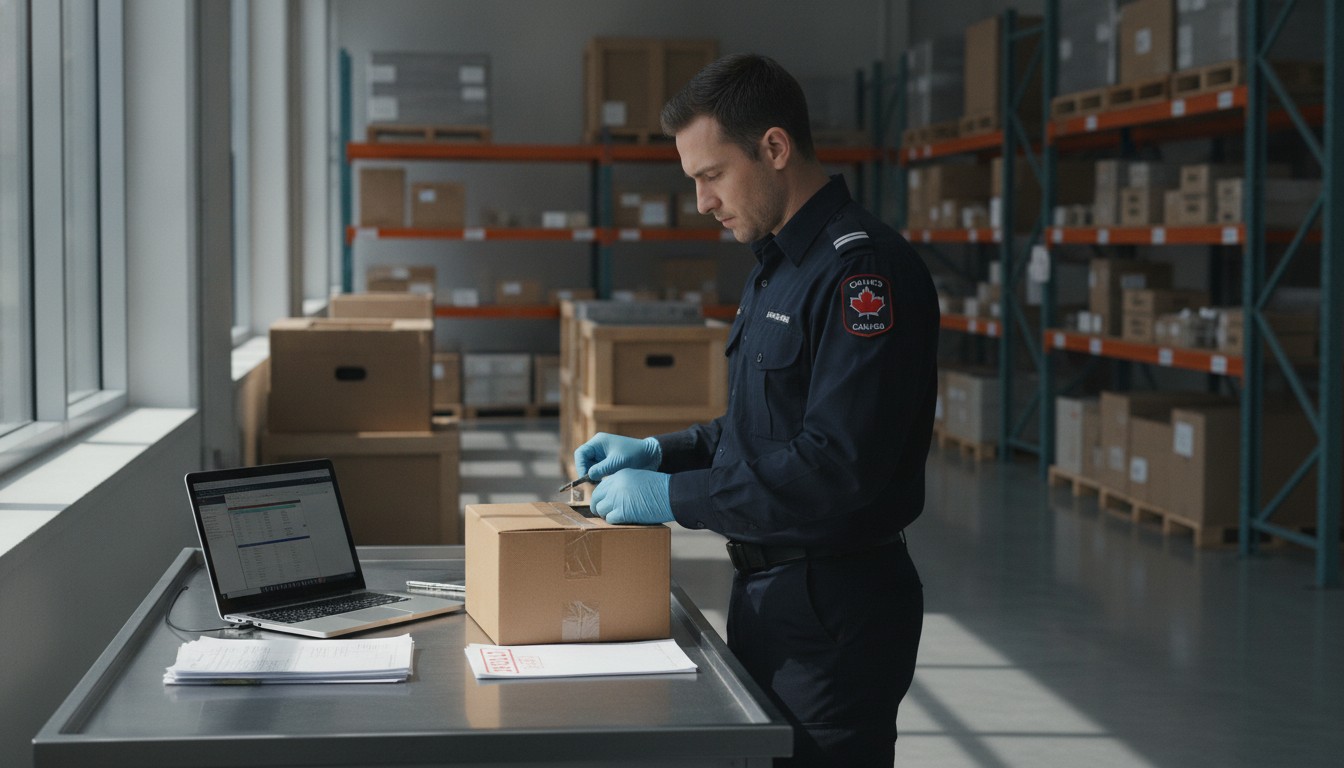
Has your tracking status shown «held at customs» for several days with no further updates? This is one of the most frustrating situations for a shipper—whether it’s an individual waiting for an online purchase or a small business whose customer is growing impatient. A package held at customs ...is, however, almost never lost: in the vast majority of cases, it is simply waiting for a document, a payment, or an inspection.
In 2026, with the end of the U.S. «de minimis» threshold and the new European customs regime, inspections have intensified and hold-ups have become more frequent, even for low-value shipments. Understanding why a package is held up and knowing exactly what to do usually makes it possible to clear it within a few days.
Here is a comprehensive guide to identifying the cause of the blockage, taking quick action, and preventing the situation from happening again.
Why is a package held up at customs?
In Canada, all incoming international shipments are inspected by the Canada Border Services Agency (CBSA). Your outgoing shipments, on the other hand, are inspected by the customs authorities of the destination country (U.S. Customs and Border Protection [CBP], European customs, etc.). A shipment is typically held for one of the following reasons:
- Incomplete or inconsistent documents : missing commercial invoice, vague description («gift,» «sample»), declared value missing or deemed undervalued.
- Unpaid duties and taxes : Since the de minimis rule was eliminated in the United States, every commercial shipment must be fully declared, and duties are due starting with the first dollar.
- Incorrect or missing HS code : An incorrect classification code often triggers a manual review.
- Restricted or Prohibited Goods : food, alcohol, lithium batteries, health products, suspected counterfeit goods.
- Random Inspection : Some shipments are simply selected at random, especially during periods of high volume.
How long can a package remain in customs?
There is no single timeframe, but here are some general ranges observed in 2026 (for reference only; these may vary by country, carrier, and time period):
| Location | Typical turnaround time |
|---|---|
| Routine checkup, complete medical record | a few hours to 2 business days |
| Physical Inspection | 2 to 5 business days |
| Missing documents or unpaid fees | until the documents or payment are received |
| Regulated Goods (Another Agency Involved) | 1 to 3 weeks |
As a general rule, a delay of 7 to 14 days with no activity is considered grounds for you to take proactive action. Before reaching this threshold, patience is often the best option: contacting customs too early will not speed up the process.
The 5 Steps to Unlock Your Package
1. Check the tracking information and exact status
«Held at customs,» «awaiting customs clearance,» «documents required»: each status has a different meaning. Note the date of the most recent event and the location (sorting center, airport, broker’s warehouse).
2. Contact the carrier, not customs
It is the carrier (or its customs broker) that communicates with the CBSA or foreign customs authorities, not you. Canada Post, for example, cannot intervene regarding a package that is in the hands of customs, but UPS, FedEx, DHL, and Purolator have in-house customs brokerage services that can tell you exactly what is missing.
3. Provide the requested documents promptly
Detailed commercial invoice, proof of payment, product data sheet, recipient’s business number or tax ID: Please respond within 24 to 48 hours. Each day of delay may result in additional storage fees.
4. Pay the required fees, taxes, and charges
The recipient usually receives a payment notice (via email, text message, or paper notice). Beware of scams: always verify that the payment link is from the official carrier. If in doubt, pay through the carrier’s official website or in person.
5. Keep records of everything in case of a dispute
Keep your tracking numbers, screenshots of the tracking information, and written correspondence. If the package is ultimately returned or destroyed, this evidence will be essential for filing a claim or requesting a refund.
Who Pays for What? Expenses to Expect
A customs hold can result in several types of fees (estimated amounts for 2026, which may vary depending on the agreement and service):
- Customs Duties and Taxes : calculated based on the declared value; in Canada, the GST/HST applies to most mailings starting at 20 $.
- Brokerage fees : from 10 $ to more than 50 $ per shipment via ground service with certain carriers; often included in express services.
- Storage Fees : After a few days of grace, customs or the carrier may charge a fee for each additional day.
- Return Shipping Costs : If the recipient refuses to pay, the return shipping costs are often charged to the sender.
For commercial shipments, the choice between DDP (duties prepaid by the shipper) and DDU (duties paid by the recipient) determines who receives the invoice—and has a significant impact on the rate of packages delivered without incident.
How to Avoid Setbacks in the Future
- Pay close attention to the commercial invoice : detailed description in English, realistic unit price, country of origin, HS code with at least 6 digits.
- Report the actual value : If an underdeclaration is detected, it will result in a hold, penalties, and a loss of credibility for your future shipments.
- Check the restrictions for your destination country Before shipping, especially for food, cosmetics, batteries, and liquids.
- Choose DDP for your customers : A customer who doesn't have to pay anything upon delivery means a package that doesn't get held up at customs.
- Work with a shipping expert : A partner who properly prepares customs documentation eliminates the number one cause of delays.
Conclusion: Act quickly, but in the right place
A package held up at customs in 2026 isn’t inevitable: it’s almost always a problem with documentation, payment, or inspection that can be resolved in a matter of days when you contact the right people—the carrier and its freight forwarder—with the correct documents in hand.
Do you regularly ship internationally and want to avoid unpleasant surprises at customs? The team at’Shipping Store prepares your customs documents, compares carriers, and supports you from pickup to delivery. Get a free quote today and ship with peace of mind.
The amounts and delivery times listed are approximate and vary depending on the carrier, the service selected, and the negotiated agreement.


 French
 English
 Spanish