
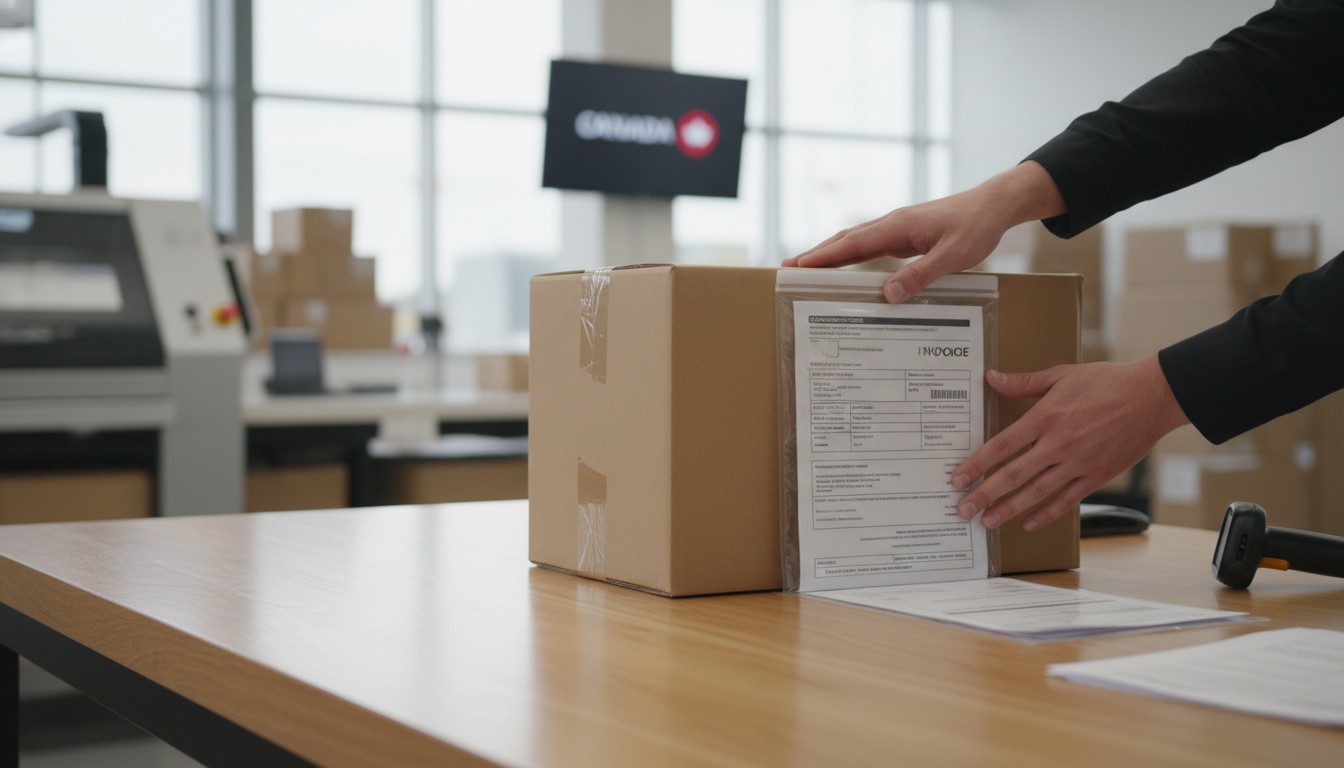
Since the end of the U.S. «de minimis» exemption on August 29, 2025, The commercial invoice is no longer optional : Every package crossing the border into the United States—even those worth just a few dollars—must now be accompanied by a complete customs declaration. For Canadian small and medium-sized businesses accustomed to quickly shipping small e-commerce orders, this document has become the most critical link in the entire shipping chain.
Just one incorrectly filled-out field—a randomly rounded value, a missing HS code, or an incorrect country of origin—and your package may be held up at customs, subject to penalties, or simply returned to the sender. Conversely, an accurate commercial invoice speeds up customs clearance and, in many cases, helps avoid unnecessary duties.
This 2026 guide details the required fields, the role of the HS code, and the most costly mistakes to avoid so you can ship to the United States with confidence.
Why the commercial invoice became indispensable in 2026
Until 2025, the de minimis exemption allowed any package valued at less than $800 to be shipped to the United States duty-free, tax-free, and with minimal customs declaration. More than 85% of Canadian exporting companies sell to the United States, and many relied directly on this rule to deliver quickly and at low cost.
That world is gone. All shipments are now subject to a formal declaration, in addition to a universal additional fee of 10 % on U.S. imports. The impact is tangible: a Canadian dietary supplement valued at US$37.40 can see its cost rise to over US$60.40 once duties, tariffs, and processing fees are added—an increase of approximately 60%.
The commercial invoice is the document that determines how these duties are calculated. It determines whether your shipment qualifies for preferential treatment. Filling it out correctly is no longer just an administrative formality—it’s a direct financial advantage.
Required fields on a commercial invoice
A valid commercial invoice for the United States must include, at a minimum, the following information:
- Sender and recipient : names, full addresses, and contact information for the exporter (you) and the importer (your customer).
- Detailed description of the goods : «men’s cotton T-shirts» rather than «clothing.» A vague description is one of the main reasons for rejection.
- Quantity and unit : number of pieces, weight, and, if applicable, dimensions.
- Unit and total value : the actual transaction amount, in the specified currency (specify CAD or USD).
- Country of origin : the country where the goods were manufactured or substantially transformed — a key factor under the USMCA.
- HS Code : the customs classification code, ideally 6 digits or more.
- Reason for export : sale, sample, return, gift, repair.
- Incoterm : Who pays the duties and shipping costs (e.g., DAP or DDP)?.
Always issue the invoice in English and attach several copies to the outside of the package in a clear document sleeve.
The HS code: the field that changes everything
The HS (Harmonized System) code classifies each product to apply the appropriate duties and rules. Internationally, it consists of at least six digits. The United States uses an expanded version, the HS code (Harmonized Tariff Schedule), 10-digit code.
The stakes are high: incorrect classification can lead to delays, fines, or even the confiscation of goods. Conversely, the correct code can make the difference between a package being taxed and one eligible for preferential treatment. Take the time to identify the exact code for each product you sell regularly, and maintain an internal reference table. An investment of a few hours that pays off from the very first shipments.
USMCA: The Key to Lowering Your Tariffs
Even after the de minimis rule expires, goods eligible for the USMCA may still enter the United States duty-free—provided they are produced or substantially transformed in Canada, the United States, or Mexico in accordance with the agreement’s rules of origin.
To qualify, you must provide a ACEUM Certificate of Origin, which is often included directly on the commercial invoice. However, there is an important caveat: the Postal services, including Canada Post, must apply the fees regardless of ACEUM eligibility, while commercial carriers such as UPS, FedEx, and DHL can apply the ACEUM exemption. The choice of carrier therefore has a direct impact on the duties paid by your customer.
The most costly mistakes to avoid
There are a few pitfalls that SMEs consistently fall into, and they can be costly:
- Undervalue the package to «pay less in duties.» This is illegal, easily detected, and subject to penalties—the minimum fine is around 100 $ per violation.
- Omit or invent the HS code, which consistently delays customs clearance.
- Description is too generic («parts,» «accessories») that require the customs officer to inspect them.
- Forget your country of origin, and at the same time lose the benefits of the ACEUM.
- Using a postal service for business mailings eligible for the USMCA, whereas a commercial shipment would have avoided the duties.
Please note: The fees, rates, and charges mentioned here are indicative and vary depending on the product, carrier, rate agreement, and service selected. Always check the terms and conditions that apply to your situation.
Save time and secure your shipments with Expert Shipping
Filling out a compliant commercial invoice, identifying the correct HS code, and choosing the carrier that minimizes your duties requires a strategic approach—especially now that every package counts. Rather than risking customs delays or unnecessary duties, rely on a team that’s well-versed in the 2026 cross-border regulations.
At Shipping Store, We help Canadian small businesses and individuals prepare their customs documents, compare carriers, and ship to the United States with confidence. Contact us or stop by the store to ensure your next cross-border shipment is handled smoothly, with no unpleasant surprises.


 French
  English
  Spanish