
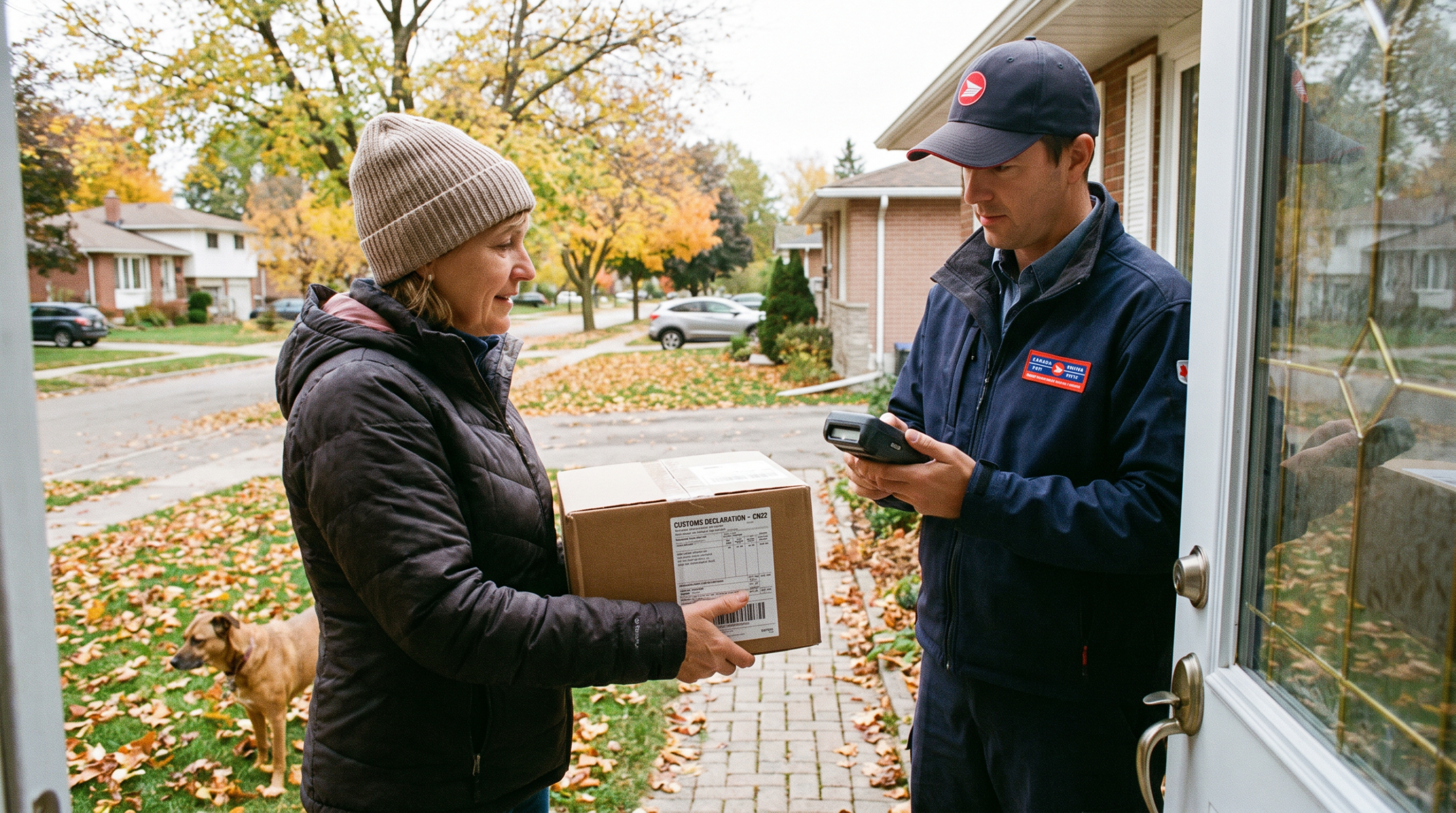
You’re expecting a package from the United States, France, or China, and the delivery person is asking for 48 $ before handing it over to you. The bill isn’t arbitrary: it adds up customs duties, sales taxes, and the carrier’s private fees. The problem is that all three are lumped together on the same line, and no one explains which ones you could have avoided.
The Customs duties on a package received in Canada depend on only three variables: the customs value of the goods, the country of origin, and the shipping method (mail or courier). Change just one of these variables, and the same pair of shoes goes from 0 $ to 60 $ in door-to-door shipping costs.
Here's how the calculation actually works in 2026, who charges what, and the five ways to lower your bill—whether you're making a personal purchase or your small business is importing inventory.
Who Bills for What: The CBSA, the Carrier, and You
The amount charged upon delivery is almost always a combination of two very different types of fees.
On the one hand, the Canada Border Services Agency (CBSA) Pay customs duties based on the tariff classification of the goods, then the GST, HST, or QST depending on your province. These amounts are set by law: they are not negotiable, but they can be contested if the classification or value is incorrect.
On the other hand, the carrier adds its own fees for preparing the declaration and paying the amounts to the CBSA on your behalf: handling fees, entry preparation fees, brokerage fees, disbursement fees, and collection fees upon delivery. These are private fees. They do not go to the government; they are often higher than the duties themselves on a small package, and they are the ones where you have some leeway.
The 2026 thresholds: 20 1Q-4Q, 40 1Q-4Q, and 150 1Q-4Q
There is no single threshold in Canada, but rather three parallel systems. The most favorable one applies to courier shipments from the United States and Mexico, thanks to the provisions of the USMCA. Everything else falls under the old threshold of 20 $.
| Location | Customs Value | Customs duties | Sales Tax/HST/QST |
|---|---|---|---|
| Mail, any origin | 20 $ CAD or less | None | None |
| Mail, any origin | More than 20 $ CAD | Applicable | Applicable |
| Messaging from the U.S. or Mexico | 0 $ at 40 $ CAD | None | None |
| Messaging from the U.S. or Mexico | 40.01 $ at 150 $ CAD | None | Applicable |
| Messaging from the U.S. or Mexico | More than 150 $ CAD | Applicable | Applicable |
| Messaging from any other country | More than 20 $ CAD | Applicable | Applicable |
Three practical implications are worth noting.
First, The method of delivery is just as important as the value. A purchase of 90 US $ items shipped from Ohio via courier arrives duty-free. The same purchase shipped via the US Postal Service exceeds the 20 $ threshold and becomes subject to duty. When an online seller lets you choose between «mail» and «courier,» it’s not just a matter of delivery time.
Second, Above the threshold, the contribution is based on the total value, not just on the excess. A package containing 155 $ items from the United States is assessed based on 155 $ items, not on the 5 $ items that exceed 150 $. Splitting an order of 300 $ into two shipments of 150 $ can therefore be cost-effective—provided that the additional shipping costs don’t eat into the savings.
Third, The 3,300 $ CAD limit for the Low-Value Shipments Program (EEFV, or CLVS) is not a duty-free threshold. It simply determines which shipments are eligible for the simplified courier declaration process. Many buyers confuse the two and expect to pay nothing on shipments up to 3,300 $.
Carrier charges: handling, brokerage, and out-of-pocket expenses
Canada Post: 9.95 $ per item
Canada Post applies a handling fee of 9.95 $ CAD per mail item subject to duties or taxes. It’s a fixed, predictable amount—and significantly lower than what a courier service charges for ground shipping. For a 60 $ package subject to approximately 8 $ in GST/HST, you therefore pay nearly 18 $ at the door—more than half of which does not go to the government.
Courier Services: Receipts, Brokerage Fees, and Disbursements
Courier companies charge differently depending on whether the shipment is sent via express air or ground transport. For international express services, routine customs brokerage is generally included in the shipping rate, leaving only disbursement and collection fees. For ground services, import preparation fees are added, and that’s where the bill goes up.
| Local Convenience | Admission Fees / Brokerage Fees | Out-of-pocket expenses | Collection Fees | Estimated total |
|---|---|---|---|---|
| UPS Express (air) | Included | 3.7 % in duties and taxes, min. ≈ 11 $ | ≈ 5 $ | ≈ 15 $ |
| FedEx Priority (air) | Included | ≈ 10 $ | ≈ 10 $ | ≈ 20 $ |
| DHL Express (Air) | Included | ≈ 11.25 $ (treatment) | ≈ 5.25 $ | ≈ 17.50 $ |
| Standard UPS (ground shipping) | ≈ 26.60 $ | 3.7 %, min. ≈ 7 $ | ≈ 5 $ | ≈ 37.60 $ |
| FedEx Ground (land) | ≈ 25.50 $ | ≈ 10 $ | ≈ 10 $ | ≈ 45.50 $ |
| Canada Post | Material Handling 9.95 $ | — | — | 9,95 $ |
These amounts are for reference only: they vary depending on the agreement, the specific service, the province, and the rates in effect at the time of customs clearance. Always check the rate schedule published by your carrier before concluding that a shipment is «free.».
The finding remains clear: for a low-value ground shipment from the United States, the private courier fees frequently exceed the duties and taxes actually owed. This is the most costly—and most preventable—anomaly in retail imports to Canada.
Gifts, Samples, and Returns: Exemptions You Need to Know
Three specific tax regimes completely change the equation, and they are consistently underutilized.
Gifts between friends or family members are exempt up to 60,$ CAD. Above that amount, the CBSA assesses duty only on the excess amount—this is one of the few situations where the duty is not based on the total value. The shipment must be a genuine gift from one individual to another, identified as such on the declaration, including the sender’s name and a description of the contents. A purchase from a retailer that the seller marks as a «gift» as a courtesy does not meet this requirement.
Returned Canadian Goods may be reimported duty-free if you can document that they left Canada and are returning unchanged. Keep proof of the original export: without it, your own goods will be treated as a new import.
Exclusions must not be overlooked. The $20 $ postal threshold does not apply to alcoholic beverages, cigarettes, cigars, manufactured tobacco, and certain publications. These items are subject to duty starting at the first dollar, and many are subject to additional provincial controls.
How to Pay, File a Dispute, and Get a Refund
For mailings, Canada Post offers three payment options: online by credit card before delivery via tracking or the mobile app; at the door using a credit card or business account; or at the post office counter in cash, by debit card, credit card, check, or money order. Paying online in advance avoids waiting and the risk of missing the delivery person, which saves you from having to pay holding fees or having the package returned to the sender.
If you believe the assessment is incorrect—overvalued, incorrect tariff classification, a gift treated as a purchase, or ACEUM origin not recognized—you can request an adjustment from the CBSA. For low-value shipments, an informal adjustment request is made using Form B2G, generally within 90 days of the declaration. Gather the invoice, proof of payment, the customs declaration for the package, and, if applicable, the ACEUM certificate of origin.
Please note: A refund from the CBSA reimburses you for duties and taxes. It does not reimburse you for the carrier’s brokerage fees, which are part of a separate business relationship. For those fees, you must contact the carrier’s customer service department directly.
Five Ways to Lower Your Bill
1. Play up the origin. Ask the seller whether the merchandise is of U.S. or Mexican origin as defined by the USMCA and whether they can provide a certificate of origin. The same product manufactured in Asia but shipped from a U.S. warehouse does not necessarily qualify for preferential treatment: what matters is the origin of the goods, not the warehouse address.
2. Choose the routing mode with full knowledge of the facts. For shipments under 150 $ CAD from the United States, courier services are more cost-effective than the postal service when it comes to customs fees. For shipments above that amount, compare the total cost: the postal service charges 9.95 $ for handling, while a private ground service can cost more than 35 $.
3. Declare high-value ground shipments on your own. You can clear a package through customs yourself at a CBSA office that offers this service to individuals, and then present proof of payment to the carrier. You pay the duties and taxes without brokerage fees. The process requires a trip and some paperwork, but it’s worth it as soon as the import processing fees far exceed the cost of your time.
4. Insist on an accurate declared value. A value inflated by the seller out of a sense of caution will cost you in actual taxes. An underreported value exposes you to a reassessment, penalties, and a withholding. Report the price actually paid, in the correct currency.
5. If you import goods regularly, opt out of the retail program. An SME that receives several shipments per month pays brokerage fees repeatedly. An importer account, an active business number in the GCRA portal, and a designated broker transform these per-shipment fees into a much lower unit cost and make it possible to consolidate shipments into a single declaration.
Key Takeaways
In Canada in 2026, the question isn’t «Will I have to pay customs duties?» It’s «What’s the value threshold for my package, through which channel is it arriving, and how much does the carrier add on top of that?» These three factors are determined before shipment, not at the doorstep.
For an SME, the math changes dramatically: a few dozen dollars in private fees per shipment add up to thousands of dollars a year—all of which can be recovered with the right customs arrangement. Our team analyzes your inbound and outbound shipments, compares brokerage scenarios, and shows you exactly where every dollar goes. Get an analysis of your shipping and import costs at expertshipping.ca.
The fees, thresholds, and percentages listed are for reference only and vary depending on the carrier, the service, the province, and the applicable commercial agreement. Always verify the current rates with the CBSA and your carrier before making a decision.


 French
 English
 Spanish
