
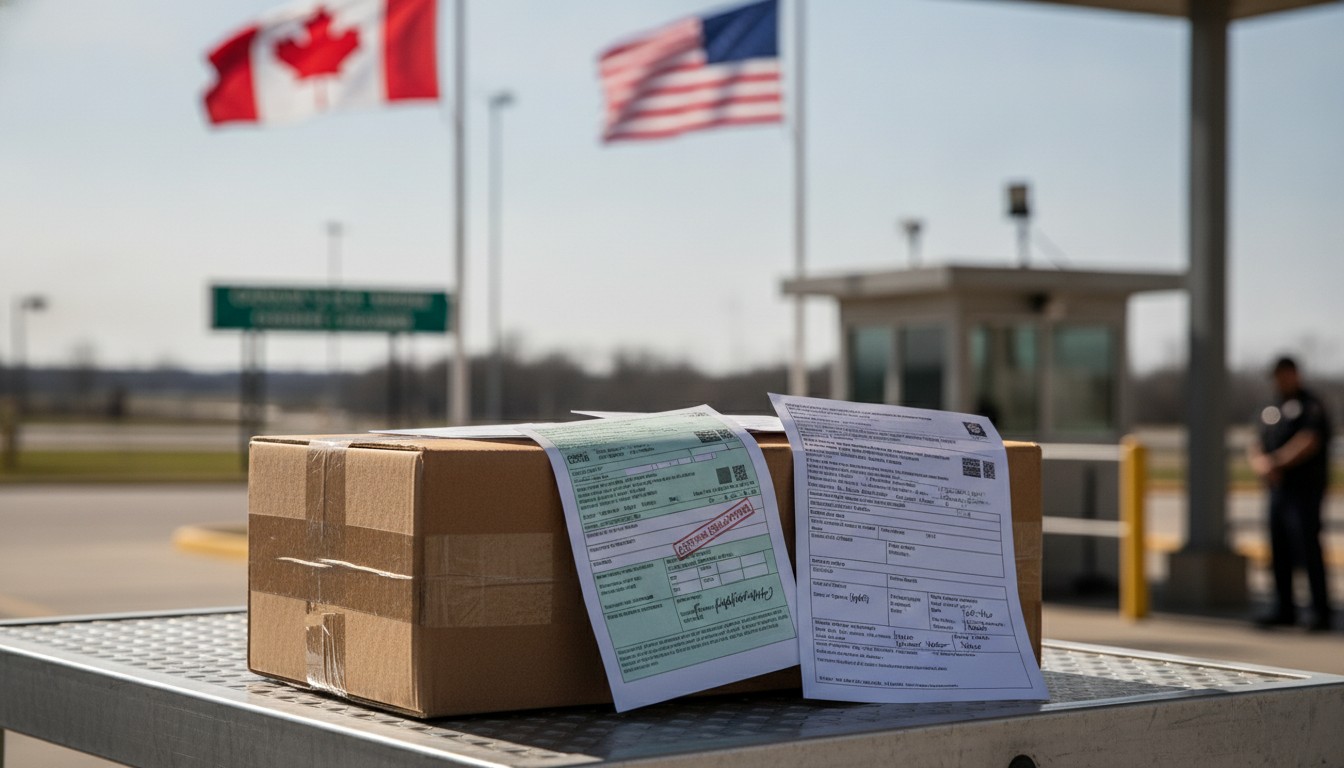
Since the suspension of the threshold de minimis the U.S. market in 2025 and the implementation of the new tariff regime in February 2026, the Brokerage fees for Canada-U.S. transactions have become one of the most significant cost burdens for Canadian SMEs shipping south of the border. Every package that clears U.S. customs now generates a formal entry, and thus brokerage fees that many shippers only discover upon delivery.
This comprehensive guide, updated in May 2026, explains in practical terms how the shipping fees of major carriers (UPS, FedEx, Purolator, DHL, Canada Post) work, what’s changing this year with the USMCA, and, most importantly, seven strategies validated by the Expert Shipping team to reduce your shipping costs per shipment.
Whether you ship ten packages a week or a thousand a month, the potential savings often range from 15% to 40% of the total cross-border cost. Let’s see how to achieve them.
What are brokerage fees in 2026?
The brokerage fees (or customs brokerage fees) are the fees charged by a customs broker to prepare the import declaration, calculate the applicable duties, and represent the shipper or consignee before U.S. Customs and Border Protection (CBP). As long as the $800 de minimis threshold was in effect, the vast majority of e-commerce packages crossed the border without brokerage fees. That is no longer the case.
Since March 2026, Each package requires a formal entry, regardless of its value. In practical terms: a shipment worth $35 to New York can incur between $15 and $25 in brokerage fees alone, on top of shipping, fuel, and duties. For many online merchants, that eats into their profit margin.
Three categories of fees to understand
It is essential to distinguish between three separate lines on your cross-border invoice: the shipping costs (the carrier's base fare), the brokerage fees properly speaking (the administrative work involved in customs clearance), and the fees and taxes (collected on behalf of the government). The first two are negotiable; the third depends on the tariff classification and the origin of the goods.
2026 Comparison of Brokerage Fees by Carrier
Not all carriers handle customs in the same way. Here is an up-to-date overview of the rates in effect in May 2026 for shipments from Canada to the United States:
| Carrier | Express Service | Standard Service / Ground | Special Feature 2026 |
|---|---|---|---|
| UPS | Included or ~$10 | Admission fee + $1.50 starting in February 2026 | Option to prepay fees and brokerage commissions by phone |
| FedEx | Included in Express | Progressive scale based on declared value | Expanded handling surcharges in September 2025 |
| Purolator | Included with US Express | Variable admission fees | Fuel surcharge of 34.5 % in April–May 2026 |
| DHL | Included in Express Worldwide | Primarily international service | Cash for shipments over $500 |
| Canada Post (USPS in the south) | — | No brokerage fees charged | Longer processing times, limited tracking, higher risk of loss |
The rule of thumb to remember: Express services generally include brokerage, whereas Ground and Standard services charge an additional fee. For a $50 package shipped to the United States, the difference between Ground (cheaper shipping + brokerage fee charged) and Express (more expensive shipping + brokerage fee included) is sometimes negligible, or even in favor of Express.
The USMCA: Your Best Ally in 2026
The’ACEUM (The Canada–United States–Mexico Agreement, or USMCA) remains, in 2026, the most powerful tool for reducing your cross-border costs and duties. As of February 24, 2026, CBP has replaced the former IEEPA tariff of 35% with a global tariff of 10% on goods that do not comply with the USMCA. Compliant goods remain exempt from this tariff.
What this means for your small business
If your products are manufactured primarily in Canada (or meet the rules of origin under the USMCA), you can:
- Avoid the 10% tariff on the declared value
- Significantly reduce the fees collected by the CBP
- Speed up customs clearance (fewer inspections)
- Better predict your DDP (Delivered Duty Paid) sales costs
In practical terms, for a monthly shipment of 20,000 CAD, simply claiming the ACEUM origin correctly can amount to CAD 2,000 in savings per month. This is often the first thing Expert Shipping checks during a cross-border audit.
How to prove origin
Prepare a ACEUM Certificate of Origin for each product, ideally included in your commercial invoice. You no longer need the official form used prior to 2020: nine required fields are sufficient (importer, exporter, producer, description, tariff classification, rule of origin, period covered, signature, date). A well-established template, integrated into your TMS or Shopify store, helps prevent customs rejections.
Seven practical strategies for reducing your brokerage fees
1. Combine multiple orders into a single shipment
The brokerage fee is charged by customs entry, not per package. Combining three orders destined for the same customer (or the same distribution hub in the United States) cuts your costs by two-thirds. For B2B merchants, consolidated weekly shipments are a cost-effective alternative to daily shipments.
2. Choose the right service based on value
For shipments under $100, Express with customs clearance included is often more cost-effective. For shipments over $200, USPS via Canada Post can eliminate brokerage fees, provided you accept delivery times of 7 to 14 days and tracking that is sometimes unreliable.
3. Prepay duties and taxes (DDP)
UPS allows you to pay duties and brokerage fees in advance via their dedicated line (1-800-742-5877). FedEx and Purolator offer similar DDP options. This prevents double billing upon delivery, improves the customer experience, and speeds up customs clearance.
4. Negotiate flat-rate brokerage fees
If you send more than 50 shipments to the United States per month, you have the leverage to negotiate a brokerage fee with your carrier or an independent broker. Typical savings: 30 to 60% on brokerage fees.
5. Use an independent customs broker
Independent freight forwarders (Livingston, Cole, A.N. Deringer, etc.) often charge less than the in-house forwarders of major carriers, especially for medium to high volumes. Bonus: they manage multiple carriers under a single customs account, which simplifies accounting.
6. Automate tariff classification (HTS)
An incorrect HTS code can result in costly unnecessary duties and shipments being rejected. Modern platforms (Zonos, Easyship, Flagship) automatically classify your SKUs and prepare customs declarations. Typical ROI: $5 to $15 in avoided duties.
7. Review your brokerage invoices every quarter
Billing errors by carriers on brokerage and surcharge lines amount to 3 to 7, % on average. A quarterly audit, conducted in-house or by a partner such as Expert Shipping, typically recovers several thousand dollars per year on average volumes.
The "de minimis" trap: what to watch out for
Many shippers still mistakenly believe that packages valued at less than $800 can be shipped to the United States duty-free. This has not been the case since 2025–2026. All commercial goods entering the United States are now subject to formal entry procedures. As a result, a package worth $30 can incur $20 in administrative fees and $3 in duties—an additional $23 on top of the $30 value. Profits are shrinking.
On the bright side: for goods that comply with the ACEUM, the flat rate of 10 % introduced in February 2026 does not apply. However, your paperwork must be in perfect order.
What about the review of the USMCA in July 2026?
The CETA will be officially reviewed in July 2026. The scenarios under consideration range from minor adjustments to partial withdrawals that could significantly alter the tariff landscape. For an SME, the best course of action is to diversify its carriers, keep certificates of origin up to date, and model two or three price scenarios before the summer. Expert Shipping is monitoring this issue closely and will publish an update as soon as the details are known.
Conclusion: Take back control of your cross-border costs
Canada–U.S. brokerage fees are no longer a minor expense: by 2026, they often account for 10 to 25% of the total cost of an exported shipment. The good news is that they are largely negotiable, optimizable, and auditable. By making effective use of the ACEUM, consolidating shipments, utilizing DDP services, and working with independent brokers, the average Canadian SME can recoup between 20% and 40% of its annual cross-border costs.
Would you like a free assessment of your current situation? The Expert Shipping team will analyze your invoices from the past three months and provide you with a detailed optimization plan. Visit expertshipping.ca to request your free audit or get negotiated rates from UPS, FedEx, Purolator, and DHL tailored to your small business’s volume. In 2026, shipping smartly south of the border is no longer a luxury—it’s a matter of profit margins.

 French
  English
  Spanish