
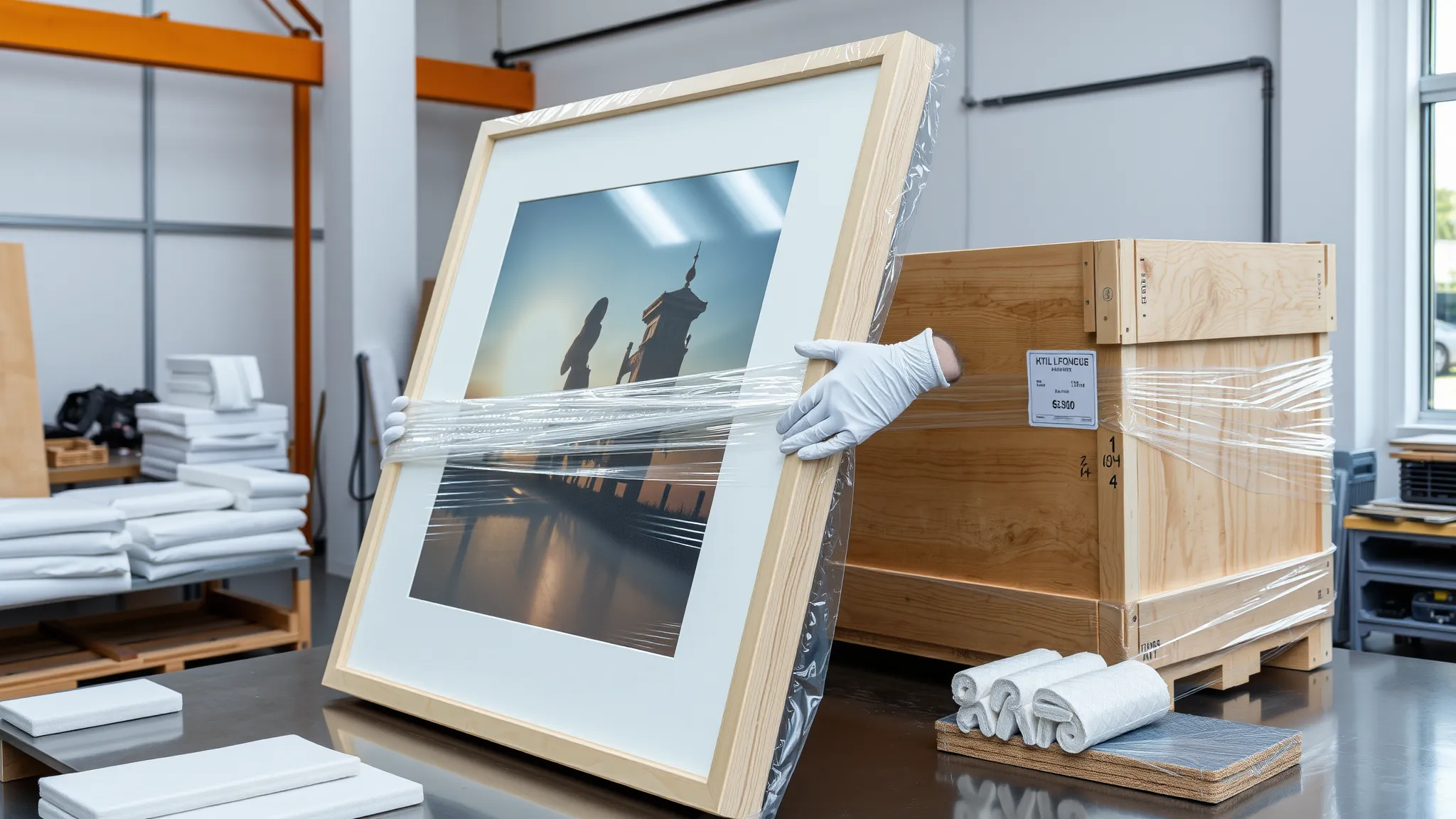
A painting, a sculpture, or a framed photograph cannot be shipped like a pair of shoes. The value is high, the item is fragile, it is often non-standard in size, and most importantly: most carriers severely limit their liability for this type of merchandise. In other words, if the box arrives crushed, you may only recover a fraction of the actual value.
Whether you're an artist delivering a commission, a gallery lending a piece for an exhibition, a framer, or simply a private individual moving a collection, the rules are the same. And they apply almost entirely before until the package leaves your workshop.
Here's what you need to know to ship a work of art in Canada or internationally in 2026: packaging, declared value, customs, and the actual cost of the transaction.
Why Works of Art Are a Special Case
Three factors combine to explain why a small painting can cost more to ship than a 20-kg package.
1. The carrier's liability is capped
Major carriers classify works of art, antiques, and collectibles as «items of unusual value.» In their terms of service, the maximum declared value accepted for this type of item is generally capped at around 1 000 $, regardless of the item's actual market value. Some simply exclude works that cannot be reproduced.
Practical implication: A canvas measuring 8,000 $ shipped without specialized coverage will, in the event of a claim, be compensated as an item worth 1,000 $—and even then, only if the packaging is deemed compliant. Always verify the coverage limit applicable to your policy before assuming you are covered.
2. Specific gravity takes precedence
A framed artwork is lightweight but bulky. A box measuring 110 × 85 × 20 cm that actually weighs 9 kg will be billed based on its bulk density, or about 37 kg, depending on the conversion factor used. You pay by volume, not by weight.
3. Oversized loads can quickly cause problems
As soon as one side exceeds approximately 1.2 m, or the sum of the length and circumference exceeds the carrier's threshold, the additional handling surcharge is added, followed by the «oversized package» surcharge. For a large box, these two charges can amount to more than the shipping cost itself.
Packaging: Where It All Comes Down to
A claim is almost always denied due to «insufficient packaging.» Carriers require packaging that can withstand drops and automated handling. Here’s the logic, from the simplest to the most robust.
Surface Protection
- Glassine paper directly on the painted surface or print: it does not stick and does not transfer moisture. Never use plastic wrap in direct contact with oil paint or varnish.
- Corner guards foam or cardboard on all four corners of the frame: that's the number one point of impact.
- Glazing : If the artwork is under glass, replace the glass with acrylic for transport if possible. Otherwise, apply a grid of masking tape to the glass to contain any shards in case it breaks.
- Bubble wrap Only then, apply outward in at least two coats.
The container
The rule: The artwork must never touch the outer wall, and nothing inside should move. Allow for at least 5 cm of cushioning material on all sides.
| Type of Work | Recommended container | Estimated cost of the container |
|---|---|---|
| Unframed print, poster | A rigid tube or a reinforced flat pouch sandwiched between two sheets of foam board | 15 $ – 40 $ |
| Small frame (up to 60 cm) | Double cardboard box (box-in-box, 5 cm of foam) | 25 $ – 60 $ |
| Medium size (60 cm to 1.2 m) | Telescoping box for flat artworks, or lightweight wooden crate | 60 $ – 180 $ |
| Large-scale, valuable artwork, sculpture | Custom-made wooden crate with custom-cut foam padding | 150 $ – 500 $ and more |
For sculptures and heavy items, a custom-built crate is not a luxury—it is often the only option that allows for palletizing and obtaining insurance coverage. Our general advice on packaging fragile items apply in full, with an added level of robustness.
Declared Value, Insurance, and Exclusions
It is important to distinguish between two things that are often confused.
Visit declared value Purchasing this coverage from the carrier increases its liability limit. It is paid in increments (usually a few dollars per $100 of value), but it remains subject to the policy’s limits and exclusions—including the one that specifically covers works of art.
The’specialized transportation insurance, taken out with an insurer or a fine art broker, covers the agreed-upon actual value, generally «from hook to hook» (from the initial hanging to the final hanging). This is the standard approach once the piece’s value exceeds a few thousand dollars. Generally, expect to pay between 0.3 % and 1 % of the insured value, depending on the destination and mode of transport.
In any case, put together your evidence file before Submission: dated photographs of the artwork from all angles, photos of each stage of the packing process, an invoice or certificate of authenticity, and a condition report if the piece is significant. Without these items, a complaint losing side. Our guide to package insurance explains the common mechanics.
Customs: Exporting a Work of Art from Canada
Original works of art have their own set of Harmonized System codes, which makes a big difference in terms of the applicable duties:
| HS Code | Merchandise |
|---|---|
| 9701 | Paintings, artwork, and drawings created entirely by hand |
| 9702 | Original Engravings, Prints, and Lithographs |
| 9703 | Original Works of Statue and Sculpture |
In many markets, original works are exempt from customs duties—but VAT or local sales tax is still due upon importation, sometimes at a reduced rate. A mass-produced print, on the other hand, is not classified under heading 9701: it falls under the regulations for printed matter and may be taxed differently. A correct HS code is therefore the first cost-cutting measure to take.
Two specific cases to be aware of:
- Temporary exhibition. If the artwork is sent to a fair, a gallery, or an exhibition and is to be returned, the ATA Carnet allows for temporary admission without paying duties or taxes in participating countries. This is the standard procedure for galleries.
- Back to Canada. Keep proof of export: A Canadian artwork that is returned after an exhibition may re-enter the country without incurring additional duties if you properly document the returned goods.
Finally, certain items that are more than 50 years old or of cultural heritage significance may require a cultural property export license. Be sure to check this well in advance: it takes weeks, not days, to obtain one.
How much does it really cost?
Here are approximate cost ranges for a complete shipment, including packaging. These amounts are for reference only and vary depending on the carrier, service, destination, negotiated agreement, and applicable surcharges.
| Screenplay | Local Convenience | Estimated total cost |
|---|---|---|
| Tube print, Montreal → Toronto | Standard Ground Package | 30 $ – 70 $ |
| Framed, 60 × 50 cm, Quebec City → Vancouver | Standard package, double box | 80 $ – 160 $ |
| 1.2-meter canvas, wooden crate, Toronto → Calgary | Oversized Packages + Handling | 250 $ – 500 $ |
| Artwork, 1.5 m, palletized crate, interprovincial | Pallet / LTL | 350 $ – 800 $ |
| 80-cm frame, Canada → France | International Express | 300 $ – 650 $ (excluding local taxes) |
The cost of the container often accounts for 25 % to 40 % of the total bill. This is also the factor that determines whether your claim will be valid: saving 80 $ on a crate only to risk a loss of 5,000 $ makes no sense.
Five Costly Mistakes
- Reuse the frame's original box. It is designed for palletized transport within a warehouse, not for the parcel delivery network.
- Write «FRAGILE» and stop there. This statement has no contractual value. Only the packaging matters.
- Underreport the value to pay less. In the event of a claim, compensation is limited to the declared amount. In customs terms, this constitutes a false declaration.
- Forget about orientation. A flat piece of art must be transported vertically, on its edge. A crate laid flat will have other crates stacked on top of it.
- Ship on a Friday before a long holiday. The artwork sits for three days in a warehouse without air conditioning. Changes in humidity cause the wood and canvas to expand and contract.
Ship a Work of Art with Confidence
The difference between a shipment arriving undamaged and a rejected claim comes down to a few decisions made early on: the right packaging, the right insurance coverage, the right tariff code, and the right service. Nothing insurmountable, but nothing to be left to chance either.
At Shipping Store, our teams pack and ship fragile and high-value items daily throughout Canada and internationally: custom crates, double packaging, declared value, customs documents, and carrier comparisons for a single shipment. Contact us for an estimate on your next piece to be shipped—ideally before you pack it.
The amounts listed are for informational purposes only and vary depending on the carrier, the service selected, the destination, applicable surcharges, and your rate agreement. The liability limits and exclusions applicable to works of art should be verified in your carrier’s terms of service.
 French
  English
  Spanish