
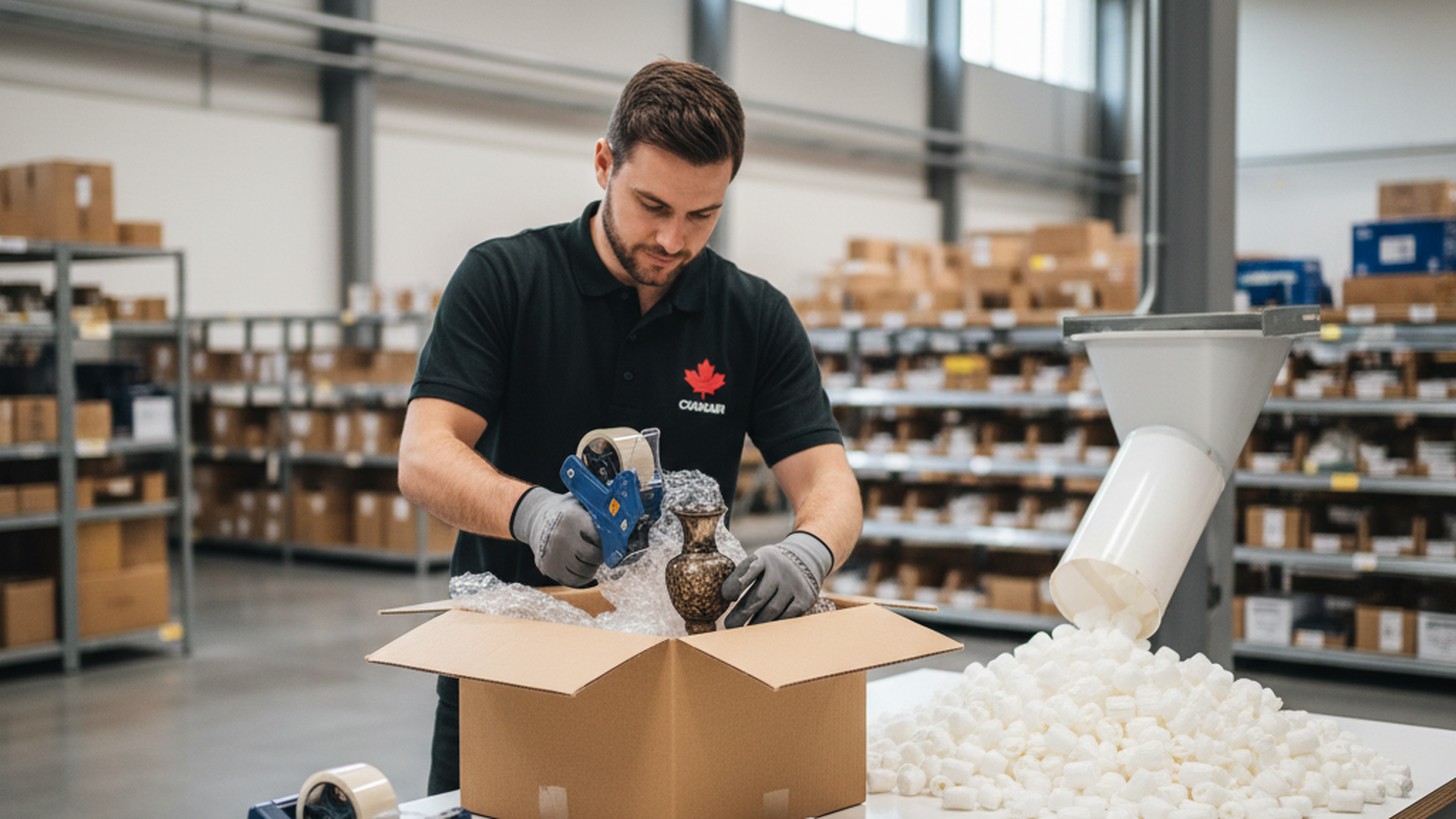
One in ten packages arrives damaged at the recipient’s address, and behind every crushed box lies a hefty bill: product replacement, return shipping costs, a claim against the carrier, and, above all, a disappointed customer. For a Canadian small business, knowing How to properly pack a fragile package is not just a logistical detail: it is a direct driver of profitability.
The good news is that most damage is preventable. It almost never results from a spectacular accident, but rather from insufficient padding, an unsuitable box, or inadequate packing material. In 2026, as FedEx, UPS, and Purolator (between 5.7% and 5.9%) make every shipment more expensive, a package that needs to be reshipped costs twice the shipping fee, plus the value of the merchandise.
This guide provides a complete, step-by-step method for protecting your shipments—and, as a bonus, helps you avoid paying for empty space.
Why Your Packages Break (and How Much It Costs You)
A package is never simply «placed» in a truck. Along the way, it is subjected to drops during automated sorting, constant vibrations, being crushed under the weight of other shipments, and temperature fluctuations. Sorting centers operated by major carriers handle hundreds of thousands of packages per day at high speeds: your packaging must be designed to withstand this reality, not a gentle move.
The cost of a damaged package far exceeds the cost of the product itself. You have to factor in restocking, labor, return shipping, and then reshipping. Given that carriers’ basic compensation is generally capped at $100 per shipment, under-packing amounts to shifting the entire risk onto your own margins.
Choosing the right cardboard: the foundation of everything
For fragile items, single-wall corrugated cardboard should be avoided. It tears and warps too easily. Always opt for:
- Double-wall corrugated cardboard For the vast majority of fragile products: it provides the necessary structural rigidity and puncture resistance.
- Triple-wall corrugated cardboard for very fragile, heavy, or valuable items (ceramics, electronics, glass).
Choose a box that’s neither too big nor too small. An oversized box lets the item rattle around and costs you bulk density pointless, since carriers charge based on whichever is greater: the actual weight or the dimensional weight. Conversely, a box that’s too small doesn’t leave room for protective padding.
The protective materials to prioritize in 2026
Focus on how materials complement each other rather than on a single product. Each one has a specific role:
- Bubble wrap : first layer to wrap the item. Laminated bubble wrap, which does not pop under pressure, is recommended; choose large-diameter bubbles (up to 32 mm) for the most delicate items.
- Custom-cut foam : the ideal solution for items that require precise positioning, as it absorbs shocks without collapsing.
- Air cushions and packing material : ideal for filling gaps and keeping the item centered in the box.
- Crumpled kraft paper : an economical and recyclable option for refilling.
The 6-sided packaging technique
The golden rule: the object must be «hanging» in the middle the materials, without ever touching the sides of the box. Here are the steps to follow:
- Wrap the object in at least 5 cm of protection on all six sides.
- Line the bottom of the box with 2 to 3 inches of packing material or foam.
- Place the object in the center, without letting it touch the edges.
- Fill in the sides, then the top, until there are no gaps left.
- Gently shake the closed box: if you hear or feel movement, add more packing material.
If there are multiple items in the same package, wrap and cushion each item individually so they don’t bump into each other.
Sealing and labeling: don’t overlook the final step
Even perfect packaging can fail because of a sloppy seal. Use strong shipping tape (not household tape) and apply the H-method : Apply tape along the entire length of the center seam, at the top and bottom, and then along the side seams at all four corners.
Next, attach clear labels « Fragile », «Top,» and «Bottom» to indicate which side is up. Make sure only one shipping label is visible, and remove any old barcodes if you are reusing a box to avoid routing errors.
Packaging: Your Best Protection
Proper packaging also helps protect your claims. Most carriers refuse to compensate for a package deemed to be inadequately packaged, even if you’ve paid for additional coverage. Also, be sure to meet the reporting deadlines: generally 6 months after shipment for a lost package with UPS, up to 9 months with FedEx, but often only 21 to 60 days for damage. Document your packaging with photos: this is your strongest evidence in the event of a dispute.
Conclusion
A well-packed package means fewer breakages, fewer returns, fewer complaints, and controlled volumetric weight. By choosing the right box, complementary materials, the 6-sided technique, and an H-seal, you turn an expense into a profitable investment. At a time when shipping costs are rising in 2026, paying close attention to packaging is one of the simplest ways to protect your profit margins and ensure customer satisfaction.
Do you want to optimize both your packaging and your shipping rates in Canada and internationally? The team at’Shipping Store is there for you to compare carriers, reduce your costs, and ship with peace of mind. Contact us today.
 French
  English
  Spanish