
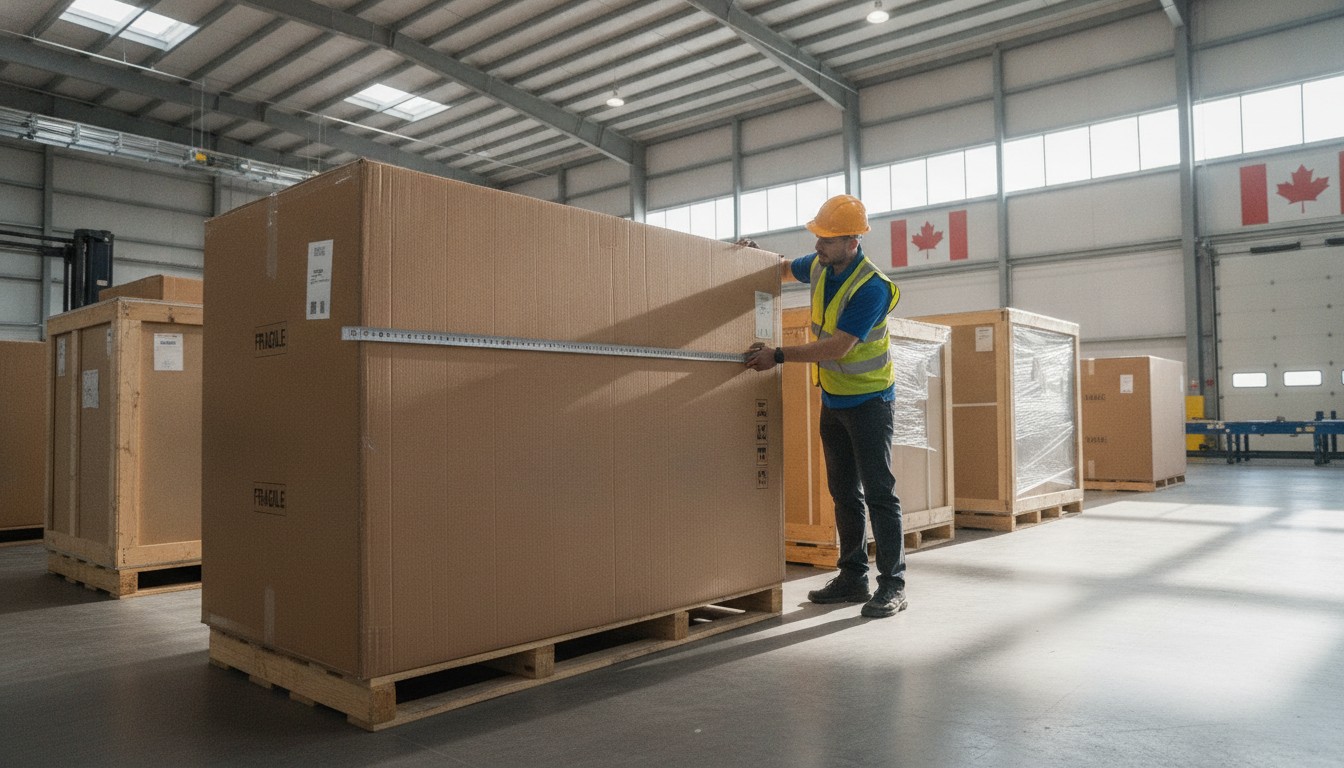
In 2026, it’s not just the base rates that are driving up your shipping bills—it’s the additional handling fees (additional handling) and surcharges for oversized packages (large package). A single package that is too long, too heavy, or poorly packed can add anywhere from 19 $ to more than 300 $ to your shipment, often without you realizing it.
The worst part? These fees have been revised for 2026. UPS and FedEx have lowered the cubic-inch thresholds that trigger these surcharges, causing packages that were exempt from fees last year to now fall into the «oversized» category.
Here’s how these fees work in Canada in 2026, what thresholds to watch for, and seven practical strategies to help small businesses and individuals stop paying for packages that aren’t anything special.
Additional handling or oversized packages: two separate fees
It is essential to distinguish between two types of overload that are often confused:
Visit additional handling (additional handling) applies to packages that require manual handling: those that are too long, too heavy, irregularly shaped, or poorly packaged. It applies well before the «oversized» category.
Visit surcharge for oversized packages (large package / oversize) is intended for very large volumes. It is significantly more expensive and is generally subject to a high minimum chargeable weight.
A single package can trigger multiple surcharges (dimensions + weight + packaging), and these surcharges add up. As a result, a bulky package can cost much more than the merchandise it contains.
Additional Handling Thresholds for 2026
At FedEx and UPS, additional handling fees typically apply when a package exceeds one of the following criteria:
- Length : The longest side is about 48 inches (122 cm).
- Second Dimension : The second-longest side is about 30 inches (76 cm) long.
- Weight : The package weighs more than 50 lb (about 23 kg).
- Packaging : non-corrugated container, strapping, round or cylindrical surface (tubes, buckets, tires).
- Volume : New for 2026: the cubic threshold has been lowered. A package exceeding approximately 10,368 cubic inches may incur handling fees.
For the dimension, allow about 33 $ per package, ranging from approximately 19 $ to 58 $ depending on the area, with the highest rates applying to remote areas. For the weight, plan on about 46 $ per package for standard shipping, and more for express shipping. These amounts are approximate and vary depending on your agreement and the service you choose.
Oversized package surcharges: the most expensive
The «oversized» category applies in 2026 when a package exceeds approximately 17,280 cubic inches or weighs more than 110 lb (about 50 kg). The surcharge typically ranges from a few hundred dollars: amounts range from the mid-200s $ to just over 300 $ per package, depending on the region and service.
On top of that, there’s a catch: oversized packages are usually charged at a high minimum weight (often 90 lb billable), regardless of its actual weight. A bulky but lightweight package is therefore charged twice: for the minimum weight and for the surcharge.
Why 2026 Is a Game-Changer
The overall rate increase in 2026 (approximately 5.9 % on average for UPS and FedEx) tells only part of the story. Carriers have also redefined the dimensional and cubic criteria additional handling and oversized packages. As a result, for many shippers, the actual increase in costs is actually closer to 8 % and 12 %, because packages that were previously «standard» now fall into these more expensive categories.
In practical terms, a package containing flat-pack furniture, a bicycle, a treadmill, or a piece of equipment that was accepted without an oversize surcharge in 2025 may be reclassified in 2026. That’s why it’s important to review your packaging sizes now.
Seven Strategies to Avoid These Fees in Canada
1. Measure before shipping
Always measure all three dimensions and add length + (2 × width) + (2 × height) to calculate the perimeter. Knowing the exact dimensions of a package before shipping it will help you avoid unpleasant surprises on your bill.
2. Downsize the box
Choose a container that fits the product. A box that is too large increases the volumetric weight and may unnecessarily exceed a handling threshold. The right size also reduces the risk of damage.
3. Split up heavy shipments
Two 45-pound packages often cost less than a single 90-pound package, which would be subject to additional handling fees (50-pound threshold) or classified as oversized (110 pounds). Do the math before combining everything.
4. Pay attention to the packaging
Use a sturdy corrugated cardboard box, avoid strapping and round containers, and seal it in an "H" shape with reinforced tape. Non-compliant packaging alone will result in additional handling.
5. Compare carriers
The thresholds and rates vary between UPS, FedEx, Purolator, and Canada Post. For large but lightweight packages, Canada Post or a regional ground service is sometimes significantly more cost-effective.
6. Check your bills
Handling fees are often mistakenly charged on packages that meet the requirements. Review your invoices: filing a dispute based on the actual dimensions often results in a refund.
7. Negotiate your surcharges
With sufficient volume, these surcharges are negotiable. A broker or a consolidation service like Expert Shipping can secure discounts on surcharges—not just on the base rate.
Conclusion
In 2026, additional handling fees and surcharges for oversized packages are among the fastest-rising costs, and the new cubic thresholds are causing packages that previously went unnoticed to be subject to charges. The good news: most of these fees can be avoided with a little planning—measure, adjust the packaging, split shipments, and compare prices.
Do you regularly ship large packages? Request a free rate analysis from Expert Shipping : We compare carriers and negotiate surcharges so you no longer have to pay for «oversized» packages that aren’t actually oversized.
The amounts listed are for informational purposes only and vary depending on the carrier, the region, the service, and your commercial agreement.

 French
  English
  Spanish