
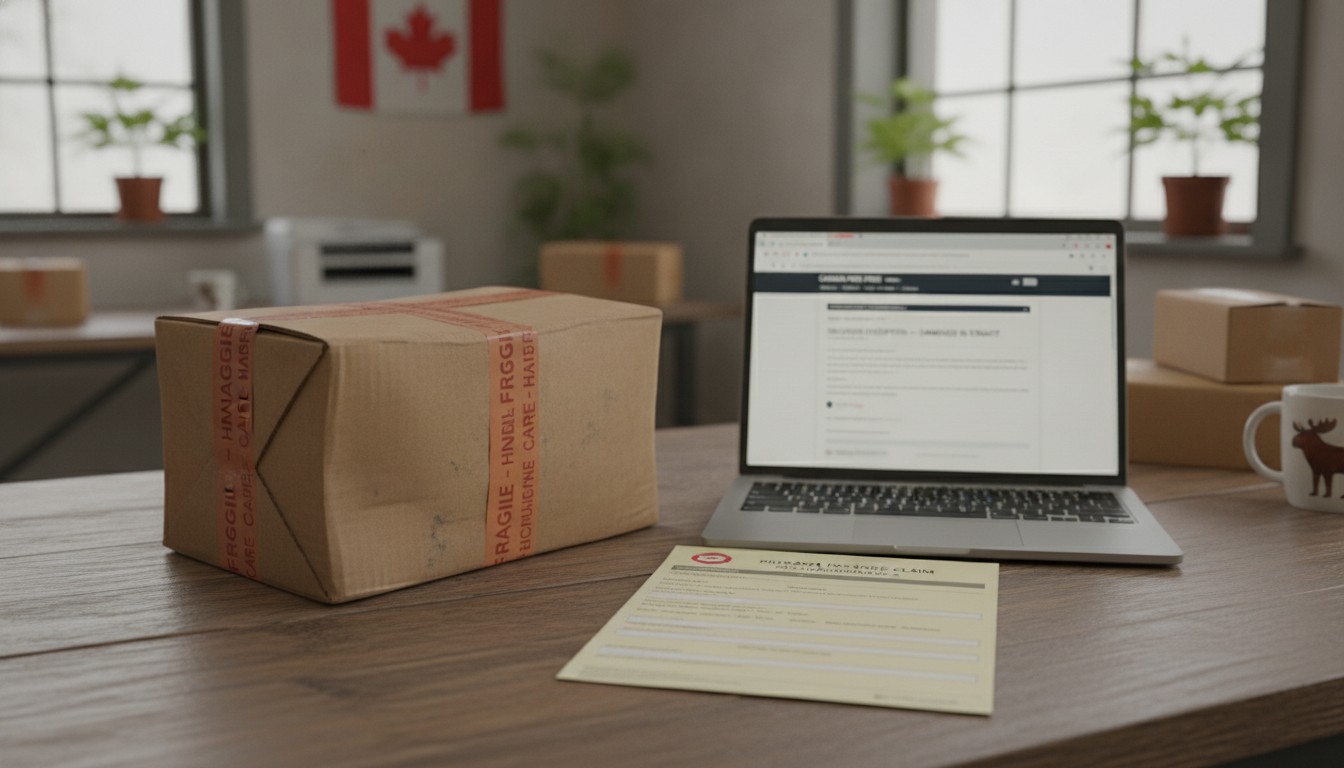
A package that never reaches its destination, a product that arrives broken, a customer demanding a refund: for a Canadian small business, every shipping incident results in lost time, unexpected costs, and, sometimes, an unhappy customer. The good news: all major carriers in Canada offer basic coverage and a claims process to recover the value of your shipments.
But you still need to know the rules. In 2026, deadlines, coverage amounts, and the required documentation vary considerably from one carrier to another. A claim filed too late, poorly documented, or for the wrong service is almost always denied.
This guide brings together, in one place, everything a Canadian shipper needs to know to file a claim for a lost or damaged package with Canada Post, Purolator, FedEx, and UPS, and above all, to maximize their chances of receiving compensation.
Basic Insurance Coverage: What Each Carrier Includes
The first thing to understand is that a package is not automatically «insured» for its actual value. Major Canadian carriers include a basic liability coverage, which is generally capped at 100 $ CA for domestic shipments on the main services. For amounts exceeding this limit, you must purchase additional coverage at the time of shipment.
- Canada Post : Basic coverage up to 100 $ for Xpresspost, Expedited Packages, and Standard Packages. Additional coverage available for purchase up to 5,000 $.
- Purolator : Basic liability of 100 $ per shipment. Declared coverage available up to the actual value, with premiums calculated in increments of 100 $.
- FedEx : Maximum liability of 100 $ CA without a declared value. For amounts exceeding this, the declared value must be added when creating the shipment.
- UPS : Basic coverage of 100 $ US (approximately 135 $ CA in 2026). Additional coverage billed in increments of 100 $ of declared value.
For shipments exceeding 100 $, the best course of action is simple: Always report the actual value. That's the only way to get a full refund if the worst happens.
Claim Deadlines: The Window You Can't Afford to Miss
The claim deadline is probably the number one reason for rejection. Each carrier has its own rules, and these differ depending on whether the issue is a loss (a package that was never delivered) or damage (a package that was delivered but damaged).
Canada Post
The investigation must be opened within 90 days based on the shipping date for a domestic package. For international shipments, you have 6 months. If there is any damage, don't wait: report the problem as soon as you receive the item, and be sure to keep the packaging and all protective materials.
Purolator
Claim for loss or non-delivery: 30 days effective as of the date of shipment. For damage claims, the time window is very short (usually 21 days), and the claim should ideally be filed upon delivery, in the presence of the driver if possible.
FedEx
FedEx offers one of the most generous time windows: 9 months to report a loss or an incomplete delivery. For visible damage, you have 60 days; for hidden damage (discovered upon opening), 21 days effective upon delivery.
UPS
UPS provides 6 months to report a loss. For damage, you must file a claim within 60 days after delivery. As with FedEx, UPS recommends keeping the original packaging, as it may be inspected.
How to Put Together a Strong Application: Essential Documentation
A claim is never just a simple email. To maximize your chances of getting a refund, prepare the following documents in advance:
- The tracking number and proof of shipment (shipping label, manifest, or carrier invoice).
- Proof of Value : purchase invoice, sales invoice, or documented cost of goods sold. No invoice, no full refund.
- Clear photos the package as received: exterior, labels, protective materials, and, of course, the damaged item from various angles.
- A detailed description the damage or the nature of the loss, with specific dates.
- The original packaging has been kept intact until the case is closed — this is often required for an inspection.
Here’s a detail that’s often overlooked: if you ship regularly, create a «claims» folder in your accounting software as soon as you create a shipment that’s at risk (fragile items, high-value items, distant destinations). You’ll save hours if a problem arises.
Comparison Table: Deadlines and Limits for 2026
| Carrier | Basic Coverage | Time limit for reporting a loss | Time Limit for Claims |
|---|---|---|---|
| Canada Post | 100 $ CA | 90 days (domestic) | Upon delivery |
| Purolator | 100 $ CA | 30 days | 21 days |
| FedEx | 100 $ CA | 9 months | 60 days (visible) / 21 days (hidden) |
| UPS | ≈ 135 $ CA | 6 months | 60 days |
Common pitfalls that lead to a claim being denied
Even with a strong application, certain mistakes will almost always lead to rejection. Things to avoid at all costs:
- Dispose of the packaging before the case is closed. Without the original box, the carrier may conclude that the item was not properly packaged and refuse to issue a refund.
- Underreporting the value cut back on coverage to save a few dollars on your premium—you’ll be reimbursed up to the stated limit, but not beyond it.
- Shipping an «uninsurable» item» : unsealed jewelry, cash, certain electronic devices without an original receipt, and items prohibited by the carrier's terms and conditions.
- Do not have the document signed «with reservations» by the recipient when external damage is visible upon delivery.
- Insufficient packaging : less than 5 cm of padding around a fragile item, a reused box, standard packing tape instead of reinforced tape.
When Packaging Becomes Your Best Insurance
The Canadian Conservation Institute recommends that a fragile package should withstand a fall of about one meter onto concrete. Specifically, this means double-wall corrugated cardboard, a minimum of 5 cm of padding on all sides (up to 7.5 or 10 cm for very fragile items), and fiber-reinforced packing tape on all seams.
Place multiple «Fragile» labels on several sides of the package, and declare the specific contents at the carrier’s counter. A package that is properly prepared, labeled, and insured not only reduces the risk of damage but also provides a much stronger basis for a claim if the worst should happen after all.
To learn more: Outsource your shipping management
For many small and medium-sized businesses, the real problem isn't so much the cost of a lost package as wasted time dealing with paperwork. Outsourcing the preparation, labeling, and tracking of your shipments to a specialized partner allows you to benefit from negotiated rates, optimized coverage, and a team that handles claims on your behalf.
At Shipping Store, our advisors compare rates and coverage options from Canada Post, Purolator, FedEx, UPS, DHL, and more in real time, and handle the entire claims process for you. Visit expertshipping.ca to get a quote or speak with an expert today.

 French
  English
  Spanish