
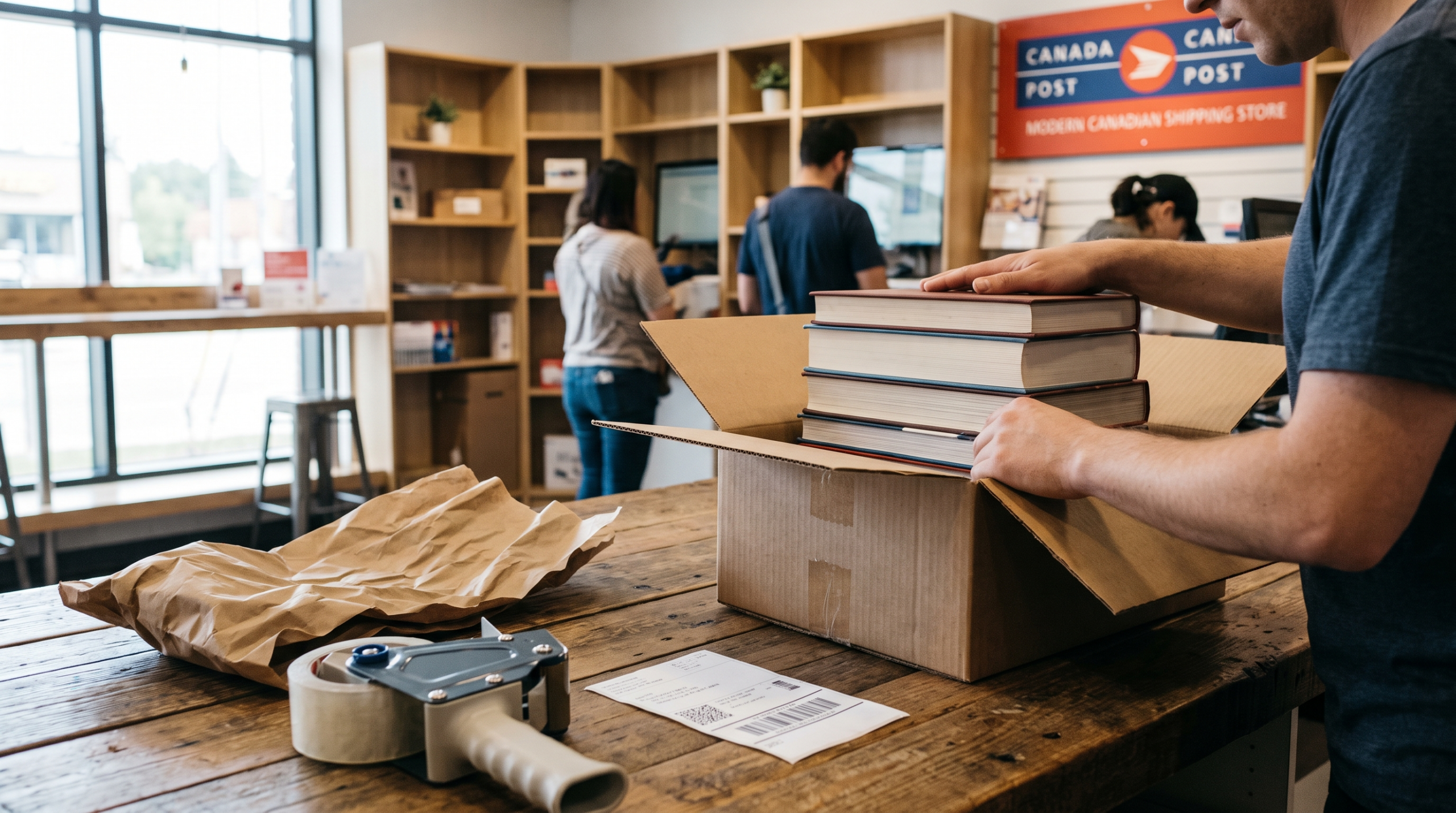
Books are the most treacherous merchandise in the Canadian e-commerce industry. They are neither bulky, fragile, nor dangerous—and yet, the shipping cost often exceeds the value of the book itself. A used bookstore owner who sells a novel for 12 $ and pays 18 $ for shipping is operating at a loss without always realizing it.
The problem stems from a physical characteristic: paper is dense. While most packages are priced based on their volume, books are priced based on their weight—and that weight adds up quickly. Three paperback novels already weigh more than one kilogram; an order of textbooks easily exceeds five kilograms.
Added to this is a distinctly Canadian frustration: unlike in the United States, there is no «Media Mail» rate available to the general public here. The discounted rate that everyone talks about does indeed exist—but it’s reserved for a very specific category of senders. Here’s how ship books at the best price in 2026, based on what you can actually afford.
Why Books Are Expensive: Actual Weight Almost Always Plays a Major Role
Carriers charge based on the higher of two figures: actual weight and volumetric weight. In Canada, volumetric weight is generally calculated by dividing the box’s volume by a factor of approximately 5,000 cm³/kg (139 in³/lb according to imperial conversion tables).
For virtually all book shipments, this calculation makes no difference: a snugly packed box containing books reaches its actual weight well before its volumetric weight. That’s good news—it means the cost-saving strategy isn’t the same as for a package of pillows or clothing.
The practical implication is significant: reducing the box size won’t save you much, whereas reducing the total weight or better distributing the contents across multiple packages can cause the shipping cost to shift from one rate tier to another. For a refresher on how this works, check out our guide on bulk density.
The «Library Materials» Rate: Who Is Eligible, and Who Is Not
Canada Post offers a preferential-rate service called Library Materials. It covers books, magazines, files, CDs, CD-ROMs, audio cassettes, video cassettes, DVDs, and other similar audiovisual materials.
Eligibility, however, is strictly regulated. The service is available to public and university libraries, as well as to recognized libraries operated by a nonprofit organization or association, provided they are open to the public in Canada. The library must complete an application form and be authorized by the Council of Urban Libraries of Canada (CBUC). Rates are not published; they are made available once the application is approved.
Two important exceptions:
- Libraries operated as commercial enterprise are not eligible.
- Libraries that limit their services to a specific user group nor are they.
In other words: a used bookstore, a publishing house, a small business that mails out catalogs, or an individual selling their collection are not eligible. The content is eligible; the sender is not. This is the most common misunderstanding on the subject.
It should also be noted that this rate has been the subject of public debate for several months: budgetary changes affecting Canada Post and the review of Bill C-15 have reignited concerns within the library community about the long-term viability of interlibrary loans. If your organization is eligible, it’s worth following this issue closely.
Which service to choose based on weight and distance
For all other shippers, the choice is between the standard services. The table below summarizes the selection criteria.
| Shipping Profile | Usually the most economical service | Estimated timeframe | Estimated cost |
|---|---|---|---|
| 1 to 2 pounds, same province | Standard package (Canada Post) or rigid envelope | 2 to 5 business days | 12 to 20 $ |
| 1 to 2 pounds, from one end of the country to the other | Standard Package | 5 to 9 business days | 18 to 30 $ |
| 3 to 10 kg (set of books) | Express shipping or private carrier with a negotiated rate | 2 to 7 business days | 25 to 60 $ |
| More than 30 kg or several boxes | Consolidated shipment or pallet (LTL) | 3 to 10 business days | Quotes on a case-by-case basis |
| International Shipping (1 to 2 kg) | Small International Package or Economy Service | 6 to 20 business days | 25 to 70 $ |
These amounts are for reference only and may vary depending on the commercial agreement, the service selected, the region, applicable surcharges, and the time of year. Always request an actual quote before setting your shipping costs for the sale.
Five Strategies for Reducing the Cost Per Pound
1. Consolidate rather than fragment
Pricing scales on a sliding scale: the second kilogram costs less than the first. A customer who orders four pounds should receive a single package, not four. If your sales platform charges shipping per item, correct this setting as a priority—it’s often the quickest way to save money.
2. Keep an eye on your weight milestones
A package weighing 5.2 kg may cost significantly more than one weighing 4.9 kg if it crosses a weight threshold. Weigh your package before packing it, and keep in mind that it’s sometimes less expensive to send two 4-kg packages than a single 8-kg package, depending on the rate schedule used.
3. Use the lightest packaging that actually provides protection
A double-wall corrugated box weighs several hundred grams more than a rigid book sleeve. When shipping a single book, this difference adds to the cost of each shipment. Reserve the reinforced box for heavy shipments and valuable books.
4. Negotiate as soon as the volume warrants it
Once you’re sending a few dozen items a month, the rates posted at the counter are no longer your best option. Check out our guide to negotiate your shipping rates.
5. Check your bills
Weight adjustment charges are common for book shipments, precisely because weight is the primary factor in determining the shipping rate. A scale that is off by 200 g results in repeated adjustments.
Packaging: The Three Most Costly Mistakes
The void. A book that moves around in its box will arrive with crushed corners. Fill in the space, but use crumpled paper rather than a heavy material.
Humidity. This is the most common and most underestimated type of damage. A simple plastic bag inside the box protects against rain on a porch, thawing in a truck, or a damp warehouse. It costs just a few cents.
The corners. In a hardcover book, damage is always concentrated on the corners and the headband. Place the books flat, stacked on top of each other—never with the spine against the side of the box.
For rare or autographed editions, declare the actual value and keep photos of how you packaged them: without proof of adequate protection, claims for damage are often denied. Our guide on complaints explains the procedure in detail.
Shipping Books Overseas
Good news regarding customs: Printed books generally fall under heading 4901 of the Harmonized System, and most countries allow them to be imported duty-free. Be careful, though—duty-free does not mean tax-free: local sales tax, customs processing fees, and the carrier’s brokerage fees may still apply.
Clearly indicate «Printed books — HS 4901» on the declaration, along with an honest value. A vague description such as «documents» or «materials» is one of the most common reasons for customs detention. See also our article on HS codes.
In a nutshell
The library rate is available, but you can only access it if you are an eligible library authorized by the CBUC. For everyone else, reducing the cost of shipping books involves three practical steps: consolidating orders, keeping an eye on weight tiers, and choosing packaging that provides protection without adding extra weight.
Do you ship books regularly from Canada? Shipping Store compares services from multiple carriers for you, gives you access to negotiated rates, and helps you design packaging tailored to paper. Request a shipping assessment—most of the booksellers and publishers we work with save several dollars per package starting in the first month.
 French
 English
 Spanish
