
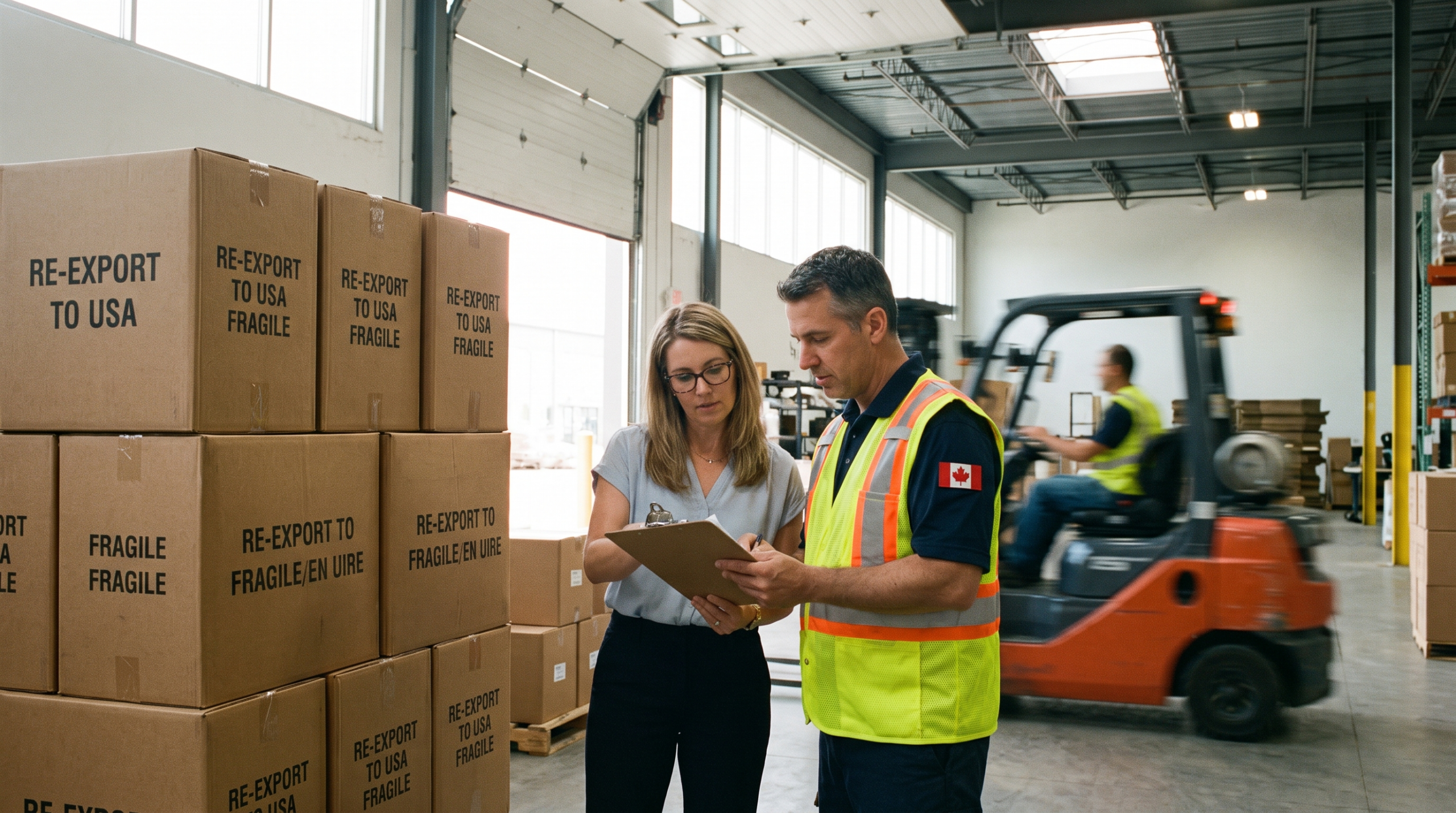
Every year, thousands of Canadian small and medium-sized businesses pay customs duties on imported goods that never remain in Canada. They forward them to a U.S. customer, return them to a European supplier, or destroy them because the model has become unsellable. In the vast majority of these cases, the duties paid upon importation are refundable—and almost no one claims them.
The mechanism is called the drawback, or the Canada Border Services Agency’s (CBSA) duty drawback program. This is neither a gray area nor aggressive tax optimization: it is an official, legally mandated program designed to prevent goods from being taxed in a country through which they are merely transiting.
This guide explains who can apply for a drawback, what is eligible for a refund and what is not, the deadlines to meet, and the ACEUM catch that reduces the refund on shipments to the United States and Mexico.
What is a customs drawback?
The principle is simple: if you paid customs duties when importing goods into Canada, and those goods subsequently leave the country—whether exported as is, processed and then exported, or destroyed under supervision—you can ask the CBSA to refund those duties.
The drawback program isn’t limited to large importers. An online retailer that imports a container of accessories and reships 30 % items to U.S. customers is eligible for the drawback program. A manufacturing facility that imports components, assembles them, and sells the finished products abroad is also eligible. A company that has imported a batch of obsolete goods and must destroy them also has one.
To submit an application, you must have a valid importer business number (BN15 program account). If you are already importing for commercial purposes, you already have one.
The Three Types of Drawback Claims
The CBSA recognizes three distinct situations. Which one applies to you determines what documentation you need to provide.
1. Export in the same state
The goods are imported and then re-exported without any changes. This is the most common scenario and the easiest to document: all you need to do is link the import to the export. This is typical in the retail sector, for transshipment, and for returns to a foreign supplier.
2. Manufacturing Drawback
Imported goods are used to produce an item that is then exported. The link between the imported input and the exported finished product must be verifiable through your production records. This involves more stringent traceability requirements, but the amounts involved are often higher.
3. Obsolete or surplus goods
Imported goods—or the finished product containing them—become obsolete or surplus and are destroyed. The destruction must be documented on a form E15, Certificate of Destruction/Export, certified, and verified either by a CBSA officer or by a qualified third party with no affiliation with your company. You don’t destroy the documents first and then ask for verification; the procedure must be prepared in advance.
What You Recover—and What Remains Lost
This is where many companies have a misconception about the amount they can recover. The drawback applies to customs duties, not to all the amounts paid at the border.
| Amount Paid Upon Importation | Is it eligible for a drawback? | Note |
|---|---|---|
| Customs Duties (Tariff) | Yes | The Core of the Program |
| Antidumping and Countervailing Duties (LMSI) | No | Excluded from the drawback |
| Tariff Quotas and Tariff Preference Level Fees | No | Excluded |
| Agricultural Adjustment Fees (Section 22) | No | Excluded |
| Sales Tax / HST | No, not because of a drawback | You can claim a tax credit for these inputs if you are registered |
| Carrier Brokerage Fees | No | Personal expenses—not a payment made to the CBSA |
In other words: if your import invoice listed 1,000 $ in «customs fees,» the portion that is actually recoverable is the «duties» line item, not the total. For goods subject to zero duties under a free trade agreement, there is simply nothing to reclaim—and that’s good news, because it means you never paid anything in the first place.
The deadlines: four years, and the clock is already ticking
The application must be filed within four years of the date of customs clearance imported goods. For goods that have been destroyed, the time limit is extended to five years. For motor vehicles, it is four years from the date the imported vehicle is released by the CBSA.
This four-year period is why the drawback program is worth looking into, even if you’ve never considered it before. Imports from 2023 are still within the eligibility window. A four-year retroactive review of re-exports often results in a five-figure sum for an SME that regularly ships abroad.
Another requirement that must be met: the goods must have been exported—or deemed to have been exported— before Submission of the application. A drawback cannot be requested for a scheduled shipment.
The ACEUM Trap: The "Lesser of Two Rights" Rule
If you export to the United States or Mexico, the USMCA (CUSMA) limits the refund. The drawback may not exceed the lesser of the following two amounts:
- the total amount of customs duties paid on imports into Canada;
- the total customs duties paid on the goods upon their entry into the ACEUM country of destination.
In practical terms: if you paid 800 $ in duties when importing into Canada and your U.S. customer paid only 300 $ in import duties into the United States, your drawback is capped at 300 $. This restriction applies to non-CEUMA-originating goods used in production. It does not apply to exports to the rest of the world, where the cap remains the amount paid in Canada.
This rule changes the order of priority: for the same volume, a re-export order to Europe or Asia often yields a higher profit than an order to the United States.
How to Put Together a K32 Application That Gets Approved on the First Try
The application must be submitted using the form K32, Drawback Application, along with supporting documents, to the CBSA office. Rejected applications are almost always denied for the same reason: the inability to link a specific import to a specific export.
Documents to be included in each application:
- the import declaration (B3 / GCRA statement) showing the duties actually paid;
- proof of export: bill of lading, export commercial invoice, carrier’s proof of delivery, export declaration if applicable;
- the correspondence between the two: part numbers, serial numbers, lot numbers, or inventory records;
- for destruction, the certified and attested E15 form;
- waivers of drawback signed by other parties who might be eligible for the same refund (importer, exporter, owner, manufacturer), to ensure that the CBSA does not refund the same duty twice.
A practical tip: Don’t treat drawback as an annual project. The companies that recover the most are those that have added a «intended for re-export» field to their inventory system as soon as goods are received. Traceability starts at the point of entry, not four years later in a file cabinet.
How much is it really worth?
Let’s consider an SME that imports 600,000 $ worth of goods per year at an average duty rate of 6.5 %, amounting to approximately 39,000 $ in duties paid. If 25 % of the volume is re-exported outside the ACEUM, the drawback base is approximately 9,750 $ per year—nearly 39,000 $ over the four-year window that is still open.
| Screenplay | Fees Paid / Year | Re-exported portion | Estimated annual drawback |
|---|---|---|---|
| Small importer | 8 000 $ | 15 % | ≈ 1,200 $ |
| SME Distributor | 39 000 $ | 25 % | ≈ 9,750 $ |
| Manufacturer and Exporter | 120 000 $ | 60 % | ≈ 72,000 $ |
These figures are for illustrative purposes only and may vary depending on the tariff classification of your goods, applicable free trade agreements, the export destination, and ACEUM restrictions. Actual duty rates depend on the HS code for each item.
Where to start
Three concrete steps, in order:
- Please provide your import declarations for the past four years and isolate the "rights paid" column. If it's zero everywhere, the case is closed.
- Cross-reference them with your exports. Any goods that are imported and then re-exported are eligible.
- Sort by destination. First, address the non-ACEUM cases, where the cap based on the lower of the two fees does not apply.
Claiming a drawback requires thorough documentation, but it involves money that has already been withdrawn from your account and that you are legally entitled to recover. For an SME that ships internationally, this is often the most profitable recovery opportunity in the entire supply chain.
At Shipping Store, we assist Canadian small and medium-sized businesses and individuals with all aspects of their cross-border shipments: customs documentation, carrier selection, minimizing surcharges, and shipment tracking. Contact our team to get an overview of your international shipments and customs costs.
The amounts and rates cited in this article are for informational purposes only. They vary depending on the tariff classification, service agreement, destination, and applicable programs. Always verify your specific situation with the CBSA or your customs broker.
 French
  English
  Spanish