
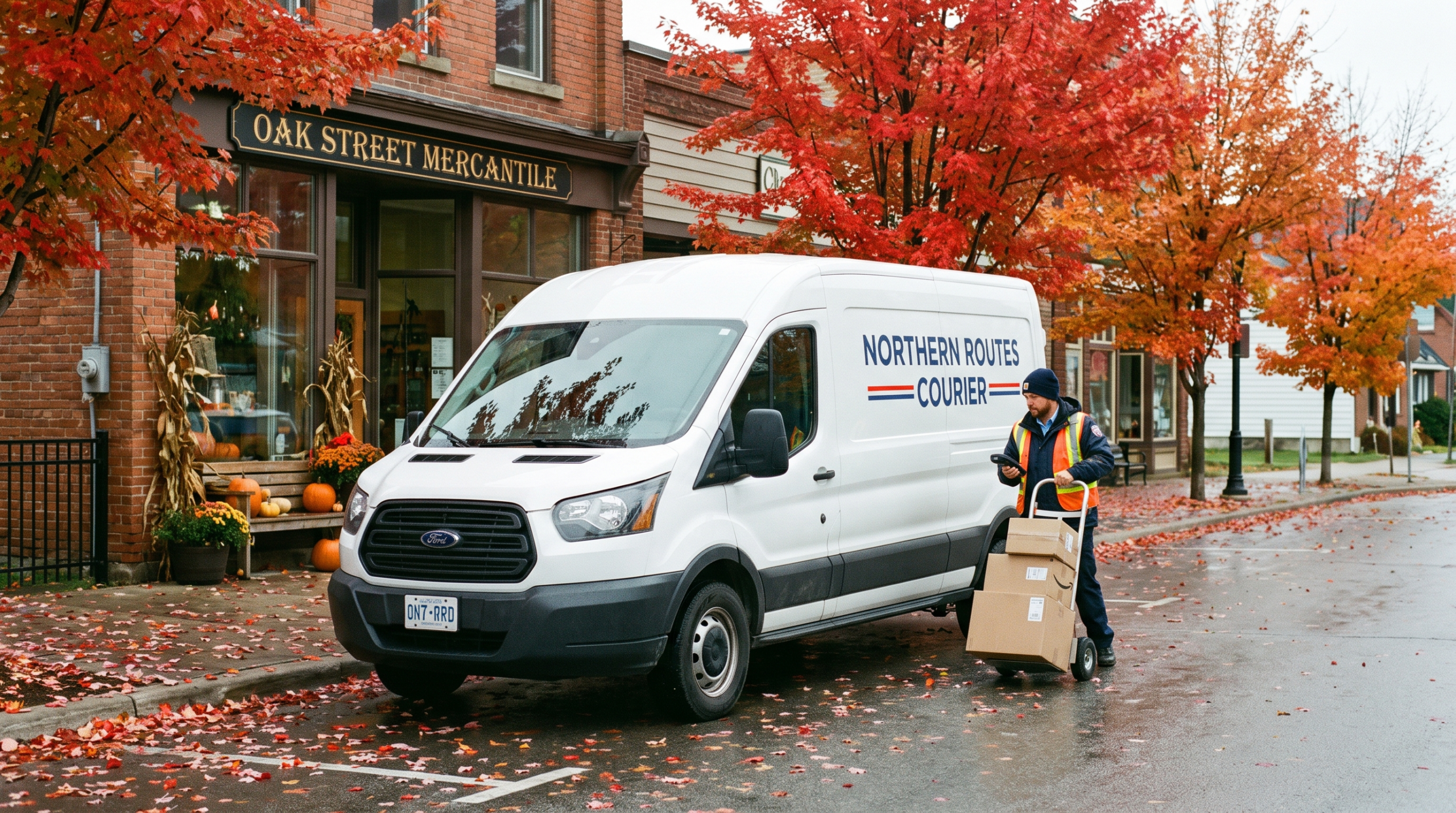
In Canada, the conversation about shipping rates almost always revolves around the same four names: Canada Post, Purolator, UPS, and FedEx. Yet a growing share of packages delivered in the country are not handled by any of them. The regional carriers — Intelcom/Dragonfly, Nationex, Canpar, GLS Canada, ICS Courier, and about a dozen provincial carriers — currently handle a significant portion of retail and e-commerce volume.
For an SME, the question isn’t which one is «the best.» It’s about determining on which routes a regional carrier is cheaper than a national carrier offering equivalent service, and on which routes it’s better to pay the national rate. The answer depends on three variables: the density of your destination, the average weight of your packages, and your tolerance for service risk.
This guide explains how to evaluate a regional carrier, what savings are realistic by 2026, and what mistakes can be costly for small and medium-sized businesses that make the switch too quickly.
What exactly is a regional carrier?
A regional carrier is a network that does not serve the entire country with its own vehicles. It focuses on a specific corridor—often the Quebec City–Montreal–Ottawa–Toronto triangle, or the Lower Mainland in British Columbia—and either subcontracts or declines the rest.
This concentration is precisely what creates the price advantage. A carrier that delivers 180 packages per route in a densely populated neighborhood of Laval has a cost per stop that is much lower than that of a national network, which must fund air hubs, transcontinental sorting centers, and service to every address in Nunavut.
Useful categories to distinguish:
- The Last Pure Kilometer (Intelcom/Dragonfly, Courant Plus): They pick up your package at a sorting center and deliver it to the customer. They’re very strong in urban residential areas, often delivering in the evenings and on weekends.
- Comprehensive regional networks (Nationex, ICS Courier): pickup, sorting, delivery, with tracking and guaranteed delivery times. Nationex is a strong player in the market for heavier packages in Quebec and Ontario.
- «Second-tier» national networks» (Canpar, GLS Canada): Nearly nationwide coverage, rates generally lower than Purolator's for domestic shipments, but more limited express options.
Comparison: What Each Type of Carrier Does Well
The table below compares service profiles. The price differences reflect typical ranges observed in the SMB market: they vary depending on your volume, your contract, and your destinations.
| Profile | Examples | Best Use | Typical Price Difference vs. National Average | Weakness |
| Last kilometer in the city | Intelcom/Dragonfly, Courant Plus | High-density B2C residential, daily volume | -15 % to -35 % | Little or no B2B, no guaranteed express service |
| Comprehensive regional network | Nationex, ICS Courier | Packages weighing 5–30 kg, QC–ON route | -10 % to -25 % | Low or outsourced coverage outside the corridor |
| Second-tier national league | Canpar, GLS Canada | B2B/B2C mix, broad coverage | -5 % to -20 % | Limited express and international options |
| National (Full) | Purolator, UPS, FedEx | Express, International, Remote Areas | Reference | Numerous surcharges, high base rate |
| Position | Canada Post | Small, lightweight packages; rural addresses | Variable | Longer lead times, limited peak capacity |
The Four Numbers to Calculate Before Making a Change
Never compare two rate schedules side by side. Compare actual costs based on your own shipments.
1. The all-inclusive cost per delivered package
Take 100 actual shipments from the last quarter. For each one, add up the base rate, fuel surcharges, residential surcharges, remote area surcharges, and handling fees, then divide by 100. That’s your benchmark. A Quebec-based small business that ships 400 residential packages per month, each weighing 2 kg, within a 100-km radius often pays between 9 $ and 14 $ all-inclusive with a national carrier, and between 7 $ and 10 $ with a well-chosen regional carrier.
2. The coverage rate of your address book
Export your destination ZIP codes from the last 90 days and ask the regional carrier which ones it serves directly. If 78 % of your packages fall within their service area, you don’t replace your national carrier—you add a second carrier and split the volume between them. This is the most common scenario.
3. The cost of undelivered packages
The remaining 22 % shipments must be sent to a domestic carrier, often at a less favorable rate since your volume with that carrier has just decreased. Recalculate the figures, taking this loss of discount into account. This is the most common mistake: a savings of 18 % out of a total volume of 78 % can be offset by a rate tier increase from the primary carrier.
4. The Cost of a Failed Delivery
A package that isn’t delivered on the first attempt rarely costs just a second attempt. It costs a customer email, a phone call, and sometimes a refund. If your first-attempt delivery rate drops from 94 % to 89 %, calculate the difference: 5 % out of 400 packages equals 20 incidents per month. At 12 $ in internal processing costs per incident, you’ve just wiped out 240 $ in savings.
Where Regional Carriers Really Make Their Money
Urban residential development with repeated volumes. It’s their turf. Most agreements don’t include a separate residential surcharge, routes are dense, and deliveries are made in the evening. A Montreal-based online store that delivers primarily on the island almost always comes out ahead.
Average-sized packages shipped over short distances. For shipments weighing between 5 and 25 kg within a 300-km radius, a regional network eliminates the need for transcontinental sorting and charges accordingly.
Flexibility in pickup. Regional carriers are more willing to negotiate later pickup windows, which allows you to extend your order deadline—a real selling point for your customers.
Where they lose
Remote areas. Outside the corridor, a regional carrier subcontracts to a national carrier and adds its own markup. You end up paying twice. Always check whether a destination is served directly or through an arrangement.
Guaranteed Express. Few regional carriers offer a genuine money-back guarantee in case of delays. If your customer is expecting a next-day delivery by 10:30 a.m., stick with a national carrier.
The B2B with a loading dock. Last-mile networks are optimized for front doors, not for warehouses with designated receiving hours and signed delivery slips.
The cross-border. No Canadian regional carrier offers integrated customs clearance like UPS or FedEx does for shipments to the United States. For cross-border shipments, the question doesn’t even arise.
How to Make the Transition Without Disrupting Your Service
- Test 10 % of the volume for 60 days. Choose a homogeneous segment—for example, all residential packages going to the same three-character ZIP code.
- Measure three metrics : all-inclusive cost per package, actual median delivery time (not the promised delivery time), first-attempt delivery rate.
- Keep your domestic carrier active. Never close an account until you have 90 days of data on the replacement.
- Check your insurance coverage. Regional carriers often have lower liability limits. If you’re shipping electronics or valuable items, be sure to read this clause before signing.
- Incorporate tracking. A cheaper carrier that doesn't update your tracking page will result in more customer calls. Confirm whether an API or integration with your platform is available.
A Realistic Cost Estimate for an SME
Let’s take a company that ships 500 packages per month, 70 of which are % residential deliveries in an urban corridor. At 12 $ per package all-inclusive with a national carrier, the monthly bill is 6,000 $. By switching the 350 eligible packages to a regional carrier at 9.50 $, these packages cost 3,325 $, and the remaining 150, at 12.50 $ after the tiered rate applies, cost 1,875 $. Total: 5,200 $. The savings amount to 800 $ per month, or 13 %.
That's true, but it's not the 30 % promised in the gross rate schedule. And that savings disappears if the first-attempt success rate drops by more than three points.
The amounts listed are for reference only. Actual rates vary depending on your service agreement, volume, service areas, and applicable surcharges.
The Strategy That Works
SMEs that succeed with regional carriers do not replace their national carrier; they add another layer. The national carrier handles express delivery, cross-border shipments, remote regions, and B2B. The regional carrier handles high-density residential delivery, which often accounts for the majority of volume and the minority of complexity.
The task, therefore, is not to choose a carrier, but to write a routing rule: which package goes to whom, based on the ZIP code, weight, and type of address. Once this rule is in place, the cost savings happen automatically, every day, without any manual decisions.
Would you like to know how much a multi-carrier route would save you on your actual routes? The team at’Shipping Store analyzes your shipments from the last 90 days and shows you, by ZIP code, where a regional carrier offers a better rate than your current one and where it's best to stick with what you have.


 French
  English
  Spanish