
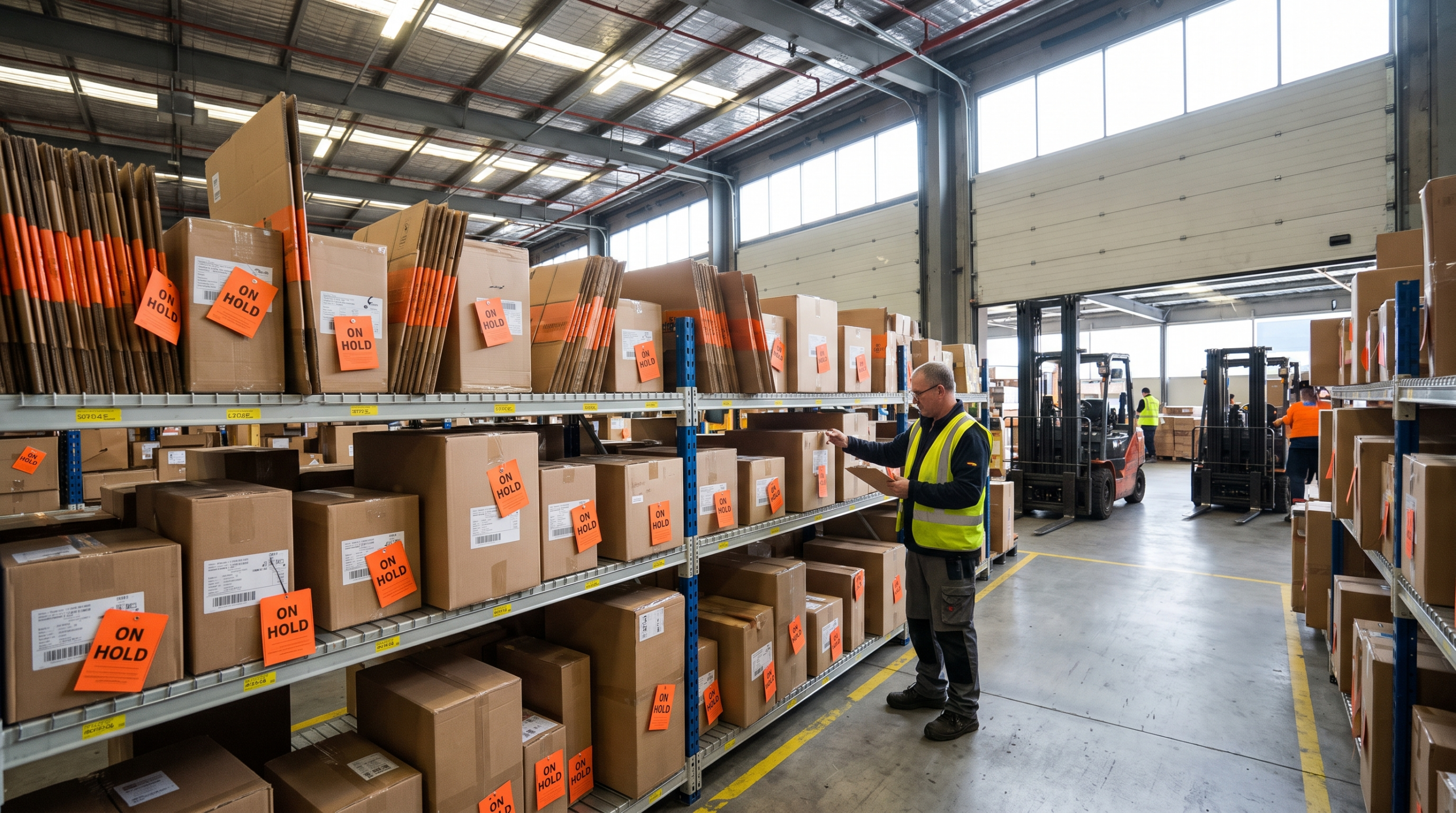
You've negotiated your rates, optimized your boxes, and compared carriers. Then an invoice arrives with a line item you've never seen before: storage fees. A package spent three days longer than it should have in a warehouse, and that cost you more than the shipping itself.
It is one of the most misunderstood surcharges in the industry, because it does not depend on weight, distance, or zone. It depends solely on the weather — and the clock starts ticking much sooner than most small and medium-sized businesses realize.
Here’s how storage and holding fees work in Canada in 2026, what they actually cost, and the six strategies that can help you avoid paying them altogether.
What exactly is a storage fee?
A shipping company is not a warehouse. Its business model is based on turnover: a package comes in in the morning and goes out in the evening. As soon as a package sits idle, it takes up a square meter that could be used for something else. The shipping company therefore charges for this downtime.
There are three situations that typically result in these fees:
- Unclaimed package at the service location. After a delivery notice is left, the package will be held at the counter. Once the holding period has expired, a fee will be charged, and the package will be returned to the sender.
- Held at customs. An incomplete commercial invoice, a missing HS code, an importer who can’t be reached—and the shipment sits in a bonded warehouse, where the clock is ticking by the day and by shipment.
- Delivery refused or postponed by the recipient. The construction site isn't ready, the loading dock is closed, and no one has the key. The truck leaves with the goods, and the warehouse charges for parking.
Not to be confused with the detention, which targets vehicles that are idling for too long while being loaded and is billed by the hour—a major issue, especially in palletized freight transport.
How many days before the counter starts?
That’s the question that changes everything. Data retention periods vary widely depending on the service, and many small and medium-sized businesses are still operating based on benchmarks from the 2010s, even though the timeframes have become much shorter.
| Location | Typical retention period | What Happens Next |
|---|---|---|
| Packages at the service point / counter | 5 to 15 business days | Return to sender; round-trip shipping charges billed |
| Shipment Held at Customs | Often 1 to 5 full days | Daily fees per shipment, followed by storage in a holding warehouse |
| Commercial Delivery Refused | 24 to 72 hours | Storage fees + redelivery fees |
| Pallet / LTL at the terminal | 24 to 48 hours (often 1 full day) | Billing per pallet and per day |
There are two pitfalls that come up time and again. First, the full days : The day of arrival generally doesn't count, but weekends and holidays often do. A package that arrives on a Thursday evening before a long weekend can rack up four billable days before anyone even notices.
Next, the’billing unit. For parcel shipping, it’s often a fixed amount per shipment per day. For LTL, it’s per pallet per day—a shipment of six pallets costs six times as much in holding fees. As a rough guide, rates in Canada typically range from a few dozen dollars per day for a parcel shipment, and are significantly higher for customs or LTL shipments. These amounts vary depending on the carrier, the agreement, and the service: always verify them using your own rate schedule.
The true cost: it's never just about storage
The classic mistake is to look at the «storage» line and think it’s no big deal. In reality, these charges almost always come in clusters. Let’s take a commercial shipment that was refused upon delivery, with an initial shipping value of 45 $:
| Invoice line | Estimated amount |
|---|---|
| Initial Transport | 45 $ |
| Unsuccessful delivery attempt | 20 $ |
| Storage (3 days) | 60 $ |
| Re-delivery | 25 $ |
| Fuel Surcharge on Accessories | ~12 $ |
| Total | ~162 $ |
Shipping costs have tripled. And the fuel surcharge—which, in many rate schedules, applies to ancillary charges as well as the base freight rate—is added on top of that. This is exactly the kind of distortion that explains why an announced increase of 5.9 % actually translates to 10 % or more on an actual invoice.
Six Ways to Avoid Paying for Storage
1. Treat the address as critical data
Most of the packages sitting in the warehouse are there because no one was able to deliver them. Always verify the unit number, the name of the business posted on the door, and especially a the recipient's contact phone number. A driver who can call won't leave with the package.
2. Enable recipient notifications right from the label
Sending an email or text message when the label is created—and again when a delivery notice is issued—significantly reduces the number of unclaimed packages. Most shipping platforms offer this service for free—but you still need to fill in the email field, which many shippers leave blank.
3. Monitor «exception» statuses, not deliveries
There’s no point in tracking packages that have already been delivered. What you need to keep an eye on are the exception statuses: unsuccessful attempt, pending at the service point, held at customs. Set up a daily review of just these statuses. Fifteen minutes a day is enough to take care of most of the work.
4. Take care of customs before shipping, not after
For cross-border shipments, three documents can prevent the vast majority of hold-ups: a complete commercial invoice (detailed description, value, country of origin), the correct HS code, and the contact information for a reachable importer. A description such as «parts» or «samples» is an invitation for inspection.
5. Refer the patient before the retention period ends
If a package is stuck in transit, don’t let the time limit run out. Redirecting it to a pickup location or a business address typically costs just a few dollars—far less than three days of storage followed by a return to the sender, who will charge you the full rate for the return shipping.
6. Review your invoices line by line, not just the total
Storage fees are frequently charged in error: due to miscalculated time frames, the arrival date being counted, or delays caused by the carrier itself. These cases can be disputed, but the window for filing a claim is short—often 30 to 180 days, depending on the agreement. A monthly line-by-line audit recovers amounts that no rate negotiation will ever get you.
The end-of-year schedule is a game-changer
From late September through mid-January, the delivery networks are operating at full capacity. Service centers are overwhelmed, hold periods are enforced more strictly, and redelivery windows are getting longer. A package not claimed by December 10 has much less leeway than one not claimed by June 10.
In practical terms: Step up your monitoring of exceptions starting in October, include pickup timeframes in your confirmation emails to customers, and prioritize pickup locations for residential addresses at risk.
Key Takeaways
- Storage fees are charged by time, not by weight—so they are not subject to your usual optimization strategies.
- The timer usually starts within 24 to 72 hours, including weekends.
- They rarely come alone: a failed delivery attempt, a redelivery, and fuel costs are almost always added to the bill.
- Validated addresses, reachable recipients, and exception monitoring eliminate virtually the entire problem.
- File your claim quickly: the window for filing claims closes soon.
The amounts mentioned in this article are indicative and vary depending on the carrier, the service, and your commercial agreement. Always check the rates that apply to your account.
Need an outside perspective on your invoices?
At Shipping Store, we help Canadian small and medium-sized businesses identify avoidable charges on their shipping invoices—such as storage, redelivery, and address corrections—and implement processes to eliminate them. Request an analysis of your shipments and see what you're paying for without even realizing it.
 French
  English
  Spanish