
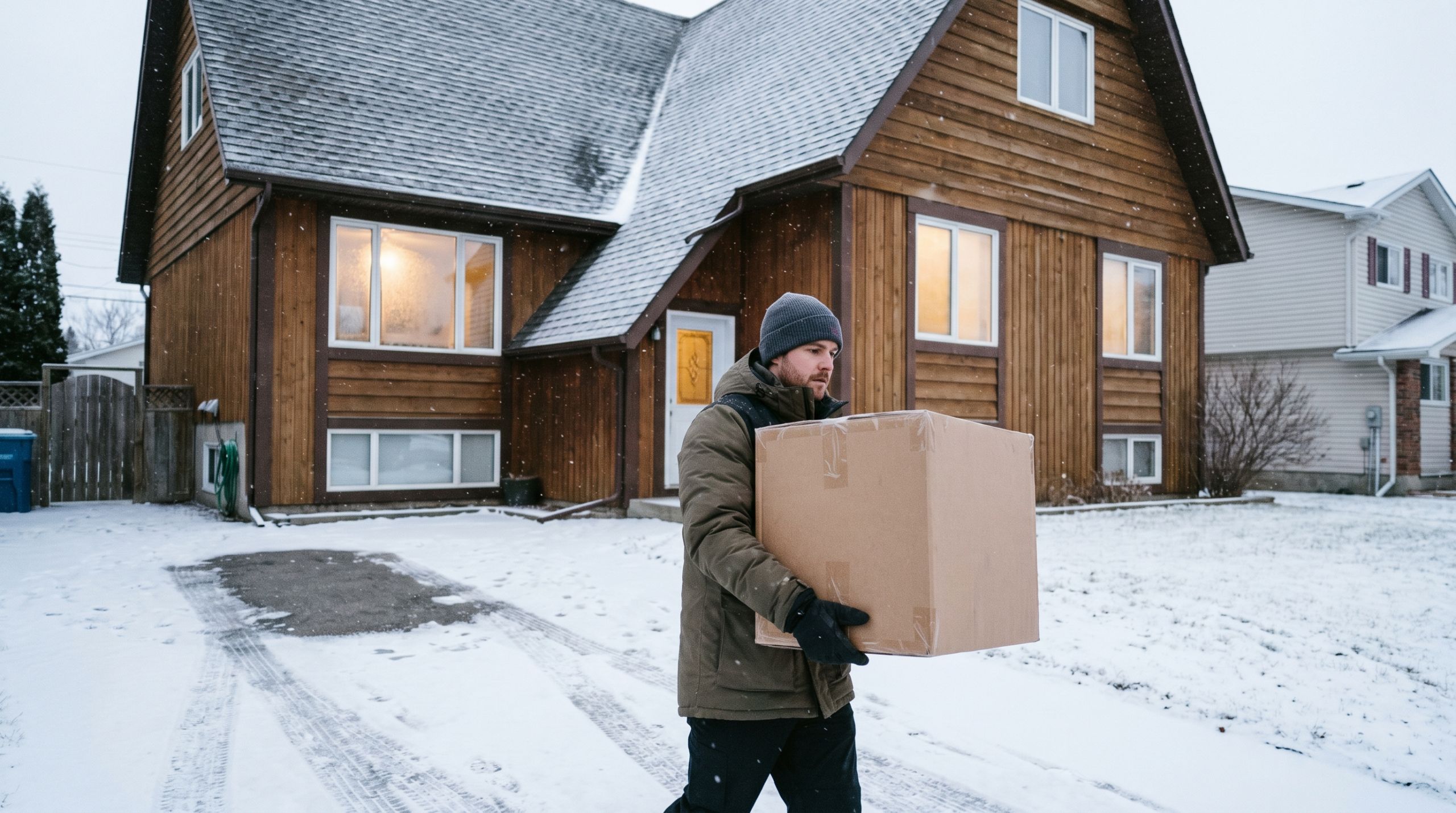
In Canada, winter doesn’t just slow down trucks—it takes a toll on the contents of packages. Between November and March, a shipment can easily spend several hours in an unheated trailer, then on a loading dock exposed to the elements, and then on a porch at -20 °C until the recipient returns home from work.
The result: spilled cosmetics, cracked bottles, batteries that no longer hold a charge, dead plants, and denied claims. Most of these losses aren’t the carrier’s fault, but rather the result of packaging designed for summer.
Shipping in Cold Weather This requires two adjustments: protecting items that freeze and choosing a service with a transit time that minimizes exposure. Here is the method we use at Expert Shipping, along with specific thresholds for each type of shipment.
What the Cold Actually Damages
Liquids and water-based products
Water expands by about 9 % in volume when it freezes. In a container filled to the brim, this expansion is enough to pop a cap off or crack a rigid plastic bottle. Emulsions—creams, lotions, water-based paints, cleaning products—separate irreversibly even if they don’t break the container: the product remains «good» on paper, but it’s unsellable.
Beverages are the worst-case scenario: a frozen can or glass bottle almost always breaks, and the mess contaminates the entire package—and sometimes neighboring packages as well—which can result in a cleaning bill from the carrier.
Lithium batteries
A lithium-ion battery does not «freeze,» but its chemical reaction slows down: below 0 °C, the available capacity drops sharply, and charging a cold cell creates a deposit of metallic lithium that permanently damages the battery. This has two practical implications: ship devices with a charge level of about 30 % (this is also the rule for air transport), and tell the recipient to let the device return to room temperature before plugging it in.
Electronics, Displays, and Plastics
LCD screens freeze: the liquid crystals solidify, the image becomes ghostly, and, in severe cases, the screen does not recover. The real danger, however, comes from the transition from cold to hot: moisture in the ambient air condenses inside the case as soon as the package enters a heated home. Rigid plastics (ABS, PVC, polystyrene) also become brittle: a case that survives a one-meter drop in July will crack in January.
Food, Plants, and Health Products
Chocolate turns white, homemade preserves burst open, and live plants and seeds often die after just one night of frost. Some health products and vaccines have strict temperature requirements: if your product falls into this category, it requires a cold chain and cannot be shipped as a simple insulated package.
Critical Thresholds and Mitigation Strategies, by Content Type
| Content Type | Critical threshold | Main Risk | Parade |
|---|---|---|---|
| Bottled liquids (water, beverages, household products) | 0 °C | Expansion, breakage, leak | Fill to 90 %, waterproof bag, double box |
| Creams, lotions, cosmetics | 0 to 4 °C | Irreversible separation of the emulsion | Insulation + thermal mass, express service |
| Water-based paints and adhesives | 0 °C | Product rendered unusable | Express service—avoid Fridays |
| Lithium Batteries and Devices | Below 0 °C | Loss of capacity, condensation | 30 % of cargo, desiccant packet |
| LCD screens, tablets, monitors | -10 °C | Crystal solidification, condensation | Double box, foam, thawing instructions |
| Chocolate and Confectionery | Variable | Whitening, texture | Lightweight insulation, short transit time |
| Plants, bulbs, seeds | 0 to 2 °C | Death of a plant | Hand warmers: 40 hours; express delivery: 1–2 days |
Winter Layering: The Three-Layer Rule
1. Insulation. An insulating wall does not generate heat; it slows down heat transfer. A layer of aluminum-coated bubble wrap or a 2.5 cm polystyrene panel in a double-walled box generally buys you 12 to 24 hours before the interior reaches the outside temperature. That’s exactly what you need to get through a night on a dock.
2. Thermal mass. Insulation alone is not sufficient beyond 24 hours. A chemical hand warmer (the type used for hands, lasting 30 to 40 hours) or a phase-change pack stored at room temperature maintains a thermal floor. Safety rule: Never allow direct contact with the product; always separate it with cardboard or foam, and never use it with lithium batteries.
3. The moisture barrier. A sealed polyethylene bag wrapped around the product, along with one or two packets of silica gel, prevents condensation from forming on the electronics during thawing. This is the step that almost everyone forgets, and it’s the one that saves the devices.
One last point: in winter, soft-padded packaging is a poor choice for any fragile items. It provides no insulation, it loses its shape, and damp cardboard loses some of its stacking strength.
Service speed is a form of protection
Each additional day in transit means one more night at -15 °C. A ground shipment taking 5 to 7 business days between Quebec and British Columbia may undergo four or five freeze-thaw cycles; an express service taking 1 to 2 days may undergo none or just one.
Three practical tips:
- Avoid departures on Thursdays and Fridays In land-based service: The package sits in an unheated sorting center all weekend.
- Pay for express shipping on sensitive items, not for the entire catalog. The express surcharge is often between 40 and 120 % of the standard shipping rate, depending on the zone and weight, but it is still less than the cost of a replacement plus return shipping.
- Offer pickup at a pickup location Instead of delivery to the front steps: the package is waiting inside, not outside.
The amounts listed here are for reference only and vary depending on your service agreement, the carrier, the zone, the billable weight, and any applicable surcharges.
Weather, Delays, and Coverage: What the Carrier Does Not Cover
There are two exceptions that appear in all transportation terms and conditions in Canada and come as a surprise every winter:
Delays caused by weather conditions do not trigger the money-back guarantee. Storms, ice storms, road closures, and flight cancellations: these events fall under the force majeure clause, and the on-time delivery guarantee is suspended. You will not be reimbursed for the express shipping fees you just paid.
Freeze damage is generally excluded from standard claims. For standard packages, frozen contents are treated as improper packaging and are therefore the sender’s responsibility. For less-than-truckload (LTL) and pallet shipments, there is a paid freeze protection service that guarantees storage and transport above freezing; this is the only reliable way to transfer this risk, and there is no equivalent service for parcels.
Practical tip: In winter, your packaging is your insurance. Document it. Take photos of the product, the insulation, the thermal pack, and the closed box before sealing it. If you do end up filing a claim for mechanical damage, these photos are what make the difference between a claim being approved and one being denied due to insufficient packaging.
Winter Shipping Checklist
- Can the product withstand -20 °C for 24 hours? If not, use insulation and a heat sink.
- Liquid containers filled to a maximum of 90 % and placed in a sealed bag.
- Double box with at least 5 cm of padding on all sides.
- Silica gel packet for any electronic device.
- Battery-powered devices are shipped with approximately 30 % of charge.
- Service selected based on the number of nights booked, not just the price.
- Land shipments are scheduled to depart early in the week.
- Written thawing instructions inside the box for electronics and cosmetics.
- Photos of the packaging retained for at least 90 days.
- Delivery times provided to your customers with a 2- to 3-day weather buffer.
In a nutshell
Shipping in cold weather in Canada costs a little more per package—insulation, a thermal pack, and sometimes a faster service—but results in significantly fewer losses. The three key decisions are always the same: know your product’s temperature threshold, build the three layers, and pay for faster shipping when the contents warrant it.
Are you shipping frost-sensitive products this winter? The team at’Shipping Store can verify your packaging, compare carrier rates for your areas, and provide you with realistic delivery times for the winter season. Request an evaluation before the first storms.


 French
  English
  Spanish