
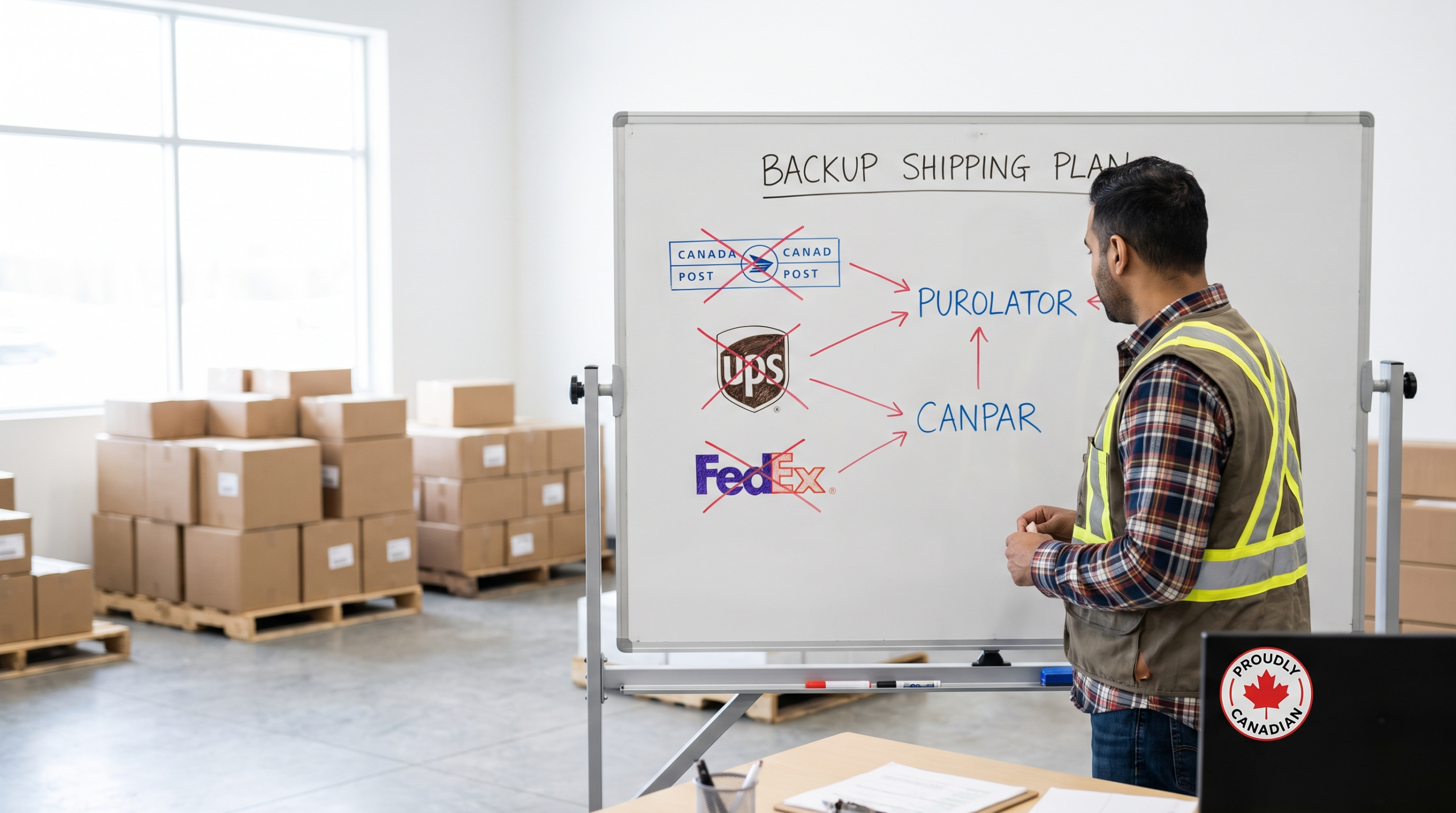
In April 2026, Canada Post began the first phase of a five-year transformation: Approximately 4 million addresses will be converted to community mailboxes, including nearly 136,000 by the end of 2026 and early 2027, in 13 pilot communities. Meanwhile, the rate increases announced for 2026 and 2027 are prompting small and medium-sized businesses to redistribute their mail volumes. Canada’s shipping network is changing—and it’s changing fast.
For an SME, however, the most costly risk isn’t a rate increase. It’s the morning when the usual carrier stops picking up shipments. During the country’s last major labor dispute, delivery punctuality dropped by about 14 %, and shippers with no alternative had to deal with delays of seven to eight days per package. Those who already had a second account switched over in a single day.
A Shipping Contingency Plan It’s not a 40-page document. It’s a single-page sheet, revised once a year, that answers three questions: Who will pick up my packages if my carrier stops delivering? How much more will it cost me? And what do I tell my customers? Here’s how to put it together.
What a Disruption Really Costs
Most small and medium-sized businesses measure service interruptions in terms of days of delay. That’s the wrong unit of measurement. The actual cost consists of four components that add up very quickly.
The first is the additional shipping cost. Switching to an express courier at the counter rate can cost up to 40 % more than the economy postal service for an equivalent shipment—and even more if you don’t have a business account and are paying the retail rate.
The second factor is the cost of customer service. A delayed package generates, on average, one to two «where is my order» inquiries. At 8 to 10 minutes to process each one, 300 delayed packages amount to one person-week.
The third is the cost of refunds and reshipments: canceled orders, packages returned to the sender, and a second shipping label paid for the same product.
The fourth—and most insidious—is a loss of volume. Buyers who don't receive their orders on time will shop elsewhere next time.
The Four Breakpoints to Map
Before choosing an alternative carrier, identify where your supply chain is breaking down. For virtually all Canadian small and medium-sized businesses, there are four points of failure.
- Pickup. If your daily volume depends on a truck that arrives at a set time, if that truck stops coming, everything comes to a halt. Do you know the address and hours of operation for the nearest drop-off point for each of your carriers?
- Labeling. Do your labels come from a single system? If your platform is connected to only one carrier, you’ll have to print labels by hand on the day of the switchover.
- Delivery addresses. P.O. boxes are served only by the postal service. If some of your customers use P.O. boxes or FlexDelivery addresses, no express mail service can take over without changing the address.
- Remote areas. Private carriers often outsource the last mile in the North and rural areas. Your Plan B may very well cover Montreal and Toronto, but not Sept-Îles.
Risk Scenarios and Countermeasures
| Screenplay | Warning Signal | A parade to prepare in advance |
| Labor Dispute (Strike or Lockout) | Notice of Negotiation, 72-hour advance notice | Active secondary account, tested replacement labels |
| Suspension of Acceptance of Shipments to a Country | Carrier Service Notice | Second international route (express mail or consolidator) |
| High Season Demand | Mandatory collection limits, extended deadlines | Plan Ahead for Shipments; Reserve Capacity in September |
| Storm or regional closure | Weather Alert, Delay Advisory by Region | Proactive message to customers in the affected region |
| Change of Delivery Address (Community Mailboxes) | Notice of Change of Address | Cleaning the address database, validation at checkout |
The Most Profitable Move: The Dormant Account
If you do only one thing on this list, make it this: Open a commercial account with a second carrier right now, even if you don't ship anything through them.
An open and verified account generally costs nothing to maintain. Opening an account during a crisis is costly and time-consuming: credit checks, business address verification, and sometimes a security deposit. Worse still, carriers have already imposed access restrictions during peak periods—pickup limits, suspensions on accepting new customers—precisely to protect the level of service for their existing customers. On the day when everyone is looking for a Plan B, new accounts are the last to be considered.
For a dormant account to be truly usable, three conditions must be met: send an actual shipment through it every quarter (otherwise it may be deactivated), make sure the login credentials are accessible to more than one person, and connect it to your labeling system before you need it.
Your decision-making thresholds, determined without emotion
A decision made in the midst of a crisis is a costly one. Write down your rules now, while no one is complaining.
| Observed condition | Automatic Decision | Who decides? |
| Strike Notice Confirmed | Prioritize urgent orders, maintain cost-effectiveness | Operations Manager |
| Actual pickup stop | Complete switch to the secondary conveyor | Decision already made; no approval required |
| Estimated delivery time of more than 5 business days | Remove delivery estimates from the website | E-commerce Manager |
| Additional cost exceeding 35 % of the selling price | Suspend free shipping; offer pickup | Management |
Reach out before the customer calls
Transparency costs far less than silence. Three steps, in order: display a dated banner on the checkout page as soon as a disruption is announced; extend your stated delivery times rather than promising the impossible; and offer a concrete alternative—a faster service partially paid for by you, a pickup location, or in-store pickup.
Also ask customers who use a P.O. box to provide an alternate street address. That’s the detail that ensures express mail gets delivered even when the postal service is down.
Your Annual Report, in Ten Points
- List your current carriers and the percentage of volume each one accounts for.
- Open or reactivate a secondary account.
- Create a test label on this secondary account.
- Write down the addresses and hours of the two nearest drop-off locations.
- Determine what percentage of your addresses are P.O. boxes.
- Find your remote-area ZIP codes and check which carrier serves them.
- Calculate the additional cost per package in the event of a switch.
- Draft the three customer messages (banner, email, and customer service response) in advance.
- Set your thresholds in writing.
- Review everything once a year, ideally in August before the peak season.
The rates and surcharge percentages listed here are for reference only and may vary depending on your service agreement, volume, the service you choose, and the delivery region. Always confirm your specific rates with each carrier.
The conclusion can be summed up in a single line
A shipping contingency plan isn't meant to predict the next disruption. It's meant to ensure that you won't have to make any decisions on the morning it happens. The secondary account, the written thresholds, and the three prepared messages are worth more than any forecast.
If you'd rather not have to manage multiple accounts and multiple labeling systems, that's exactly what Shipping Store : access to multiple carriers through a single point of contact, negotiated rates, and an alternative route already in place when a network experiences delays. Request an assessment of your shipments and identify your weak spots before the next peak season.


 French
  English
  Spanish