
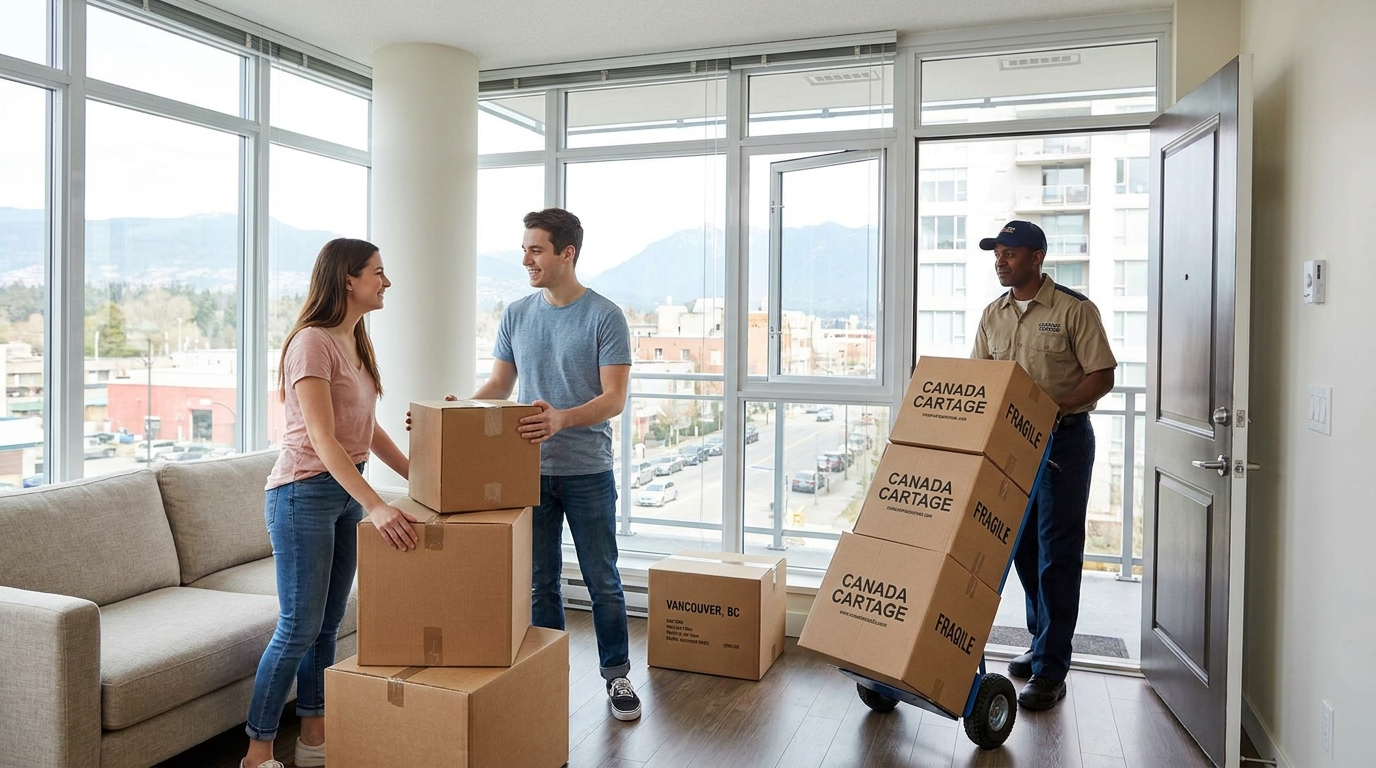
Renting a truck to haul ten boxes across the country? In 2026, this instinctive choice often costs more than you might think: rental fees, gas, hotels, meals, and days off all add up quickly. For small moves—moving into an apartment, relocating for a job, or moving back in with your parents— ship your moving boxes Shipping via a carrier is an increasingly popular alternative in Canada.
The process is simple: you pack your belongings into sturdy boxes, create your labels online, and Canada Post, Purolator, UPS, or FedEx will deliver everything to your new address. No truck to drive, no miles to cover, no furniture to haul up stairs.
In this guide, we compare the actual costs of shipping a package versus using a moving truck or a moving company, we detail the rules you need to follow (weight, dimensions, packaging), and we share practical tips for paying less for each box you ship.
Shipping Your Boxes or Renting a Truck: The Real Cost
Let's take a concrete example: a move from Montreal to Toronto (about 540 km) with 10 boxes weighing 15 kg each.
| Option | Estimated cost | Effort Required |
|---|---|---|
| Truck Rental (One-Way) | 300 $ to 600 $ + gasoline (100 $ to 150 $) | Drive, Load, Return |
| Professional Movers | 1,200 $ to 2,500 $ | Minimal, but expensive |
| Shipment of 10 boxes via a carrier | 250 $ to 450 $, depending on the service | Packaging and drop-off only |
These figures are approximate and vary depending on the agreement, the service selected, the time of year, and the distance. But the trend is clear: for shipments of fewer than about 15 boxes and without large furniture, shipping by parcel is almost always the most economical solution—especially if you don’t have the appropriate driver’s license or help with driving and unloading.
When a Package Wins (and When It Loses)
This package is a good deal if:
- Are you moving? fewer than 15 to 20 boxes without bulky furniture; ;
- The distance is long (more than 300 km): the cost of the truck skyrockets with the number of kilometers, but not the cost of the package; ;
- You're flexible about delivery times: standard shipping takes 2 to 7 business days, depending on the destination; ;
- You're moving on your own and can't drive a 15-foot moving truck.
A moving truck or professional movers are still the best option if:
- Are you moving furniture, appliances, or more than twenty boxes?; ;
- Each box weighs well over 30 kg: the carriers’ additional handling fees (often 19 $ to 58 $ per oversized package) eat into the savings; ;
- Everything has to arrive on the same day as you.
Comparison of Shipping Carriers for Your Packages in 2026
Each carrier has its own strengths when it comes to this type of shipment. Here are the key points to keep in mind (estimated rates, which may vary depending on the agreement and service):
- Canada Post : Ideal for packages weighing less than 30 kg. The Regular service is the most economical option for long distances, and the network of service counters makes drop-off easy. Strict limit: 30 kg per package.
- Purolator : Excellent value for money in Canada, extensive national network, affordable ground shipping options for interprovincial shipments.
- UPS : Accepts packages weighing up to 68 kg, which is convenient for heavier boxes; the UPS Standard service is competitive on the Quebec–Ontario–West routes.
- FedEx : An economical ground shipping option with reliable tracking, ideal for shipments to regions served by its road network.
Important tip: the bulk density applies. A large box that is half-empty is charged based on its volume, not its actual weight. Use medium-sized boxes (45 × 45 × 60 cm or smaller) that are packed tightly: you’ll always pay less than you would with very large, lightweight boxes.
Packing Your Boxes Properly: The Golden Rules
- Double-wall corrugated boxes For books, dishes, and heavy items; crushed recycling bins can result in rejected shipments or damage.
- Maximum 25 kg per box In practice: Beyond that, handling becomes risky, and additional fees may apply.
- H-shaped closure with packing tape (not masking tape) over all openings.
- Alignment : crumpled paper or bubble wrap to fill in the gaps; nothing should move when you shake the box.
- Labeling : The full address of the recipient and the sender must be written both inside AND outside each box, in case the outer label comes off.
- Prohibited or Discouraged Items : aerosol cans, propane tanks, flammable liquids, plants, and uninsured valuables.
Five Tips for Saving Money in 2026
- Compare rates from several carriers Before each shipment: On the same route, the difference can range from 30 to 40 %, depending on the service.
- Use a shipping service provider With Expert Shipping, you benefit from negotiated rates normally reserved for high-volume businesses—even for a single shipment.
- Avoid express options : For a planned move, the budget service does the same job for much less.
- Ship on weekdays and outside of peak season : From late October through mid-January, several carriers impose peak-season surcharges.
- Declare the value of your property and get insurance for boxes containing valuable items: just a few dollars can save you from unpleasant surprises.
In a nutshell
For a small move in 2026, shipping your moving boxes via a carrier is often the simplest and most cost-effective option in Canada: no need to rent a truck, no long hours on the road, and online tracking of each box all the way to its destination. The secret: well-packed medium-sized boxes, careful packing, and systematically comparing rates.
Ready to ship your boxes without breaking the bank? Shipping Store compares rates from Canada Post, Purolator, UPS, and FedEx for you and lets you take advantage of negotiated rates on every shipment. Get your quote in just a few clicks at expertshipping.ca.
The rates mentioned in this article are for reference only and vary depending on the agreement, service, time of year, and destination.




 French
 English
 Spanish