
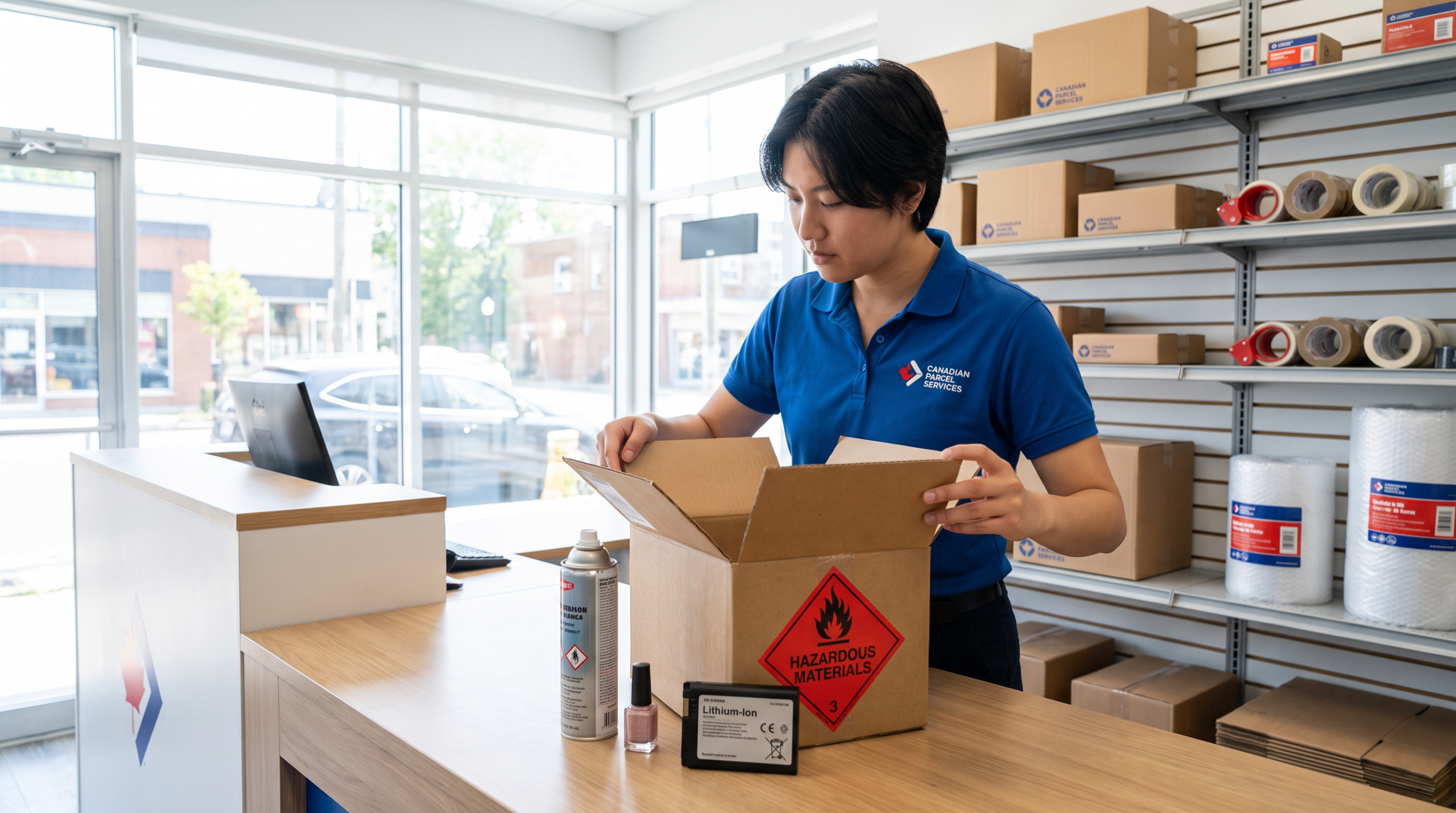
Every week, packages are refused at the counter or removed from the delivery network because they contain an item the sender didn’t realize was prohibited. A bottle of nail polish, a can of hairspray, a lighter forgotten at the bottom of a moving box: the list of Items Prohibited from Shipment to Canada is much longer than most small and medium-sized businesses and individuals realize.
Rejection isn't the worst-case scenario. An unreported item that falls under the Regulations on the Transportation of Dangerous Goods (TMD) exposes the sender to penalties, voids any insurance coverage, and can result in the detention of an entire shipment—sometimes an entire truckload. Canada Post updated its list of prohibited items on May 29, 2026, and private carriers also enforce their own restrictions, which are often stricter than those of the postal service.
Here is the complete overview for 2026: the three levels of restrictions to be aware of, the everyday items that are prohibited, the exact requirements for regulated products, and what changes depending on whether you’re shipping to Canada, the United States, or internationally.
Prohibited, restricted, regulated: three concepts that should not be confused
The most common misconception is the belief that an item is «prohibited» or «permitted.» In reality, three different regulations coexist, and they call for very different procedures.
- Prohibited at all times. No service, agreement, or packaging makes it possible to ship these items. This applies to explosives, ammunition (including inert ammunition and replicas), fireworks, and radioactive materials.
- Controlled or restricted. Shipping is permitted, but only if specific conditions are met: required delivery service, proof of age, signature, service agreement, and authorized recipient. Alcohol, tobacco, vaping products, firearms, and cannabis fall into this category.
- Regulated under the TMD. The item is accepted in «limited quantities» if the packaging, labeling, and documentation comply with the TDG Regulations. This category includes aerosols, perfumes, nail polish, and lithium batteries.
The golden rule: A TMD-regulated item shipped without a declaration is not an administrative error—it is a violation. And it is the shipper, not the carrier, who is liable.
Dangerous Goods Classes, in Plain Language
Most over-the-counter refusals involve everyday consumer products that fall into one of these categories.
| TMD Class | Real-life examples from everyday life | Typical status via mail |
|---|---|---|
| Class 1 — Explosives | Ammunition, fireworks, flares, firecrackers | Prohibited |
| Class 2 — Gases | Aerosols (hairspray, deodorant, paint), lighters, propane tanks, fire extinguishers, inhalers | Prohibited or subject to quantity limits as specified in the agreement |
| Class 3 — Flammable Liquids | Nail polish and nail polish remover, perfumes and colognes, paints, paint thinner, thinners, lighter fluid | Limited quantities, strict conditions |
| Class 6 — Toxic and Infectious Substances | Medications, biological samples, bacterial cultures | Limited, standardized packaging |
| Class 7 — Radioactive Materials | Certain smoke detectors, measuring instruments | Prohibited |
| Class 8 — Corrosive Substances | Acids, caustic soda, industrial cleaners, mercury, lead-acid batteries | Prohibited or restricted |
| Class 9 — Miscellaneous | Lithium batteries, gas-powered devices (even when empty, such as lawn mowers and saws), and strong magnets | Restricted, specific packaging rules |
An important point: Some products containing low concentrations are not regulated. If in doubt, the manufacturer’s material safety data sheet or CANUTEC (1 613 992-4624) can resolve the issue in a matter of minutes—which is far less costly than having a shipment held up.
Everyday Items That Surprise Us the Most
In our in-store experience, five product categories account for the majority of refusals, and these are almost always made in good faith.
Aerosols and liquid cosmetics
Hairspray, aerosol deodorant, shaving cream, nail polish, perfume: these fall under Classes 2 and 3. A Christmas gift package containing a 100-ml bottle of perfume is not something the network takes lightly. You can find our detailed advice in our guide on Shipping cosmetics and perfumes.
Lithium Batteries
They’re everywhere: cordless tools, scooters, power supplies, toys, computers. By mail, they can only be shipped to Canada and the United States. Batteries on their own (not installed in a device) are subject to the most restrictions; those installed in a device are subject to fewer restrictions. See our complete guide on the shipment of lithium batteries.
«Empty» motor-driven devices»
A lawn mower, snowblower, chainsaw, or generator remains a Class 9 item even if the tank has been emptied: residual vapors are sufficient. A documented rinse and an appropriate declaration are required.
Valuables and Precious Metals
Gold, silver, and precious stones are prohibited from being sent by mail, unless a specific agreement has been made with Canada Post. Cash is never covered in the event of loss, regardless of the carrier.
Foodstuffs and Plants
Fish, meat, game, fruits, and vegetables are permitted if they are properly prepared, but at the sender’s own risk, and an import permit may be required. Live plants and seeds are also subject to CFIA regulations.
Regulated Items: The Exact Requirements in 2026
| Article | Requirements to Be Met |
|---|---|
| Alcoholic Beverages | Parcel service agreement or mandatory SPPE program; proof of age and signature required upon delivery. Authorized shippers only (retailers, manufacturers, distributors, or individuals within the same province). Up to 70 % of alcohol: container of no more than 5 liters. For importation by mail: less than 24 % of alcohol and through an authorized organization. |
| Tobacco | Prohibited between provinces or territories, except between manufacturers or retailers, between two private individuals, or if authorized by federal law. Proof of age is required. |
| Vaping Products | Compliant lithium battery; surface transport only; no shipments to Omnibus Air Service offices; proof of age required. Any health claims require approval from Health Canada. |
| Firearms | No international shipping. Within Canada: Standard or expedited shipping with proof of age; the firearm must be unloaded, without ammunition, locked in an opaque, sturdy container, and with no external indication of the contents. Shipping by air, XpressPost, and Priority is prohibited. An SPPE account is required. |
| Cannabis and Drugs | Shipment is permitted only under the circumstances provided for in the Cannabis Act and other applicable laws. |
| Live animals | Prohibited unless prior approval is obtained. Permitted under certain conditions: bees, day-old chicks, leeches, and small, non-venomous cold-blooded animals. |
| Medical equipment and biological samples | Neither infectious nor toxic; accurate packaging and labeling; no coverage in the event of loss or damage. |
These terms are for informational purposes only and are subject to change without notice: they vary depending on the carrier, the service selected, and—for small and medium-sized businesses—the negotiated commercial agreement. A shipper with a contract often has access to an expanded program that allows them to ship items that are refused at the general public counter.
What Changes Depending on the Destination
An item that is perfectly permissible in Canada may be rejected as soon as it crosses a border.
- Domestic shipments. The most flexible regulatory framework. Restrictions stem primarily from the TMD and provincial laws (alcohol, tobacco).
- To the United States. In addition, there are regulations from U.S. Customs and Border Protection (CBP) and other U.S. agencies (FDA, ATF, USDA). Lithium batteries are still allowed, but dairy products, meat, and many plant-based foods are prohibited.
- International. Each country publishes its own list. Lithium batteries cannot be shipped by mail outside the United States. Firearms are prohibited without exception. An item may also require a license or certificate (phytosanitary, CITES, export permit).
Before sending anything outside of Canada, it's a good idea to check the list of destination countries and the carrier's list, and then prepare the customs documents accordingly. Our country-specific guides detail these requirements for each destination.
What Really Happens If You Ship a Prohibited Item
The consequences range from the least serious to the most costly:
- Refused at the counter. The best-case scenario: You leave with your package, at no cost.
- Network withdrawal in progress. The package is intercepted during sorting. According to the carrier, return or disposal fees may apply, and the contents may be destroyed without compensation.
- No insurance. An inaccurate statement will void the coverage. Even damage unrelated to the prohibited item will not be covered.
- Cleaning and handling fees. A leaking container or a burst aerosol can result in decontamination costs that far exceed the value of the package.
- Regulatory sanctions. A violation of the TMD can result in significant fines for the shipping company, and it is documented.
Your checklist before dropping off your package
- Inventory the actual contents, not the expected contents. Items added «at the last minute» are the leading cause of rejection.
- Identify anything that is pressurized, flammable, corrosive, battery-powered, or living.
- Check the manufacturer's safety data sheet if a chemical is involved.
- Confirm the destination: domestic, U.S., or international—the rules differ.
- Choosing the right service: Some items require ground transportation and cannot be shipped by air.
- Declare, label, and document—rather than hope to go unnoticed.
- If you're unsure, ask at the counter before packing: checking is free, but refusal is not.
Ship with peace of mind
Most of the packages that were refused could have been shipped without any problems if the right service, packaging, and declaration had been used. The challenge isn’t the ban itself—it’s knowing which category your product falls into before you go to the counter.
At Shipping Store, our teams verify the eligibility of your shipment, direct you to the appropriate carrier and service, and prepare the packaging and documentation in accordance with the TMD when necessary. Contact your Expert Shipping store Or request a quote online before packing your next delicate shipment—it’s the most cost-effective way to check your shipping process.
The terms, restrictions, and classifications presented here are for informational purposes only. They vary depending on the carrier, service, destination, and applicable commercial agreement, and are subject to change without notice. Always check with your carrier or store before shipping.

 French
 English
 Spanish
