
Are you moving, have you sold your bike online, or are you heading off to participate in a cyclosportive on the other side of the country? Shipping a Bike to Canada It's entirely possible, but it's one of the trickiest types of shipments there is: bulky, fragile, and often subject to additional handling fees if you don't handle it properly.
Between choosing the right box, partially disassembling the bike, volumetric weight, and significant price differences among carriers, a few decisions made before shipping can easily cause the bill to vary from 50 $ to over 100 $. Here’s the complete guide to shipping a bike to Canada in 2026 without any unpleasant surprises.
Why Is a Bicycle Considered an «Oversized» Package?»
A standard bike box measures approximately 135 x 20 x 75 cm. These dimensions exceed the thresholds at which UPS, FedEx, and Purolator apply additional handling fees, which are generally charged when the longest side exceeds 121 cm. Depending on the carrier and the service, these fees typically range from 19 $ to 58 $ per package, in addition to the base rate.
In addition, there is the bulk density : A packaged bicycle often weighs 12 to 18 kg, but its volume corresponds to a billable weight of 30 to 40 kg, depending on the carrier’s conversion factor. It is almost always the volumetric weight that determines the cost of shipping a bicycle. Reducing the size of the box by a few centimeters therefore has a direct impact on the cost.
How to Properly Disassemble and Pack Your Bike
Minimal disassembly
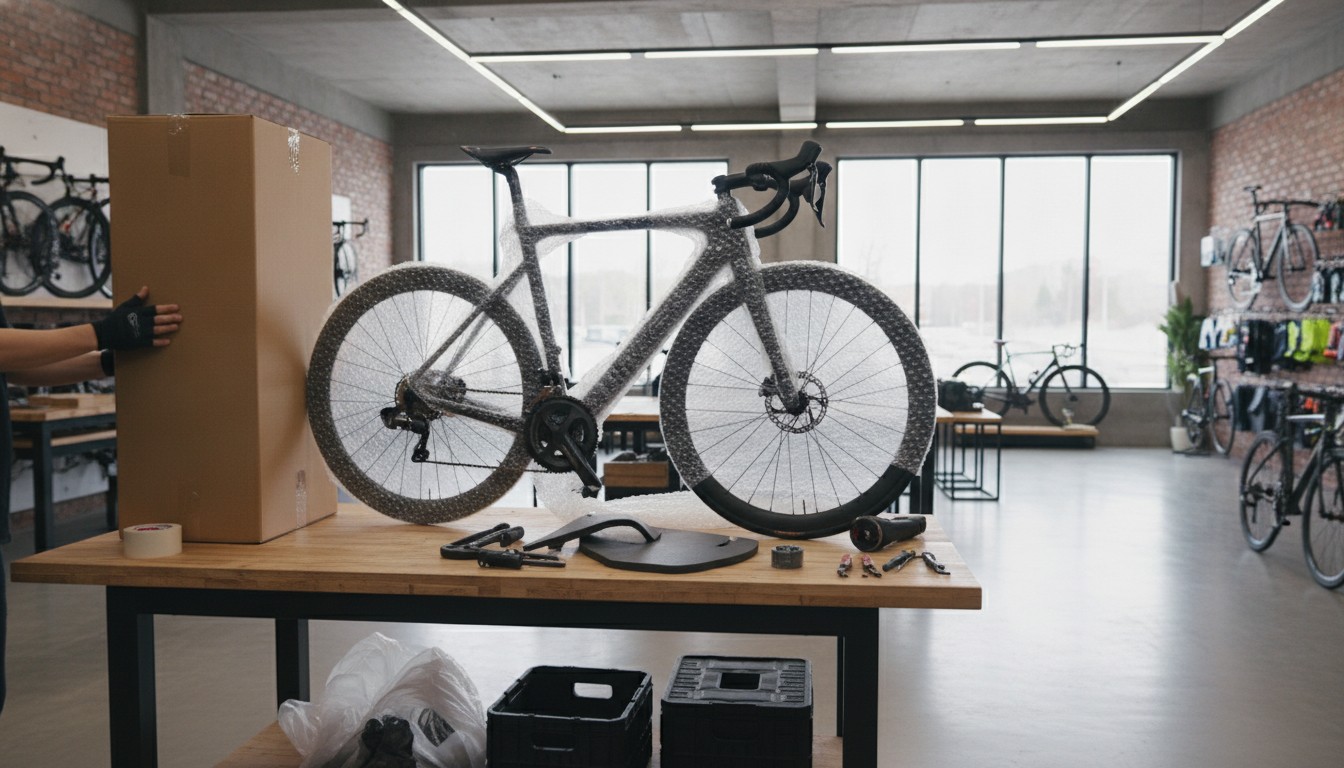
- Front wheel : removed and placed next to the frame, with a fork spacer to prevent it from being crushed.
- Pedals : Unscrewed and packed separately (note: the left pedal's thread loosens when turned clockwise).
- Handlebars : mounted parallel to the frame or detached from the stem and attached along the top tube.
- Saddle and seat post : lowered or removed to reduce the height of the box.
- Rear derailleur : Ideally, it should be unscrewed and wrapped; this is the part that is most often damaged.
Protection
Wrap the frame in foam tubing or bubble wrap, protect the fork and dropouts with spacers, and secure loose parts in a secondary box attached to the inside. A new double-wall corrugated bike box costs between 25 $ and 40 $ at a packaging retailer; many bike shops also give away the boxes from their new bikes for free, which is a cost-effective and eco-friendly option.
Comparison of Transportation Options in 2026
The rates below are approximate for a packaged bicycle (approximately 135 x 20 x 75 cm, 15 kg actual weight) shipped between two major Canadian cities. Actual prices vary depending on distance, the service selected, applicable surcharges, and your rate agreement.
| Option | Estimated cost | Typical turnaround time | Good to Know |
|---|---|---|---|
| Canada Post (Standard Package) | 60 $ – 100 $ | 3 to 9 business days | The limit for the standard shipping plan is 96 cm for the longest dimension: most bike boxes exceed this limit, so be sure to check before you go |
| Purolator | 90 $ – 160 $ | 1 to 5 business days | Non-standard fees may apply; good national network |
| UPS / FedEx (ground) | 90 $ – 180 $ | 1 to 6 business days | Additional handling fees are almost always charged for a bike box |
| Specialized Bicycle Services | 150 $ – 300 $+ | 2 to 7 days | Hard case provided or collected upon arrival, appropriate insurance, ideal for high-end bicycles |
For an entry-level or mid-range bike, shipping via a general carrier with proper packaging still offers the best value for the money. For a carbon bike costing several thousand dollars, the declared value and the quality of the packaging matter more than a few dollars’ difference in the base rate.
Insurance and Declared Value: Don't Skip This Step
The liability coverage included by default by most carriers is limited (often around 100 $). For a bike worth 800 $, 2,000 $, or more, declare the actual value and pay the insurance surcharge, which is usually a few dollars per 100 $ of value. Take a photo of the bike before packing it and keep your proof of purchase: in the event of a claim, these documents make all the difference.
Five Mistakes That Drive Up Your Bill
- Choosing a box that's too big : Each additional centimeter increases the billed volumetric weight.
- Leave the box «half empty» : The contents shift around, the risk of breakage skyrockets, and claims for poor packaging are often denied.
- Pay the retail price at the counter : The prices listed in stores are often 10 to 50 % higher than the negotiated prices available through a reseller or shipping platform.
- Forget about extraordinary expenses : Compare the total price (including surcharges), not just the base fare.
- Shipping an electric bike battery without taking the proper precautions : Lithium batteries for electric-assist bicycles almost always exceed 100 Wh and are subject to dangerous goods regulations. They must often be shipped separately via a certified carrier and must never be packed inside the bicycle box without proper declaration.
Shipping a Bike Internationally
For shipments to the United States or Europe, in addition to logistics, you’ll need to provide customs documents: a detailed description («used bicycle,» actual value), HS code, and commercial invoice. Since the exemption ended de minimis In the United States, even a low-value used bicycle shipped to the U.S. must be fully declared. Allow for additional processing time and check the applicable duties before shipping.
Conclusion: Plan ahead, pay less
Shipping a bike to Canada is no big deal once you know the ropes: a properly sized box, careful disassembly, an appropriate declared value, and—most importantly—a comparison of total prices among carriers, including surcharges.
At Shipping Store, we help individuals and small businesses ship their bulky packages—including bicycles—at the best price, with rates negotiated with major carriers and a professional in-store packing service. Get your quote in just a few minutes and ship your bike with peace of mind.
The rates mentioned in this article are for reference only and vary depending on the carrier, the service, the destination, and your rate agreement.




 French
 English
 Spanish