
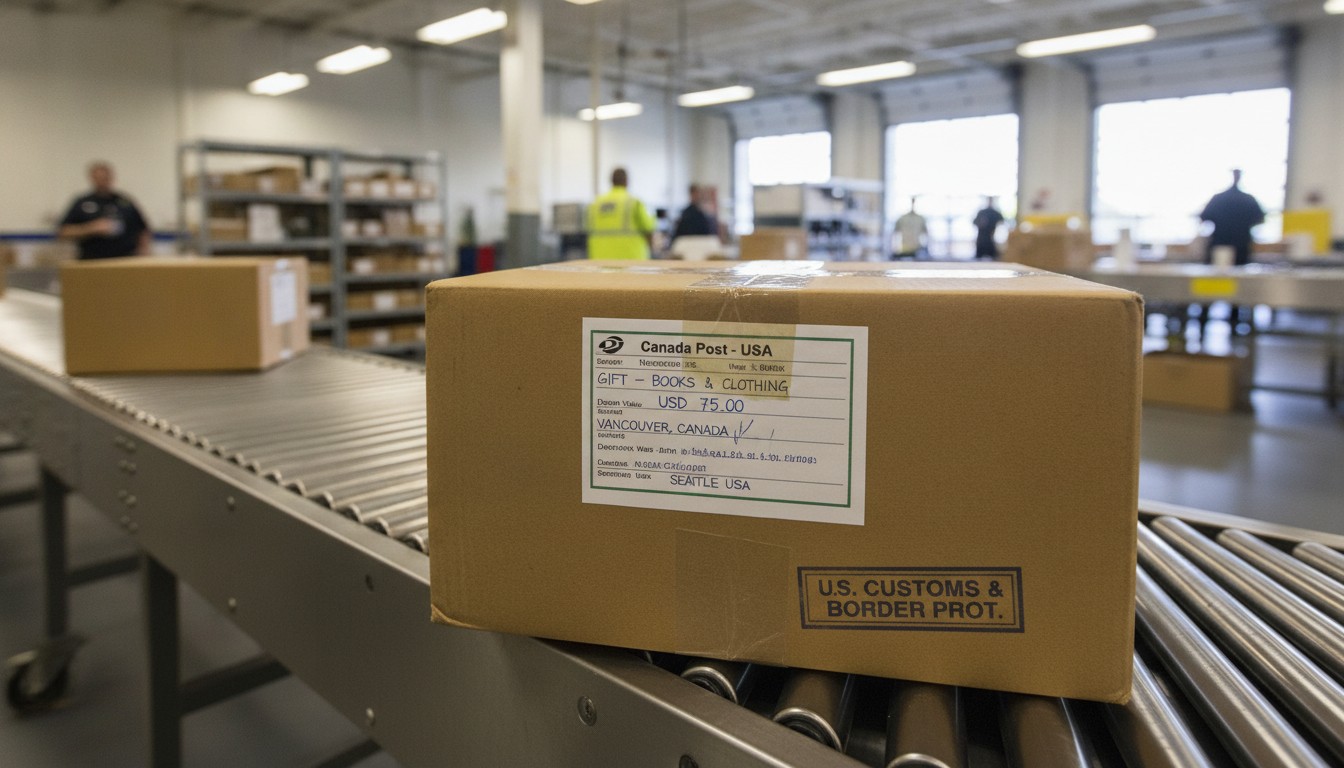
For years, shipping a package weighing less than 800 grams to the United States was almost as simple as sending a domestic package: no duties, minimal paperwork, and fast delivery. Those days are gone. Since the U.S. presidential executive order took effect on August 29, 2025, and was subsequently extended by a new executive order in February 2026, the «de minimis» exemption has been completely suspended. Every package crossing the border, regardless of its value, must now be subject to a full customs declaration.
For a Canadian small or medium-sized business—especially if a significant portion of your sales comes from U.S. customers—this change is not just a minor administrative detail. It’s a fundamental shift in your business model. Here’s what you need to know, along with three practical strategies for adapting without losing your U.S. market.
What exactly is the «de minimis» exemption?
The expression comes from Latin the law does not concern itself with trifles — «The law does not concern itself with trivial matters.» In international trade, this is a threshold below which a shipment enters a country duty-free and with simplified customs clearance. In the United States, this threshold was set at $800 per shipment per recipient per day. This is what allowed a Quebec-based seller on Shopify to ship directly to a customer in Boston or San Diego, at a lower cost and without customs hassles.
What has changed, and when
- May 2025 : Shipments from China and Hong Kong will no longer be exempt.
- August 29, 2025 : Presidential Decree 14324 suspends the exemption for all countries of origin, including Canada.
- February 20, 2026 : A new executive order extends the suspension, confirming that it is no longer a temporary measure.
Specifically, all commercial shipments to the United States—regardless of value, origin, or shipping method (postal or courier)—now require a complete customs declaration: a detailed commercial invoice, Harmonized System (HS) codes, declared value, country of origin, and payment of applicable duties.
The Impact on Canadian SMEs
According to a recent analysis, 73% of Canadian Shopify stores ship at least some of their orders to the United States. For many small and medium-sized businesses—particularly those specializing in handmade goods, clothing, cosmetics, or niche products—U.S. customers account for 50% to 80% of revenue. Even a giant like Lululemon, which shipped two-thirds of its U.S. orders from Canadian warehouses, estimated the impact at $240 million in gross profit.
The direct consequences for your business:
- Customs duties payable on each shipment (the rate varies depending on the product's HS code).
- Brokerage fees charged by the carrier for customs clearance, often between 10 and 30 per shipment.
- Longer transit time, due to customs processing.
- Risk of unpleasant surprises for the customer if the charges are collected upon delivery.
- No more paperwork with each shipment (commercial invoice, HS code, certificate of origin).
Three strategies for adapting
1. Absorb the costs and keep your prices the same
The simplest option in the short term: continue to show the same prices to your U.S. customers, but absorb the new costs within your margin. This is feasible if your gross margin is wide enough and your product faces little direct competition.
Be careful, though: a product whose margin drops from 45% in Q1 to 28% in Q1 quickly becomes unprofitable once marketing and return costs are factored in. Do the math before you commit.
2. Switch to DDP mode with a courier service
The Incoterm DDP (Delivered Duty Paid) means that you, the sender, pay the duties and taxes in advance. The carrier—UPS, FedEx, DHL, Purolator International—handles customs clearance and charges everything to your account.
Benefits: U.S. customers receive their packages at their doorstep with no hidden fees, their shopping experience remains seamless, and your return rate for «payment refusal» drops to zero. You can then pass on the cost either in the product price or in the shipping fees displayed at checkout. Transparency is better for business than unpleasant surprises.
If your product is eligible, be sure to take advantage of the’Canada–United States–Mexico Agreement (USMCA) : With a valid certificate of origin, a product manufactured in Canada can enter the United States duty-free. You then pay only brokerage fees and applicable taxes, not the customs duty.
3. Move part of your inventory to the United States
For small and medium-sized businesses with a steady volume of shipments to the U.S. market (say, 100 shipments per week or more), it makes economic sense to transfer part of their inventory to a U.S. 3PL warehouse. Once you’ve crossed the border via consolidated shipping—a single customs clearance for hundreds of products—you ship to your U.S. customers just like a local merchant.
The result: delivery in 1 to 4 days, no hidden fees for the customer, and the ability to offer «free» shipping—which is now the norm on Amazon. The initial cost (3PL fees, remote management) pays for itself quickly if there’s enough volume.
Checklist for your upcoming shipments to the United States
- Is the HS code for each product up to date in your system?
- Does your commercial invoice show the actual value in USD or CAD?
- If your product is Canadian, do you have an ACEUM certificate of origin?
- Have you decided between DDP and DDU (and is this clear to the customer)?
- Does your return policy take the new customs fees into account?
- Do the prices listed on your website reflect the new reality?
- Can your carrier handle customs clearance on your behalf?
How Expert Shipping Can Help You
At Expert Shipping, we see Quebec SMEs adapting to this new reality every day. Our team can help you choose the right carrier based on your shipping profile, prepare your customs documents, optimize your HS codes, and even negotiate competitive DDP rates.
Stop by our store or contact us: we’ll assess your situation for free and recommend the most cost-effective solution to maintain—and grow—your sales in the United States despite the end of the de minimis.
This article is updated as regulations change. Last updated: May 2026.

 French
  English
  Spanish