
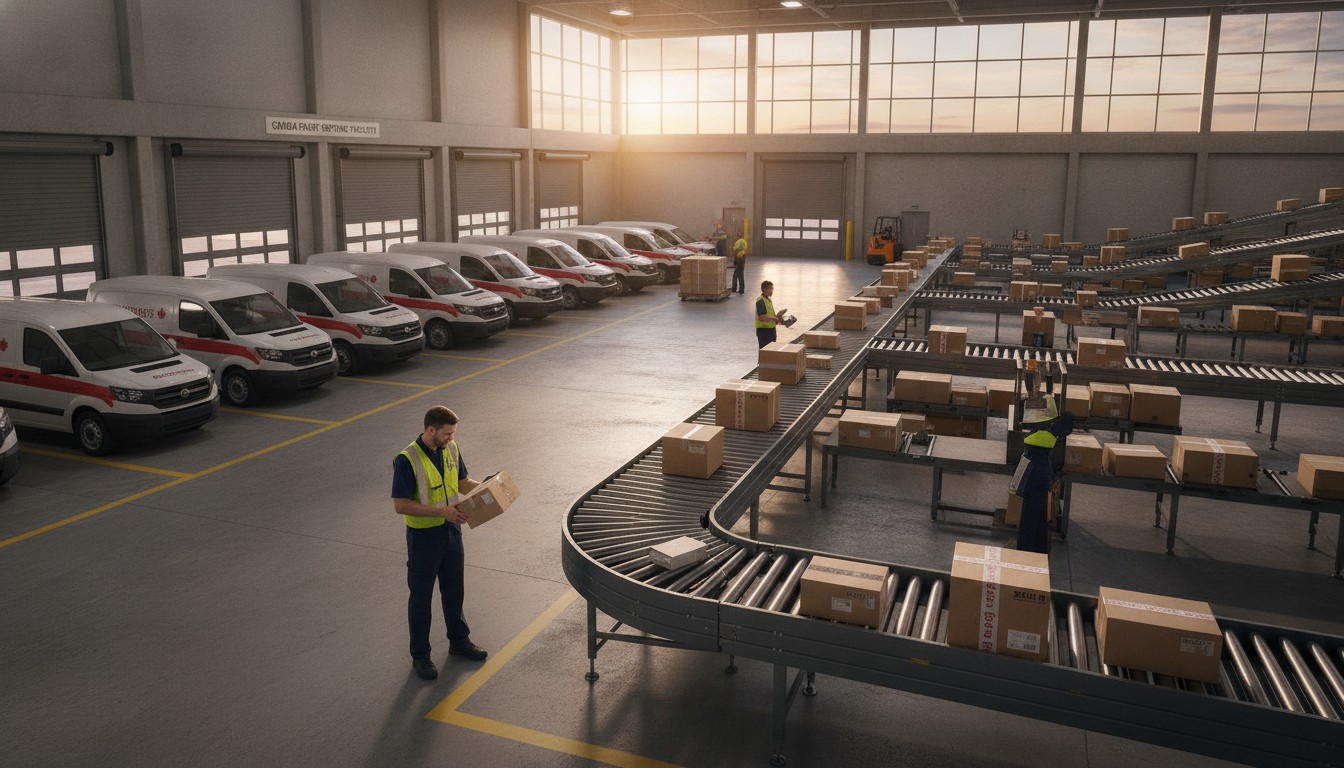
You're comparing two identical packages: same weight, same box, same carrier. One costs 12 $, the other 29 $. The difference isn't in the service or the speed—it's the shipping zone. It is the most decisive pricing factor in Canada, and yet it is the one that most small and medium-sized businesses never consider.
In 2026, with across-the-board increases of 5.9 % at UPS, FedEx, and DHL, and 5.7 % at Purolator, each zone crossed costs more than before. The same zone error occurs on hundreds of packages each month—and quickly adds up to thousands of dollars a year.
Here's how zones actually work in Canada, how much they cost you, and seven practical strategies to lower your average zone without changing your products or customer base.
What is a shipping zone in Canada?
A shipping zone is a distance range between the pickup location (or the carrier's origin terminal) and the destination ZIP code. The farther the distance, the higher the base rate—regardless of weight.
Each Canadian carrier follows its own logic:
- Canada Post uses a rate schedule based on province and distance bracket. Intra-provincial shipments are billed at the lowest rate; shipments to the territories and northern regions are at the top of the rate schedule.
- Purolator combines an origin-destination matrix by region (Quebec, Ontario, West, Atlantic, North) with its own mileage bands.
- UPS and FedEx In Canada, a system of numbered zones is used—generally numbered 1 through 9 for domestic mail—based on the first three characters of the origin and destination ZIP codes.
The common factor: the area is determined by the pair origin-destination, not just by destination. Two different warehouses shipping to the same customer may be located in two separate zones.
Zone and remote zone overload: two different things
Many shippers confuse the two. The area is included in the base rate. The overload in a remote or extensive area (5 to 15 $, depending on the carrier) is a fixed amount added on top for ZIP codes outside major urban corridors. A package may therefore be in a high-rate zone and incur the surcharge: the two are added together.
What a zone jump Really Costs
Here is an estimate for a 2-kg package sent via standard ground shipping from Montreal. These figures are approximate and may vary depending on your contract, the service you choose, and the time of year.
| Destination | Distance Marker | Estimated Base Rate | Difference from the lowest zone |
|---|---|---|---|
| Laval, QC | Intraprovincial Court | 11 to 14 $ | — |
| Toronto, ON | Neighboring province | 15 to 19 $ | +35 % |
| Winnipeg, MB | Medium distance | 19 to 25 $ | +70 % |
| Vancouver, BC | Transcontinental | 24 to 32 $ | +110 % |
| Whitehorse, YT | North + remote area surcharge | 38 to 55 $ | +250 % and above |
The difference between the lowest and highest points therefore regularly exceeds 110 % on the base rate for an identical package—and up to 250 % northbound. And since the fuel surcharge is calculated based on percentage In addition to the base rate, a high-zone rate also automatically increases the fuel charge.
The Multiplier Effect We Tend to Forget
Let's take an SME that ships 400 packages per month with a high average zone. Lowering the average zone by just one level results in savings of about 3 to 4 $ per package, or 1,200 to 1,600 $ per month, or 14,000 to 19,000 $ per year. Without negotiating a single line of the contract.
How to Find Out Which Zone You're Actually Shipping To
Most small and medium-sized businesses don't know their average zone. To calculate it, export three months' worth of shipping invoices and add three columns: destination ZIP code, billed zone, and total cost. Then look at the breakdown.
Three warning signs:
- More than 30 % of your packages are being shipped to the two areas farthest from your network.
- Your average cost per package has increased even though the average weight has remained the same: your zone mix has shifted.
- The same region keeps coming up with a remote-area overload: there may be a regional carrier that is better positioned.
7 Ways to Lower Your Average Zone in 2026
1. Ship from the right origin
The zone depends on the origin. An SME in Quebec City that sells primarily in Ontario pays for one more zone than a competitor that drops off its packages in Montreal. Dropping off your shipments at a drop-off location closer to the main corridor may be enough to drop down one zone.
2. Combine your multiple orders
Two packages to the same customer means two base rates for the high-zone category. A single consolidated package means a single base rate, a single residential surcharge, and a single fuel surcharge. For a transcontinental shipment, consolidation often saves 15 to 25 $.
3. Use the right carrier for each region, not just one for everything
Canada Post remains highly competitive for long-distance shipments and small, lightweight packages, particularly to regional areas. Purolator and regional carriers are often better for the Quebec-Ontario corridors. A multi-carrier strategy that compares rates for each shipping label automatically selects the best price for each zone.
4. Bring your inventory closer to your customers
If 40 % orders are shipped to the West, a forward storage facility in Calgary or Vancouver reduces the shipping distance from a transcontinental area to a local one. The break-even point is often around 300 to 500 orders per month to that region.
5. Adjust your free shipping thresholds by region
A single, Canada-wide free shipping threshold means your Montreal customers are effectively subsidizing your shipments to Vancouver—or eroding your profit margins. A region-specific threshold protects profitability without driving away local customers.
6. Verify the ZIP codes before printing the label
An incorrect ZIP code doesn’t just trigger address correction fees ranging from 20 to 26 $—it can also result in the package being re-billed at a higher rate. Validating the address at the time of order resolves both issues at once.
7. Negotiate targeted discounts for your highest-volume areas
Negotiated discounts are often applied by zone groups. If 60 % of your volume is destined for two specific zones, ask for a more aggressive discount. in those areas rather than a lower overall percentage. Carriers are more willing to accept a targeted concession.
The Most Costly Zone Errors
- Compare carriers within a single area. A carrier that's unbeatable for short-distance shipping may be the most expensive for transcontinental shipping. Compare based on your actual shipping mix, not on a typical package.
- Ignore the volumetric weight in high-altitude areas. A box that's too big for a shipment to Vancouver costs twice as much: inflated billable weight and high zone rate.
- Forget about the fuel surcharge. Calculated as a percentage, it increases the cost of each dollar of the zone fare. Two more zones also mean more fuel charges.
- Ignore peak periods. From October through January, high-season surcharges are added to the already high zone rate.
Take action before the peak season
The good news about zones is that they’re predictable. Unlike fuel costs or general price increases, you can model them, measure them, and reduce them—using your own billing data.
Start with a simple exercise this week: calculate your average margin over the last 90 days, then identify the 20 % ZIP codes that generate the highest costs. That’s where you’ll find the quickest savings.
At Shipping Store, we compare rates from Canada Post, Purolator, UPS, FedEx, and DHL zone by zone for each shipment, so your packages are always sent at the best available price. Request a free analysis of your shipping zones and see how much you could recoup before the 2026 peak season.
Note: The amounts listed are for reference only and may vary depending on your commercial agreement, the service selected, the actual and volumetric weight, the time of year, and any applicable surcharges. Always confirm rates with your carrier or shipping partner.

 French
  English
  Spanish