
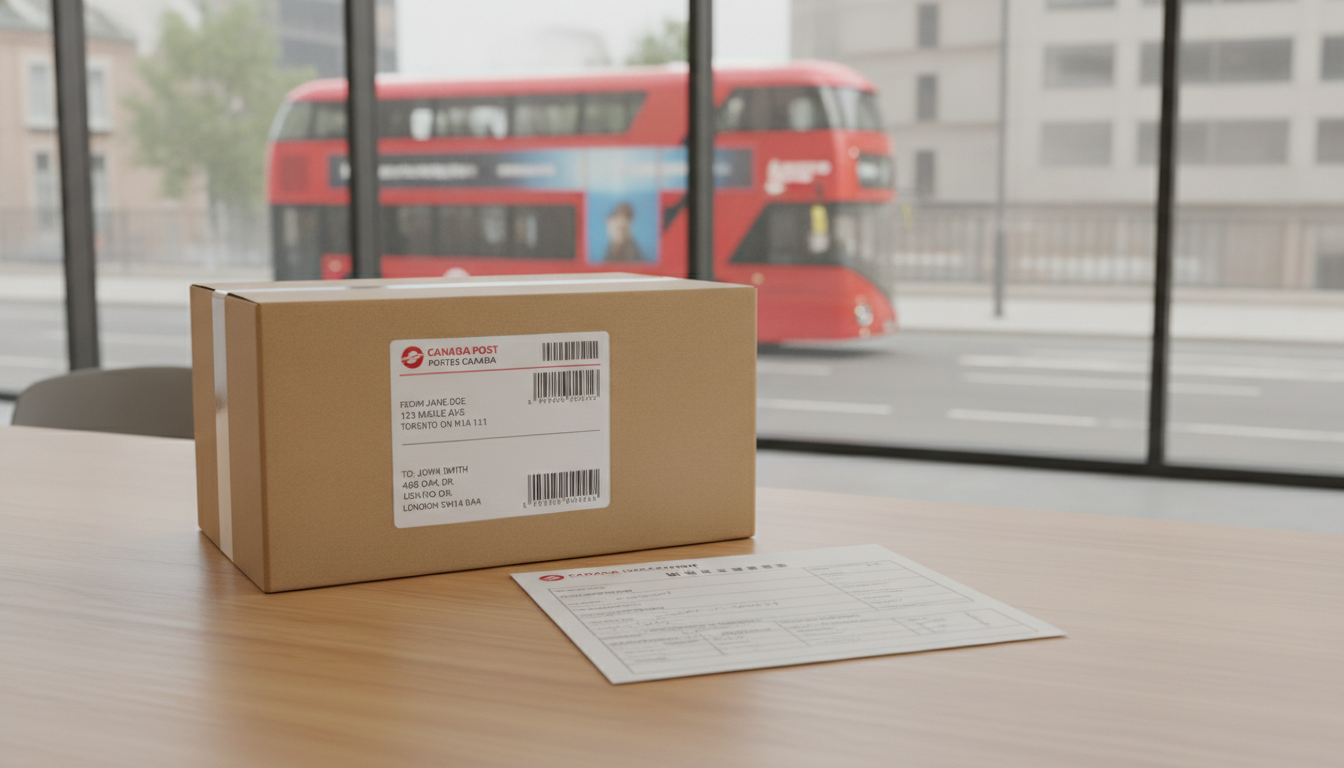
The United Kingdom remains one of the top three export markets for Canadian SMEs outside North America. However, it is also one of the destinations where packages are most frequently held up at customs due to incorrect declarations. UK regulations differ from those of both the United States and the European Union, and many Canadian shippers instinctively apply the wrong parameters.
Since Brexit, the United Kingdom has been managing its own customs tariff, its own value threshold, and its own import VAT system. A package that would pass through to Paris without a hitch could be held up in London for purely administrative reasons.
Here’s what a Canadian small business needs to master by 2026 in order to ship to the United Kingdom without any unpleasant surprises—neither for her nor for her client.
The £135 threshold: the rule that changes everything
The key figure is £135—the value of the goods, excluding shipping and insurance. This is what determines which collects VAT and when.
For orders under £135, UK VAT at a rate of 20 % is due at the time of sale, and the foreign seller is responsible for collecting it and remitting it to HMRC. This requires being registered for VAT in the United Kingdom. For amounts over £135, VAT and any applicable duties are collected at the border by the carrier, who adds its own handling fees.
Please note: The handling of low-value shipments is subject to announced changes on the British side, similar to the elimination of the de minimis threshold in the United States and the €150 threshold in Europe. Before shipping a large volume, confirm the current rules with HMRC or your customs broker—these are the kinds of regulations that can change from one quarter to the next.
An example with figures
| Position | £100 package | £300 package |
|---|---|---|
| Value of Goods | 100 £ | 300 £ |
| Customs Duties (under CETA, Canadian Origin) | 0 £ | 0 £ |
| VAT 20 % | £20 (collected at the time of sale) | £60 (collected at the border) |
| Carrier's customs clearance fees | 0 $ | 15 $ to 25 $ (typical) |
| Who pays upon delivery? | No one | The consignee, except in DDP |
These amounts are for reference only and vary depending on the carrier, the service, and the negotiated agreement.
CETA: Your Best Tool—If You Ask for It
The Comprehensive Economic and Trade Agreement between Canada and the United Kingdom maintains zero or reduced tariffs on the vast majority of goods of Canadian origin. This provides a real competitive advantage over Asian or American sellers.
But this benefit is never automatic. It requires a Declaration of Origin on the commercial invoice, using the required wording and your business number. Without this information, the carrier will apply the standard rate, and recovering the difference afterward requires filing a formal claim with HMRC—a lengthy process that is rarely worthwhile for a single package.
There are two conditions to verify: the product must actually meet the rules of origin (simply reshipping Chinese goods does not qualify), and you must be able to document that origin if HMRC challenges it within five years.
The Commercial Invoice: Five Costly Mistakes
- Vague description. «Clothing» or «items» isn't enough. Write «men's cotton shirt, long sleeves, 60% cotton, 40% polyester.».
- HS code is missing or consists of only 6 digits. Provide the most accurate tariff code possible; an incorrect code may cause a product to be reclassified from a zero rate to 12 %.
- Understated value. Reporting 20 $ for an item sold for 200 $ is a violation, not a loophole. HMRC compares this with your sales records.
- The word «gift» on a commercial shipment. The British gift tax exemption applies only to transactions between individuals, without consideration.
- EORI number missing. The British business recipient needs it; without it, the package will be held up.
DDP or DAP: Who Pays the Bill?
With DAP, the recipient receives a payment notice before delivery. For online sales, this is the most damaging scenario for the customer experience: the package refusal rate rises significantly, and you end up paying for the return shipping.
With DDP, you prepay duties, VAT, and customs clearance fees. The unit cost goes up, but the package arrives without a hitch. For an average order value exceeding 150 $ CA, DDP is almost always the best option once returns and customer service are factored in.
Realistic delivery times from Canada
| Type of service | Estimated timeframe | Follow-up |
|---|---|---|
| International Express | 2 to 4 business days | Comprehensive, from start to finish |
| Standard / Priority | 6 to 12 business days | Full |
| Economy / Postal | 10 to 21 business days | Part-time, depending on the department |
Add 1 to 3 business days if the package is held for customs inspection. The delivery times listed above are estimates and depend on the carrier, the season, and the point of origin.
Items to Watch
Certain products require additional preparation: cosmetics (compliance with the UK Cosmetics Regulation and a responsible person in the United Kingdom), food products, wood products, leather goods, and items containing lithium batteries. Alcohol and tobacco are subject to a separate excise tax regime and are generally not eligible for standard package shipping.
What You Need to Set Up Before Your First Mailing
- Check whether your annual sales volume requires you to register for UK VAT.
- Classify each product with a validated HS code, once and for all.
- Create a commercial invoice template that includes the CETA declaration of origin.
- Choose between DDP and DAP and clearly display the choice at the checkout.
- Compare at least two carriers: for this destination, the differences in customs clearance fees often exceed the difference in shipping rates.
In a nutshell
Shipping to the United Kingdom from Canada isn’t complicated—it’s just different. The £135 threshold, the CETA Certificate of Origin, and the choice between DDP and DAP are the three factors that determine the profitability of your shipments. A well-drafted commercial invoice alone resolves the majority of issues.
Want to compare your options and actual rates for travel to the United Kingdom? The team at’Shipping Store analyzes your shipments and recommends the carrier-service combination best suited to your volume.

 French
  English
  Spanish