
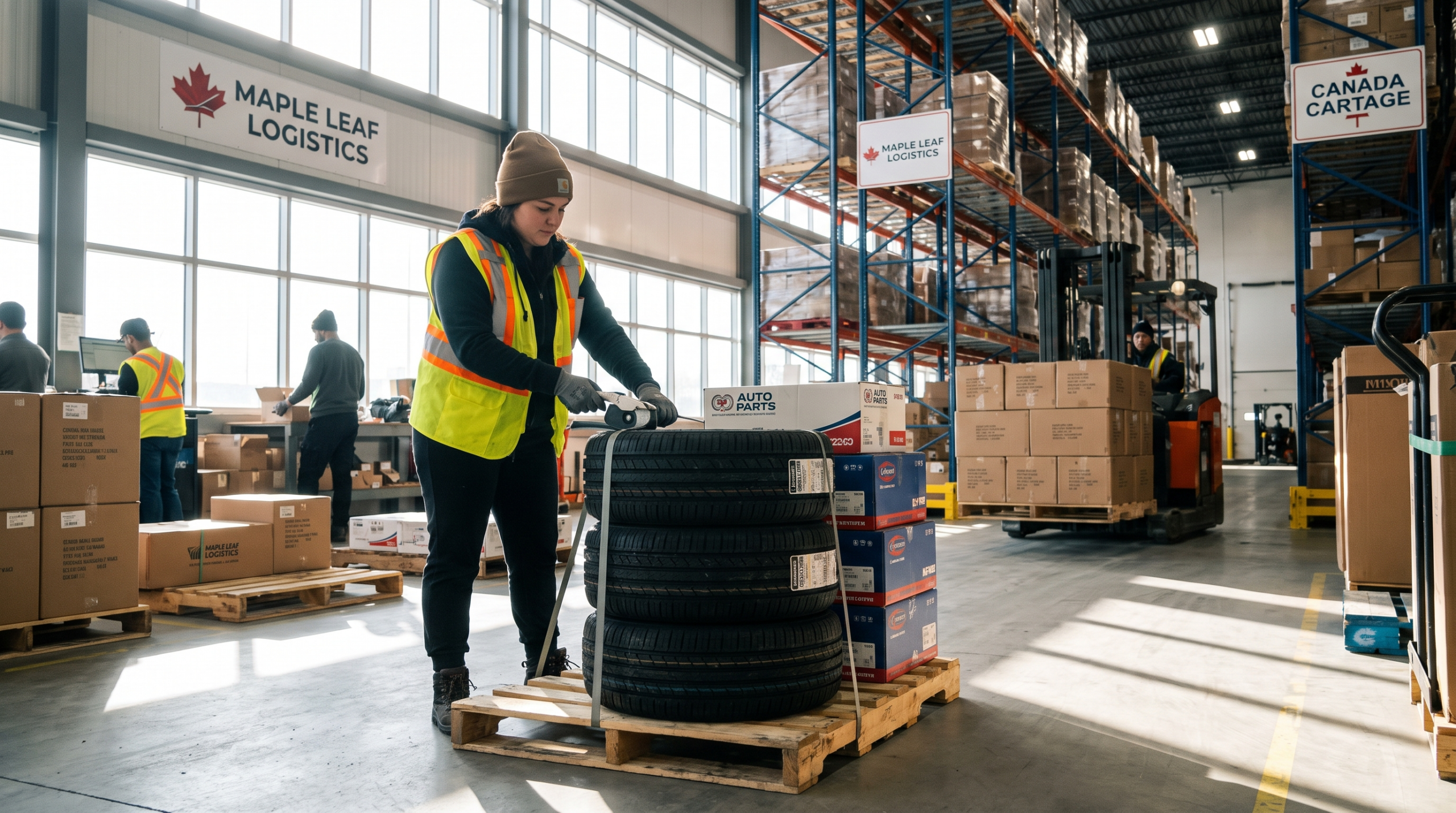
Auto parts are among the goods most heavily penalized by carriers’ rate schedules. A bumper measures 1.5 meters but weighs 6 kilograms. A set of four tires weighs more than 60 kilograms and arrives as unpackaged cylindrical packages. An engine block fits into a small box but packs 45 kg into a space just 30 centimeters wide. Each of these profiles triggers a different surcharge.
The result: many Canadian auto repair shops, parts recyclers, and online retailers are paying two to three times the base rate without ever understanding why. In 2026, with announced rate increases ranging from 5.7 % to 5.9 % at FedEx, UPS, and Purolator—and a real impact of 8 % to 12 % per package once surcharges are stacked—the profit margin quickly vanishes on a part sold for 80 $.
This guide breaks down the actual costs involved in shipping auto parts and tires within Canada, as well as practical ways to reduce them.
Why Is It More Expensive to Ship Auto Parts?
Three factors almost always come into play with this type of merchandise.
1. Density
Carriers charge based on the greater of the actual weight or the volumetric weight (length × width × height ÷ conversion factor). On the Canadian courier network, this calculation increases the bill by an average of 15 % to 20 %. For an auto body part—hood, fender, bumper, door panel—the discrepancy is much more extreme: a box measuring 120 × 60 × 25 cm containing 7 kg of plastic may be billed as 30 kg or more.
2. Additional handling
In 2026, a package will incur additional handling fees as soon as it exceeds one of these thresholds at FedEx or UPS:
- length greater than approximately 48 inches (122 cm);
- a second dimension greater than approximately 30 inches (76 cm);
- weighing more than 50 lb (about 23 kg);
- non-corrugated packaging, strapped packaging, or cylindrical surfaces—which directly targets the tires, exhaust pipes, and buckets;
- a cubic volume exceeding approximately 10,368 cubic inches, a threshold that will be lowered in 2026.
Allow approximately 33 $ per package, ranging from about 19 $ to 58 $ depending on the zone and service. A tire shipped bare—without a box—meets two criteria on its own.
3. Dimensional rounding
A subtle but costly change: carriers now round up any fraction of an inch. A box measuring 48.2 inches is billed as 49 inches—and falls into the «oversized» category. For long items, a single centimeter of incorrectly sized packaging makes the difference between the standard rate and a surcharge of 33 $.
The Five Part Profiles and the Correct Shipping Method
| Room Type | Cost Profile | Recommendation 2026 |
| Small parts (filters, sensors, chips) | Lightweight and compact | Standard package, custom-sized box. Be sure to check the minimum billable weight. |
| Heavy, compact parts (alternators, calipers, discs) | Heavy; may weigh more than 23 kg | Packages: Split them into shipments weighing less than 22.5 kg to stay below the handling threshold. |
| Body parts (hoods, bumpers, fenders) | Bulky and lightweight | Dominant volumetric weight: Estimate the pallet size based on 2–3 pieces. |
| Tires (single tire or set) | Cylindrical, bulky | Still in corrugated boxes. A set of 4 fits on a pallet. |
| Engines, transmissions, axles | Very heavy | LTL pallets are required for shipments weighing more than 68 kg. |
The pivot point to the palette
The rule of thumb in Canada: Starting at 68 kg or three boxes shipped to the same address, always request a less-than-truckload (LTL) quote in addition to the package rate. For auto parts, LTL is often more cost-effective than you might think, because it doesn’t charge for additional handling, oversize surcharges, or volumetric weight in the same way.
In practical terms, four winter tires weighing 12 kg each, shipped in four separate packages, result in four handling surcharges (totaling 130 $ or more even before transport). The same four tires strapped to a half-pallet constitute a single shipment, priced based on the actual weight of the pallet.
The next threshold—the transition to full truckload (FTL)—is generally around 10 to 12 pallets. Below that, LTL remains the more cost-effective option.
Pack Your Way Out of the Surcharge
Packaging isn't an expense; it's a direct pricing lever.
- Put the tires in the box. A corrugated cardboard tire box negates the «cylindrical surface» criterion. The cardboard costs a few dollars; the surcharge costs thirty.
- Cut to the correct length. If your room measures 118 cm, don't buy a 125 cm box—you'll be paying for 7 cm of potential excess. Measure the box when it's closed and inflated, not when it's flat.
- Drain all fluids. Any part containing residual oil, fuel, or brake fluid is considered a hazardous material. A used engine must be drained and the process documented.
- Lock the content. A loose metal part punctures the box during transit, and you lose your claim: carriers refuse to cover damage caused by inadequate packaging.
- Protect painted surfaces. Apply foam film followed by double-wall corrugated cardboard to painted body panels; even a single scratch can ruin the resale value.
Compliance Pitfalls to Be Aware Of
Some auto parts are not considered standard packages:
- Airbags and seat belt pretensioners : Classified as dangerous goods (pyrotechnic safety devices). They require an authorized carrier account and TMD documentation.
- Lithium Batteries for Hybrid and Electric Vehicles : Class 9, with labeling rules that change at 1er January 2027. Both versions of the label remain valid through December 31, 2026.
- Used fuel tanks, pumps, and fuel lines : Flammable residues. Cleaning and purging documented prior to shipment.
- Gas shock absorbers and compression springs : often subject to the rules governing compressed gases.
- Imported Tires : The CBSA has specific documentation requirements for importing tires. Check the classification before promising a delivery date to a customer.
Three Ways to Save Money Right Away
Compare rates before every large shipment. The differences between carriers for oversized items are much greater than for standard packages. The weight of a single axle can vary by 60 % from one carrier to another, depending on the region.
Group orders for the same customer. A shop that places orders with you three times a week should receive a consolidated shipment. You'll eliminate two fixed costs and two potential surcharges.
Use a freight forwarder. An SME that ships between 50 and 500 packages per month can, through an intermediary, obtain rates normally reserved for high-volume shippers—with typical savings of 20 % to 35 %. For auto parts, where the base price is already high, the absolute savings per shipment are considerable.
The amounts listed are for reference only and vary depending on the commercial agreement, the service selected, the destination, and the fuel surcharge in effect at the time of shipment.
In a nutshell
Shipping auto parts and tires to Canada in 2026 hinges on three decisions: the right packaging (to meet weight limits), the right shipping method (packages under 68 kg, pallets for heavier loads), and the right rate (systematic comparison rather than a detailed rate schedule). Companies that follow these three rules save between 20 % and 35 % on their shipping costs without changing a single operational process.
Do you regularly ship heavy or oversized items? Request a rate comparison on Expert Shipping and find out in just a few minutes what your shipments should actually cost.

 French
  English
  Spanish