

A guitar, a violin, a saxophone, or a stage keyboard doesn’t behave like an ordinary package. It’s a long, hollow object that’s often fragile when under tension, and whose replacement value far exceeds the carriers’ automatic coverage. Every year, Canadian musicians, instrument makers, and music retailers learn the hard way that the problem is almost never the shipping itself—it’s the packaging and declaration.
The good news is that ship a musical instrument Avoiding damage or unpleasant surprises depends on a handful of decisions made even before the label is printed. The choice of box, how the ropes are tensioned, the declared value, and the shipping service selected make all the difference between a 60 $ shipment that arrives intact and a 2,000 $ claim that is denied.
This guide provides a comprehensive overview of the issues for 2026: how to pack different types of instruments, what surcharges apply to long packages, what carrier insurance actually covers, and how to compare shipping options within Canada and to other countries.
Why Musical Instruments Cost More to Ship
Three factors are driving prices up, and their effects are cumulative.
The length. An acoustic guitar case is typically between 105 and 115 cm long. Once packed in an outer box, the longest side often exceeds 120 cm. This is precisely the threshold at which carriers begin to charge additional handling fees.
Volumetric weight. A guitar in its case rarely weighs more than 7 to 9 kg. But a box measuring 125 × 45 × 20 cm has a volumetric weight of about 22 kg, based on the 5,000 divisor used by most carriers. You pay for space, not for weight.
The declared value. Automatic coverage is typically around 100 $ for most carriers. An instrument valued at 3,000 $ requires additional declared value, billed in increments of 100 $.
What this means in practice
| Instrument | Typical box dimensions | Actual weight | Volumetric weight | Billed Weight |
|---|---|---|---|---|
| Violin (hard case) | 85 × 35 × 20 cm | 4 kg | ~12 kg | 12 kg |
| Acoustic guitar | 125 × 45 × 20 cm | 8 kg | ~22 kg | 22 kg |
| Electric guitar | 120 × 42 × 18 cm | 9 kg | ~18 kg | 18 kg |
| 88-key keyboard | 145 × 45 × 25 cm | 17 kg | ~33 kg | 33 kg |
| Alto saxophone | 70 × 35 × 25 cm | 5 kg | ~12 kg | 12 kg |
| Combo amplifier | 65 × 55 × 35 cm | 20 kg | ~25 kg | 25 kg |
The figures above are for reference only and vary depending on the instrument model, the case used, and the volumetric divider specified in your service agreement.
The double-box rule: non-negotiable
The most important principle of shipping instruments can be summed up in one sentence: The case is not shipping packaging. A case protects the instrument from impacts during normal handling, but not from a 1.5-meter drop onto a sorting conveyor belt.
The method that works:
- Layer 1 — the instrument. Loosen the strings by half a tone to a full tone. Do not loosen them completely: on an acoustic guitar, completely losing tension changes the pressure on the soundboard and can shift the bridge. Partially loosening them is sufficient.
- Layer 2 — internal shim. Fill the space under the headstock with bubble wrap or a rolled-up towel. This is the number one cause of breakage: the neck breaks at the joint with the headstock because the headstock shifts inside the case.
- Layer 3 — the case. Close and lock it. A soft case (gig bag) is never sufficient for shipping via a carrier.
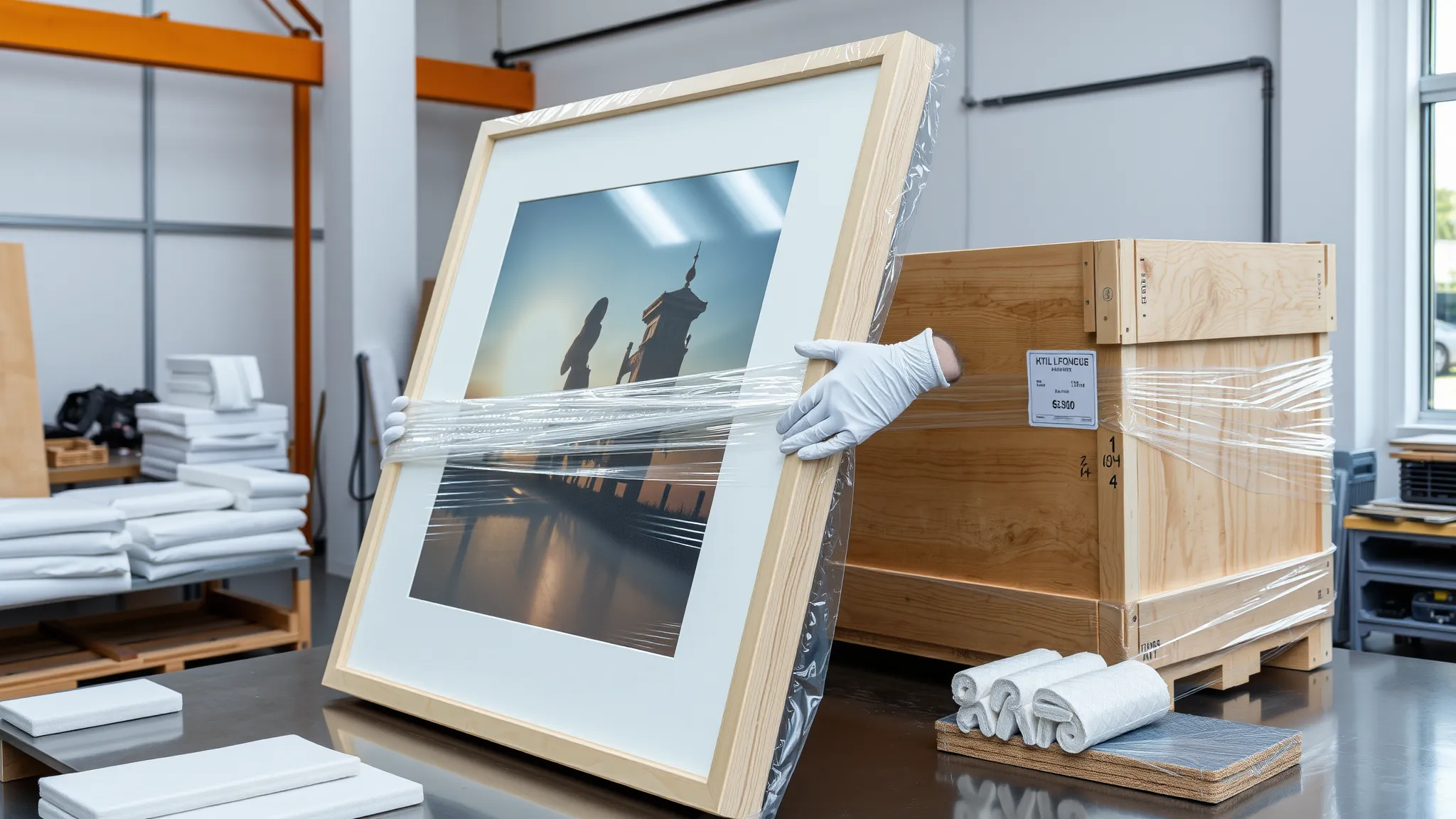
- Layer 4 — the outer padding. At least 5 cm of foam or bubble wrap on all sides, including the ends.
- Layer 5 — the outer box. Double-wall corrugated cardboard. The guitar cases sold by music retailers are designed for this purpose.
Special Cases
Brass and woodwind instruments. Disassemble whatever can be disassembled: nozzle, chamber, barrel. Pack each part separately. Never leave the nozzle attached—it’s the part that bends the breech.
Keyboards and synthesizers. Remove the control panel, the pedal, and the power supply. Protect the pitch and modulation knobs, which stick out and are the first to break.
Bowed instruments. Loosen the bow hair. A taut bow that is subjected to a sudden impact will break the bow stick or split the bow tip.
Tube amplifiers. Remove the light bulbs if you can and pack them separately. Otherwise, the shipment almost always arrives with at least one broken light bulb.
Surcharges that apply to long packages
In addition to the base rate, several fees apply depending on the package’s dimensions. Here are the typical thresholds for 2026 among major carriers in Canada.
| Overload | Usual threshold | Affected instruments | Order of magnitude |
|---|---|---|---|
| Additional handling — length | Longest side > 122 cm | Guitars, 88-key keyboards, double basses | 25 $ to 45 $ |
| Additional Handling — Weight | More than 23 kg per package | Amplifiers, stage keyboards | 25 $ to 45 $ |
| Oversized Packages | Length + circumference > 300 cm | Double basses, harps, flight cases | 100 $ to 180 $ |
| Residential Overload | Home Delivery | All | 5 $ to 8 $ |
| Remote area | Extended ZIP Code | All | 5 $ to 15 $ |
| Declared value | Beyond Basic Coverage | Instruments > 100 $ | ~3 $ per 100 $ |
These amounts are approximate. They vary depending on the carrier, the service, and the negotiated agreement. An important point: additional handling charges and oversize surcharges generally do not apply simultaneously—the higher of the two applies. However, residential and remote area charges are added on top of that.
The Trap of the Box That's Too Big
Many shippers choose an oversized box «just to be safe» and fill it with paper. This is a miscalculation: increasing the longest side from 118 cm to 125 cm pushes the shipment over the threshold for additional handling fees and adds 25 $ to 45 $ to the cost of the shipment, in addition to increasing the volumetric weight. Fit the box to the contents, then pad it with dense foam rather than filler material.
Insurance and Declared Value: What Is Actually Covered
This is the most commonly misunderstood point. A carrier’s declared value is not an insurance policy. It is a liability limit, and that liability includes exclusions.
Exclusions That Hurt:
- Inadequate packaging. If the instrument was shipped without an outer case, the claim will be denied. Almost without exception.
- Antique or collectible instruments. Several carriers exclude or impose strict limits on works of art, antiques, and collectible instruments. An antique violin may fall into this category.
- Internal damage with no external damage to the box. If the box arrives undamaged but the handle is broken, the carrier often concludes that there was a packaging defect.
- Depreciation. Reimbursement is based on the proven market value, not on the price paid or the cost of a new replacement.
For an instrument valued at more than 2,000 $, specialized insurance from a musical instrument insurer or third-party shipping insurance is often less expensive than the carrier’s declared value and offers broader coverage. In any case, take photos of the instrument from all angles before packing it, and then photograph each step of the packing process. Without these photos, a claim will be difficult to process.
Which carrier to choose based on the shipment
| Shipping Type | Often the most advantageous option | Why |
|---|---|---|
| Violin, flute, small woodwinds — domestic | Canada Post or ground service | Below the handling thresholds, the package remains standard |
| Guitar — household | Ground transportation service under a negotiated agreement | The length surcharge applies everywhere: the discount off the base rate makes all the difference |
| Keyboard or heavy amp | LTL pallet if there are multiple pieces | For shipments weighing more than 30 kg, freight rates are often higher than those for packages |
| A highly valuable instrument | Express Service with Signature | Fewer handling steps, less time in the warehouse |
| International | Integrated carrier (DHL, FedEx, UPS) | Managed Customs Clearance, End-to-End Tracking |
The CITES Case: Not to Be Ignored on the International Stage
Many instruments contain materials regulated by CITES: rosewood (Dalbergia), ebony, tortoiseshell, antique ivory, and mother-of-pearl from certain species. Since the 2019 relaxation of regulations, most finished rosewood instruments can be traded without a permit for noncommercial use. However, international commercial sales—or instruments containing ivory or tortoiseshell—still require CITES documentation.
A shipment held at customs for this reason is not only delayed—it may also be seized. If you’re shipping an antique instrument out of Canada, verify its composition with the manufacturer or a luthier before preparing the commercial invoice.
Five Practical Ways to Lower Your Bill
- Adjust the box, not the padding. Every centimeter below the 122-cm threshold is potentially worth 25 $ to 45 $.
- Deliver to a business address or a pickup location. This eliminates clutter in the home, and the instrument is stored inside rather than on the front porch.
- Take apart whatever can be taken apart. A keyboard shipped without a stand or pedals can sometimes reach a volume high enough to move up a level.
- Combine multiple shipments. A retailer who ships three instruments to the same address on the same day should have them priced as a multi-piece shipment.
- Compare before printing. For a long package, the price difference between carriers often exceeds 40 % for the same delivery time, because the handling thresholds and zone schedules are not the same.
Pre-Shipment Checklist
- Strings loosened by a half-tone to a whole tone—not completely loose
- Space under the head of the neck filled in
- Bow relaxed, nozzles and jars disassembled
- Lockable hard case
- At least 5 cm of padding on all sides, including the ends
- Double-wall corrugated outer box, custom-fit
- Dated photos of the instrument and each stage of the packaging process
- Declared value or third-party insurance in place
- Signature upon delivery enabled for orders over 500 $
- For international shipments: commercial invoice, HS code, and CITES verification
Conclusion
Shipping a musical instrument to Canada isn’t rocket science, but there’s no room for improvisation. The case alone isn’t enough, the declared value isn’t insurance, and a few extra centimeters on the box can cost more than the padding itself. Properly executed double-box packaging, dated photos, and the right service ensure the instrument arrives intact at a reasonable price.
At Shipping Store, we regularly pack and ship instruments to musicians, music schools, and retailers across Canada. We compare rates from multiple carriers for the same shipment, we’ll be upfront with you when a handling threshold is about to be exceeded, and we prepare customs documents for international shipments.
Do you have an instrument to ship? Request a quote at expertshipping.ca and we'll tell you exactly how much shipping will cost—including any surcharges—before you pay.
 French
  English
  Spanish