
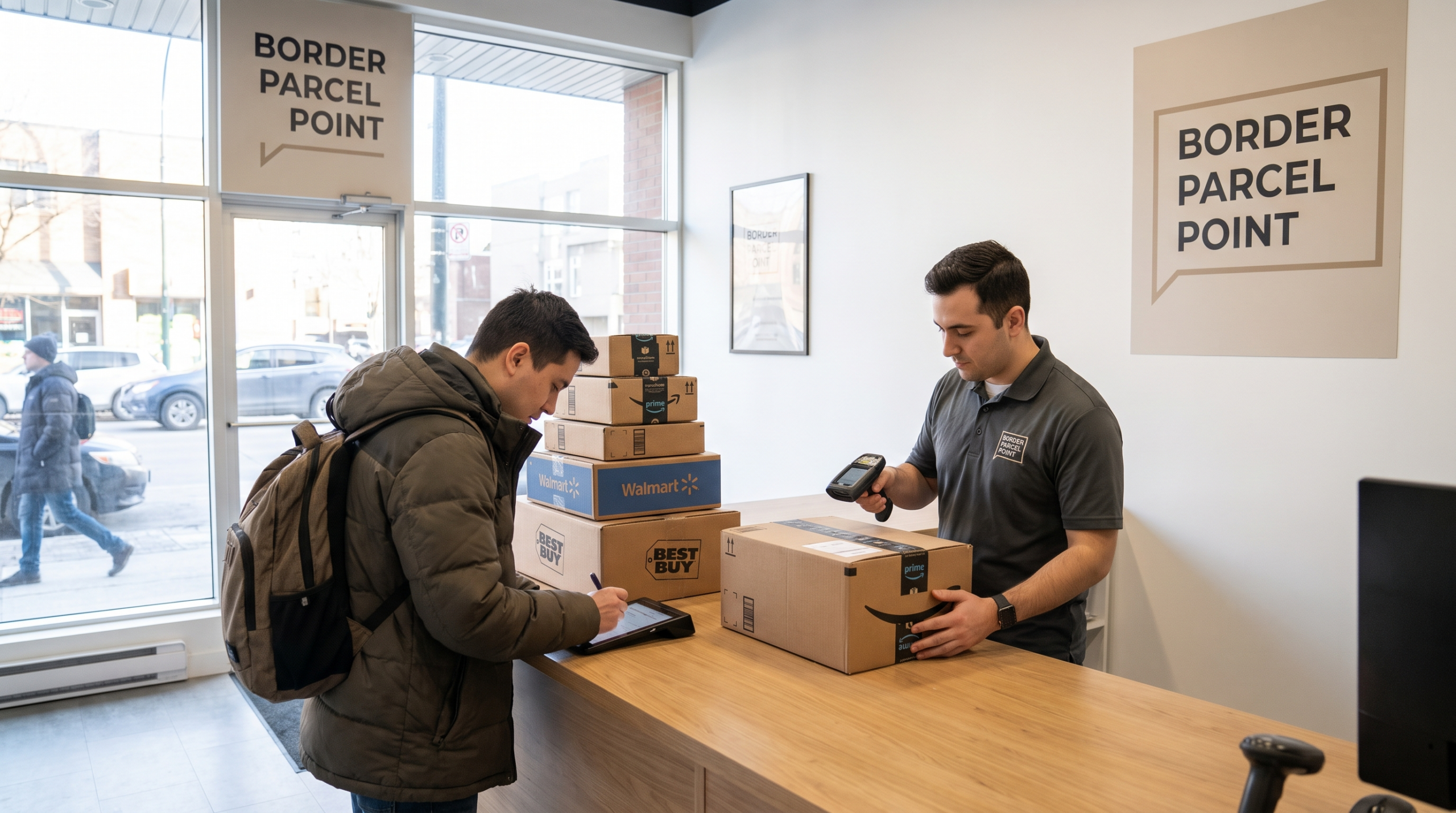
Thousands of U.S. retailers still refuse to ship to Canada, or charge international fees that double the price of a small item. The Parcel Forwarding from the United States to Canada This gets around the problem: you receive a shipping address in the United States, the merchant ships the item there as a domestic shipment, and then your package crosses the border to your home.
In 2026, the math is no longer the same as it was two years ago. Canadian de minimis thresholds, carrier brokerage fees, and package consolidation completely change the profitability of the operation. A purchase of 90 $ US can come in without a penny more—or cost 45 $ in incidental fees.
Here's how forwarding actually works, what you pay at the border, and when it's worth it for an SME or an individual.
How Does Package Forwarding Work?
The process consists of four steps:
- You'll get a U.S. address. A mail forwarding service provides you with a physical address (often in a state with no sales tax, such as Delaware, Montana, or Oregon) along with a P.O. box or suite number.
- The merchant delivers to this address. For him, it's a domestic shipment: often free for purchases of 35 $ or 50 $ or more, and with no geographic restrictions on payment.
- The warehouse receives and stores goods. You'll receive a notification, sometimes with a photo of the package. Most services offer free storage for a few days to a few weeks.
- You are requesting that the package be forwarded to Canada. You choose the carrier, declare the value and contents, and pay for cross-border shipping plus any applicable duties and taxes.
The most useful option for small and medium-sized businesses is the consolidation : Five orders from five different merchants arrive at the same address; the warehouse combines them into a single box, and you pay for just one cross-border shipping fee instead of five.
What You'll Really Pay at the Border in 2026
This is where most people get it wrong. The cost of importing a package into Canada depends on three factors: its value, its country of origin, and the chosen mode of transportation.
De minimis thresholds by courier service
For courier shipments (UPS, FedEx, DHL, Purolator) originating in the United States or Mexico, the ACEUM sets two distinct thresholds:
| Package Value (CAD) | Customs duties | Taxes (GST/HST/QST) |
|---|---|---|
| Less than 40 1Q-4Q | Exempt | Exempt |
| From 40 $ to 150 $ | Exempt | Due |
| More than 150 $ | Payable according to tariff classification | Due |
Key point: These thresholds apply only to shipments carried by courier services, not to postal shipments. A package sent by mail is handled differently, with a much lower threshold. Choosing the right shipping method can therefore be worth more than the discount negotiated on the shipping itself.
Origin matters more than provenance
A package shipped from the United States is not automatically considered «American.» Under the USMCA, only goods actually manufactured in the United States, Canada, or Mexico are duty-free for amounts over 150 $. A T-shirt sewn in Bangladesh but sold by a retailer in Michigan remains subject to the duties applicable to textiles, often ranging from 16 % to 18 %.
Before reshipping an item that costs more than 150 $, check the country of manufacture on the label or product page—not the seller's address.
Brokerage Fees: The Real Surprise
Duties and taxes are predictable. Brokerage fees, however, are much less predictable. Courier companies charge an entry fee to prepare the customs declaration, often based on a sliding scale that can range from 20 $ to 40 $ for a package of modest value—sometimes more than the duties themselves.
These fees are approximate and vary depending on the carrier, the service selected, and your commercial agreement. A negotiated corporate account—or a service that includes customs clearance in its rate—often eliminates this line item entirely.
When Forwarding Is Profitable — and When It Isn't
Let's run the numbers for three typical scenarios.
| Screenplay | Value | Estimated Additional Costs | Verdict |
|---|---|---|---|
| A small accessory that's hard to find in Canada | 35 $ | Cross-border transportation only | Often profitable |
| Apparel, 3 consolidated orders | 220 $ | Shipping + taxes + possible textile duties | Profitable if consolidated |
| Unique Electronics | 600 $ | Shipping + taxes + brokerage fees | Compare to the Canadian price after conversion |
The rule of thumb: reshipping is the better option when the item is not available in Canada, whenever you can combine multiple orders, or when the price difference is significantly more than 30 % after conversion. It loses out when the item is heavy, bulky, or available locally at a comparable price.
Also be mindful of volumetric weight: a consolidated shipment that is light but bulky may be charged based on its volume rather than its actual weight, which negates the savings from consolidation.
Five Costly Mistakes
- Underreport the value. The CBSA may request the purchase invoice. If an under-declaration is detected, it will result in a re-assessment, delays, and, in the event of a repeat offense, a systematic review of your shipments.
- Forget about controlled goods. Lithium batteries, aerosols, perfumes, alcohol, supplements, and certain food products are restricted or prohibited when being forwarded. Check before you buy, not after.
- Leave the package lying around. Free storage is ending. The daily fees that follow can quickly add up for a forgotten package.
- Vague content descriptions. «General merchandise» or «gift» may trigger an inspection. A precise description, including the HS code if you have it, speeds up customs clearance.
- Ignore the current trade measures. Since September 2026, certain goods of U.S. origin have been included on Canadian lists of retaliatory tariffs. A covered item may cost significantly more than expected, regardless of the USMCA.
Forwarding or Direct Shipping: Which Should an SME Choose?
For a Canadian retailer or reseller that sources products from the United States, forwarding is a temporary solution, not a long-term strategy.
| Criterion | Forwarding | Direct Carrier Account |
|---|---|---|
| Setup | Immediate | Request a business number and an agreement |
| Cost per package | Service Fees + Shipping | Rate negotiated based on volume |
| Customs Clearance Inspection | Limited | Sold, through a designated broker |
| Appropriate volume | A few packages a month | Regular volume |
Once you exceed about ten shipments per month, opening a carrier account and working with a dedicated freight broker is generally less expensive and gives you the visibility that mail forwarding does not provide.
Ready to optimize your cross-border shipments?
Forwarding solves an access problem, not a cost problem. If your shipment volumes increase, the real savings come from a negotiated rate, proper tariff classification, and choosing a carrier based on the destination rather than out of habit.
At Shipping Store, we help small and medium-sized businesses and individuals in Canada compare carriers, prepare their customs documents, and reduce their ancillary costs on cross-border shipments. Request a quote and see how much you can save on your next shipments.
The thresholds, rates, and fees mentioned in this article are for informational purposes only and may vary depending on the carrier, the service selected, the origin of the goods, and your commercial agreement. Always verify the current rules with the CBSA and your carrier before shipping.

 French
  English
  Spanish