
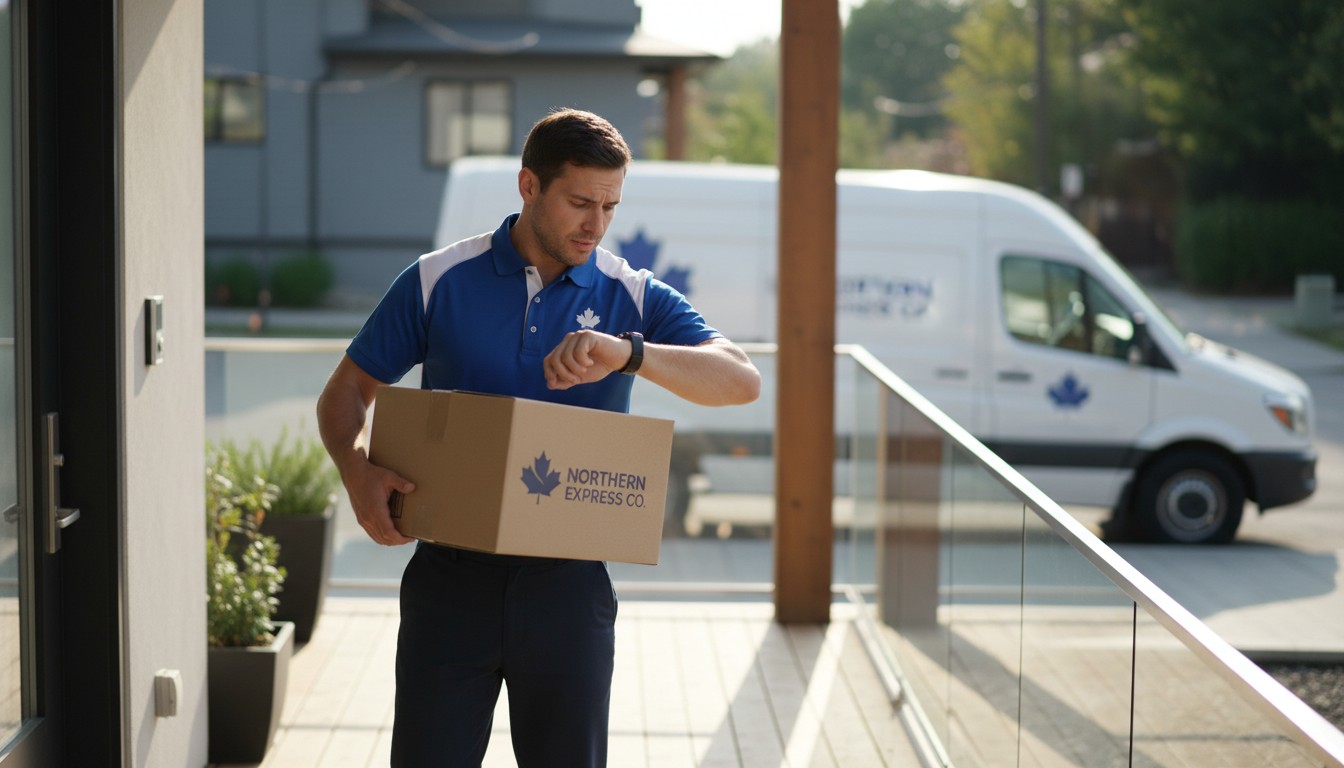
Every year, Canadian small and medium-sized businesses pay for a «guaranteed» shipping service… and then forget to claim what they’re owed when the package arrives late. The money-back guarantee However, the refund policy offered by UPS, FedEx, Purolator, and Canada Post may reimburse all or part of the shipping costs for a package delivered late. But you still need to know the rules, as several of them changed in 2026.
Reduced coverage at Purolator, the reinstatement of FedEx’s guarantee for Canada, and very short claim windows: the 2026 landscape rewards organized shippers and penalizes those who miss deadlines. Here’s how the money-back guarantee works, what’s changed this year, and the steps you need to take to get your money back.
It should be noted from the outset that the amounts and percentages listed below are indicative and vary depending on the service selected, the delivery area, and the commercial agreement negotiated with each carrier.
What exactly is a money-back guarantee?
The money-back guarantee — also known as service guarantee or Guaranteed Service Refund (GSR) with certain carriers—is a contractual commitment: if the package is not delivered (or if no delivery attempt is made) within the promised time frame, the carrier will refund or credit the shipping charges for that shipment. For both UPS and FedEx Express, a delay of as little as 60 seconds past the promised time is generally sufficient to make the shipment eligible.
The key issue—and the most costly one for small and medium-sized businesses—is: This refund is almost never automatic. It is up to the sender to notice the delay, verify eligibility for the service, and file a claim within what is often a very short time frame. Once the deadline has passed, the money is lost for good.
What's changing in 2026
The year 2026 brought significant changes. The most notable: Purolator reduced the coverage of its warranty, while FedEx restored it for certain Canadian shipments. Here is a brief comparison.
| Carrier | Change 2026 | Refund | Time Limit for Filing a Claim |
|---|---|---|---|
| Purolator | Effective March 30, 2026, coverage will be reduced | Credit or refund of 50 % service fee + taxes (instead of 100 %) | According to the terms of the service (Express) |
| FedEx | Guarantee reinstated for certain import/export shipments to Canada (Canadian payers), effective for shipments on or after February 12, 2026 | Reimbursement of transportation costs (Express; a 60-second delay is sufficient) | 15 calendar days based on the invoice date (or shipment date if paid in cash or by card) |
| UPS | GSR Maintained for Eligible Services | Reimbursement of Shipping Costs for Late Deliveries | 15 days depending on the expected delivery date |
| Canada Post | On-time delivery guarantee once again fulfilled in 2026 | Usually a postage credit to be reused | 30 business days depending on the shipping date |
Specifically, a Purolator Express shipment that would have been fully reimbursed in 2025 is now only eligible for half the rate as of March 30, 2026. Conversely, small and medium-sized businesses (SMEs) that ship with FedEx to or from Canada have had a guarantee reinstated for their Express shipments as of February 2026—yet another reason to systematically check delivery times.
What services are actually covered?
The guarantee does not apply to all shipments, and this is often where shippers go wrong. As a general rule:
- Express and Priority Services : These offer the best coverage (UPS Express, FedEx Express, Purolator Express, Canada Post Priority, and XpressPost).
- Canada Post Expedited Package : covered by the on-time delivery guarantee for business accounts.
- Standard Economic and Land-Based Services : The warranty is often limited, suspended, or nonexistent. Always check the current service manual.
Before counting on a refund, make sure the service you used is one that comes with a delivery guarantee. A package sent via economy service to save a few dollars will, in most cases, leave you with no recourse in the event of a delay.
Exclusions That Void Your Reimbursement
Even for an eligible service, there are several situations in which the sender is not entitled to a refund. The most common exclusions are:
- Extreme weather conditions and natural disasters (force majeure).
- Customs Delays on international shipments—a sensitive issue since the end of the «de minimis» exemption for shipments to the United States.
- Incomplete or incorrect address, recipient not present, or refusal to accept delivery.
- Peak periods : Some carriers suspend their coverage during the holidays or peak seasons.
Be sure to document each shipment carefully: a clear and complete address isn’t just good logistics practice—it’s also what protects your right to a refund.
How to File a Claim: Step by Step
The process is simple, but it requires precision and speed. Here are the steps to follow:
- Check the tracking information : Compare the actual delivery time or date with the delivery timeframe promised by the service you used. Note any delays, no matter how minor.
- Determine your claim window : 15 days for UPS (after the scheduled delivery date) and FedEx (after the invoice date), up to 30 business days for Canada Post (after the shipping date). The clock is ticking.
- File a complaint : through your carrier account or customer service, by providing the tracking number, the service, and the shipment date. Remember that at Canada Post, only the sender can file a claim.
- Follow the treatment : Please allow approximately 8 to 10 business days for a UPS claim to be reviewed. Keep a written record of each correspondence.
Why So Many Small and Medium-Sized Businesses Are Leaving Money on the Table
The hidden cost is real. Since reimbursement isn’t automatic and the time windows are short, an SME that ships dozens or hundreds of packages a month ends up overlooking acceptable delays—especially when it’s already passing those costs on to its own customers. Yet every unclaimed late express shipment represents lost shipping revenue, month after month.
The solution? Establish a verification routine: export the list of priority shipments every week, identify late deliveries, and file claims before the deadline. For high-volume shipments, a systematic tracking process (whether handled in-house or outsourced) quickly pays for itself, as it turns a theoretical entitlement into real savings.
Conclusion
In 2026, the money-back guarantee remains one of the most underutilized cost-saving tools among Canadian shippers. With Purolator’s reduction to 50 %, the reintroduction of FedEx’s guarantee for Canada, and claim deadlines as short as 15 days, the difference comes down to discipline: monitoring deadlines, understanding exclusions, and filing claims on time.
At Shipping Store, we help small and medium-sized businesses and individuals choose the right service, compare carriers' rates, and ship with peace of mind. Contact our team at expertshipping.ca to optimize your shipments and never let a refund slip through your fingers again.





 French
 English
 Spanish