
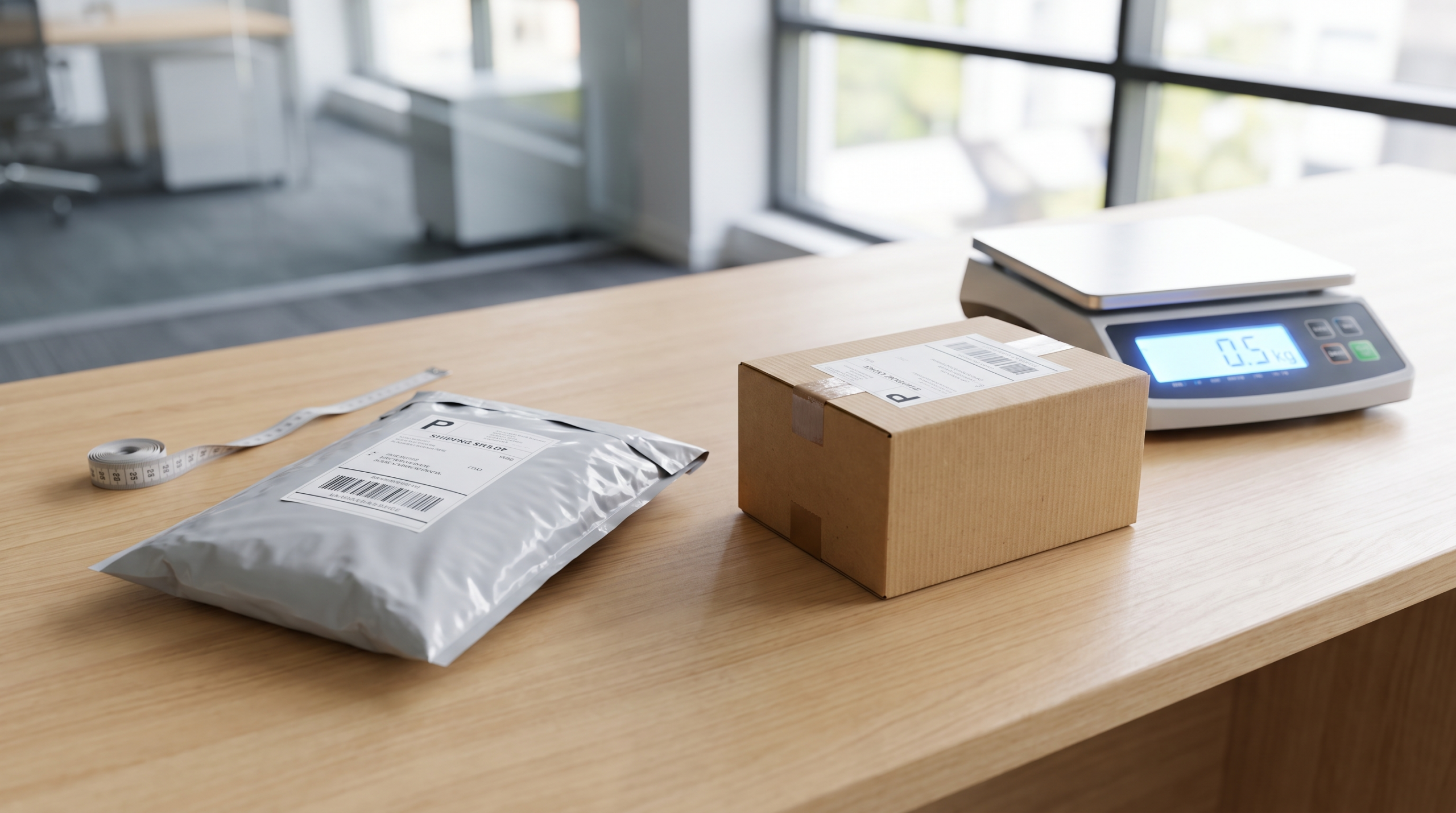
Choose between a padded envelope or box It may seem like a minor detail. In reality, it’s one of the most costly shipping decisions for Canadian small and medium-sized businesses, because it affects three factors at once: the cost of the packaging itself, the billable weight of the package, and the risk of a claim.
The same 700-gram sweater can be billed as a 1-kilogram package in a soft envelope, or as a 2-kilogram package in a 30 × 25 × 10 cm box. Out of 200 shipments per month, the difference amounts to hundreds of dollars—even though none of the carriers has changed its rates.
Here's how to make that decision based on numbers rather than instinct, taking into account the Canadian oversize and volumetric weight rules applied by Canada Post, Purolator, UPS, and FedEx.
The cost of the packaging itself: a range of 4 to 10 times
First item, and the most obvious one: what you pay for the container. The market size estimates for 2026, for North American supply, break down as follows.
| Packaging Type | Small volume (500 to 1,000 units) | High volume (10,000 units or more) |
|---|---|---|
| Plastic envelope (poly mailer) | 0.25 $ to 0.55 $ | 0.08 $ to 0.25 $ |
| Bubble envelope | 0.55 $ to 1.20 $ | Varies depending on the format |
| Padded paper envelope | 0.60 $ to 1.30 $ | Varies depending on the format |
| Corrugated cardboard box | 2.50 $ to 6.00 $ | 1.00 $ to 2.50 $ |
For a comparable volume, an envelope costs 4 to 10 times less per unit than a box. However, the cost of the box must be considered alongside the cost of the packing materials it requires: kraft paper, air cushions, or packing flakes. A poorly packed box is not only risky, but it is also heavier and bulkier than necessary.
These amounts are approximate and vary depending on the supplier, the format, the thickness of the film or the corrugation of the cardboard, and the order volume.
Volumetric weight: that's where the shipping costs really add up
The second charge does not appear on the supply invoice, but it appears every month on the carrier's invoice. All Canadian carriers bill the greater of the actual weight and the bulk density, calculated based on the package's dimensions. Packaging that is larger than its contents therefore increases the cost, even if nothing extra has been added inside.
The classic example: a 1.5-pound (about 700 g) hoodie.
- In a box measuring 12 × 10 × 4 in. : The volumetric weight is approximately 3.5 lb, rounded up to 4 lb for billing purposes.
- In a flexible envelope measuring 12 × 15 inches : The package weighs about 2 lb.
Same product, same destination: the box doubles the billable weight. On a network with per-pound pricing, every weight tier unnecessarily exceeded is charged for each shipment, twelve months a year. That is why volumetric weight is the first factor to consider even before negotiating rates.
The overloads that the box can trigger
Third point, often overlooked: a box that’s too large can cause the package to fall into a higher rate category. In Canada, a shipment is considered oversized and incurs additional charges as soon as any of its dimensions exceeds 1 m (39.4 in), or its second-longest side exceeds 76 cm (30 in). The general limits that must not be exceeded remain 2 m per dimension, 3 m for length plus circumference, and 30 kg of actual weight.
A flexible envelope almost never exceeds these limits. A box chosen «just in case»—especially for long items—regularly does. Added to this are the extra handling fees charged for irregularly shaped or oversized packages, which amount to tens of dollars per item with express carriers.
Be careful, though: some carriers charge the box rate for envelopes that are too bulky. The general rule is a maximum thickness of about 3 in. (7.6 cm) for a shipment to remain in the «envelope» rate category. If it’s thicker than that, you’ll pay the box rate without getting the protection that comes with it.
Breakage: What Can Wipe Out All Your Savings
The packaging does not protect against compression or corner impacts. Therefore, the calculation must take into account the damage rate, not just the unit cost.
Consider a retailer that ships 10,000 orders per month and saves approximately 2.00 $ per order by switching from boxes to envelopes—that’s nearly 20,000 $ per month. If the breakage rate increases by 1 percentage point, the cost of replacements and customer service rises to about 2,500 $. At 5 percentage points, the cost rises to 12,500 $: most of the savings are wiped out, not to mention the negative reviews and time spent handling claims.
In other words, the envelope is cost-effective as long as it doesn't increase the damage rate by more than a few points. Beyond that, the box becomes the more economical choice again.
Comparison: Which Packaging for Which Shipment?
| Criterion | Padded envelope | Cardboard box |
|---|---|---|
| Unit cost | Very low | 4 to 10 times higher |
| Billable Weight | Close to the actual weight | Often inflated by volume |
| Risk of Oversizing | Virtually zero | Real for large formats |
| Impact Protection | Low to moderate | High |
| Water resistance | Plastic wrap | Unlined, lightweight |
| Storage space | Very compact | Bulky (flat or assembled) |
| Ideal for | Clothing, textiles, flexible accessories, printed items, shatterproof flat parts | Electronics, glass, ceramics, liquids, items with fragile corners, valuables |
A Simple Decision-Making Rule for Your Workshop
To avoid having to make decisions on a case-by-case basis, establish a written rule that the entire team follows.
- Envelope if the item is flexible, unbreakable, lies flat when compressed to a thickness of about 7 cm, and can withstand compression.
- Box if the item is rigid, fragile, contains a liquid, has vulnerable corners, or exceeds the value at which a claim would be costly to you.
- Box Just Right In all other cases: reduce the dimensions before increasing the fill. Every centimeter removed reduces the bulk density.
Next, measure the impact over an entire period: average billable weight per shipment, number of oversized packages, and complaint rate. These three figures are enough to determine whether the rule is working.
Conclusion
Proper packaging is, by definition, neither an envelope nor a box: it is the smallest container that actually protects the product. Envelopes are better in terms of unit cost, volumetric weight, and surcharges. Boxes are the better choice whenever breakage is likely. Applying this distinction by product category is often the quickest way to save on shipping costs, because it doesn’t require any renegotiation of rates.
Want to know how much your choice of packaging actually costs you per package? The team at’Shipping Store compares your shipments across multiple carriers, checks your billable weight, and shows you where you're paying for empty space. Request an analysis of your shipments and start paying for the product itself rather than the packaging.
The amounts and thresholds listed are for reference only and vary depending on the carrier, the service selected, and your rate agreement.

 French
  English
  Spanish