
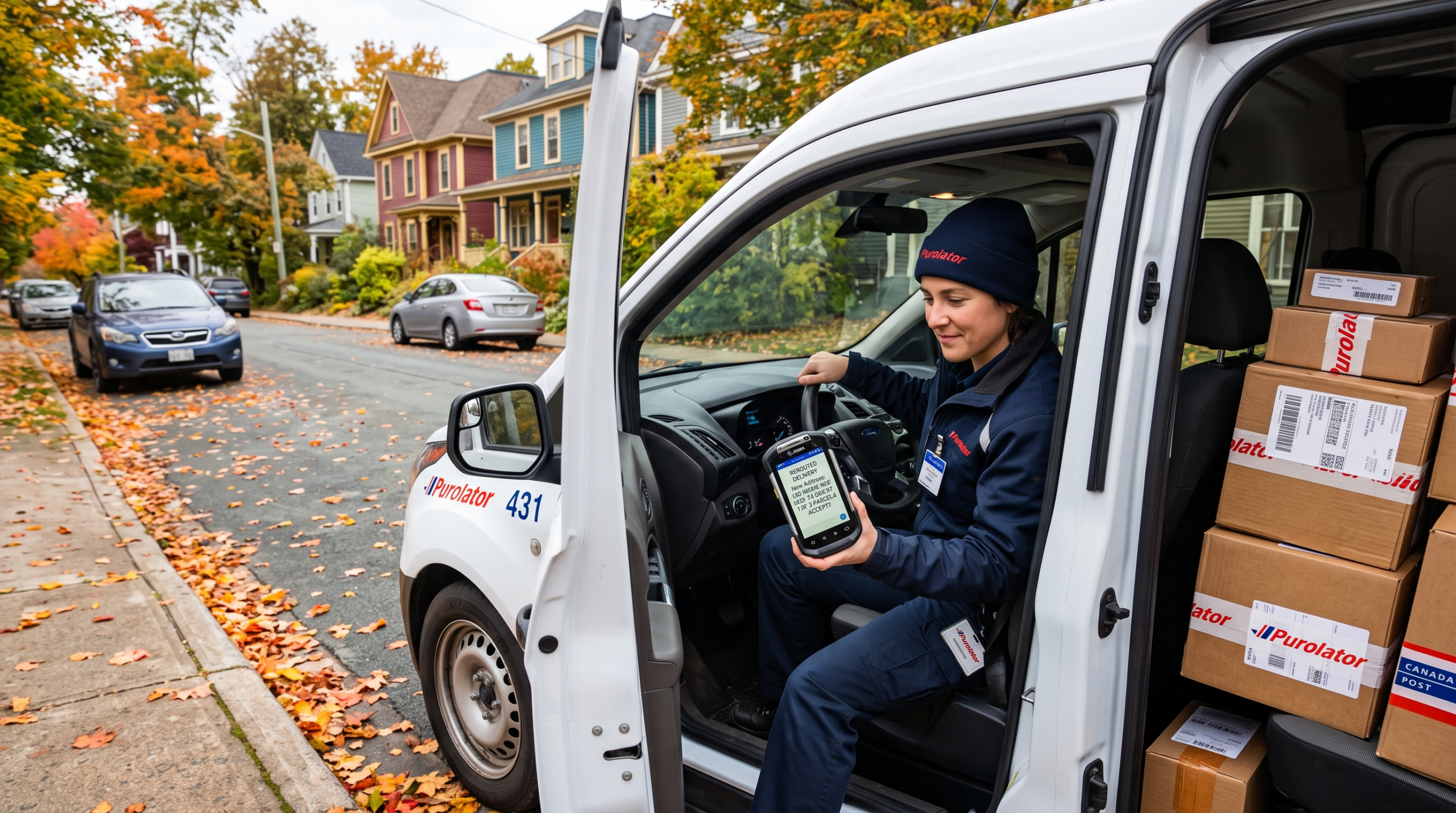
The package has already been shipped. The customer just wrote to say that he moved last week, or that the recipient will be away for three days, or you just noticed a typo in the house number. The question then becomes very practical: can we still redirect a package along the way, and how much does it cost?
The answer depends largely on the carrier, when you take action, and who makes the request—the sender or the recipient. Some redirects are completely free. Others result in interception fees, a new shipping charge, or worse, a return to the sender that the sender has to pay for twice.
This guide explains, carrier by carrier, what's possible in Canada in 2026, how much it costs, and—most importantly—how to organize your shipments so you never have to pay for a redirection.
Redirect, intercept, or retain: three different things
The terminology used by carriers can be confusing, and that confusion costs money. It is important to distinguish between three actions.
- Hold at the point of service : The package remains at the terminal or post office, and the recipient picks it up. This is almost always the least expensive option—and is often free.
- Redirect to a pickup location : The package is redirected to a partner store, a locker, or a post office. This service is usually free when the recipient requests it before the first delivery attempt.
- Intercept and Change the Address : You are requesting delivery to an address different from the one on the label. This is the most expensive option, because the carrier must physically reroute the package and often charge for shipping again.
General rule: The farther the new address is from the old one, the higher the bill. A change within the same city is treated as a simple redirection. A change to a different province is treated as a new shipment.
What Each Carrier Offers in Canada
Here is a comparative overview of the options available in Canada in 2026. The amounts are approximate: they vary depending on the service, the province, and your service agreement.
| Carrier | Redirect Tool | Withheld at the point of service | Change of Address While in Transit | Estimated cost |
|---|---|---|---|---|
| Canada Post | FlexDelivery / Delivery Notice | Free (post office) | Limited — especially before shipping | 0 $ to 20 $ |
| Purolator | Redirection to a drop-off location | Free through the agent network | Yes, upon request | 15 $ to 30 $ |
| UPS | Delivery Intercept / Access Point | Free to an Access Point | Yes, including interception fees | 20 $ to 35 $ |
| FedEx | Delivery Manager / Hold at Location | Free at FedEx locations | Yes, redirection fees | 20 $ to 35 $ |
Two observations stand out. First, Redirecting to a pickup location almost never costs anything, whereas changing your address is expensive. Second, the price difference between the two options—often 20 $ to 35 $—frequently exceeds the profit margin on a small online order.
Who is eligible to request a retrial?
A point that is often misunderstood: the sender and the recipient do not have the same rights. The recipient can usually have the package forwarded to a pickup location or request a hold, but cannot change the delivery address to another residential address—this is a fraud prevention measure. That change is up to the sender, who is also the one who will be billed.
In practical terms, if you’re an SME and a customer writes to you saying, «I gave the wrong address,» your account will cover the costs. That’s why it’s important to validate addresses upfront rather than correcting them later.
The True Cost of a Failed Redirect
A redirection request made too late doesn't always work. If a delivery attempt has already been made for the package, several issues can arise—and that's when the bill gets steep.
- Address Correction Fee : When the carrier corrects an incomplete address on its own, it typically charges 20 $ to 30 $ per package, even though you didn't request it.
- Additional attempts : After three unsuccessful attempts, most carriers return the package.
- Return Transportation : Returns to the sender are billed as a full shipment, often at the one-way rate.
- Forwarding : You will then have to pay for a third shipment to return the merchandise to the correct address.
For a 5-kg package shipped at 18 $, the total cost can reach 60 $ to 70 $—nearly four times the initial shipping cost. This is one of the most underestimated cost items for small businesses that ship within Canada.
Seven Ways to Never Pay for a Redirect
Redirects are a symptom, not an inevitability. Here are the strategies that address the problem at its root.
- Please confirm the address when placing your order. An address validation tool at checkout eliminates most corrections. This is the only item on this list that, on its own, yields more benefits than all the others combined.
- Please confirm before printing the label. An automated email saying, «Here is the address we’ll be using,» sent a few hours before shipment, captures recent moves.
- Offer the pickup option right at checkout. If the customer chooses a locker or a partner store on their own, there’s nothing left to redirect—and you avoid residential overload at the same time.
- Turn on notifications from the shipping carrier. When the recipient receives the shipping notification, they can request a free hold on the shipment themselves instead of asking you to intercept it for a fee.
- Take action before the first attempt. A request made while the package is still at the terminal is often free; the same request made after a delivery attempt is considered a redirection and is subject to a fee.
- Block incomplete addresses. Missing apartment numbers, missing ZIP codes, three-line addresses: these mailings account for the majority of correction fees.
- Review your invoices. Interception and correction fees are frequently charged twice or applied to packages delivered without incident. A monthly review often recovers a few hundred dollars a year.
The Special Case of Moving
Canada Post’s mail forwarding service does not cover everything. Shipments from private carriers—Purolator, UPS, FedEx—do not follow your mail forwarding service: they are delivered to your old address and then returned. If you or your customers are moving, the only reliable solution is to update the address directly with each merchant before placing an order.
For small and medium-sized businesses that are moving to a new warehouse or location, be sure to update the pickup address and return address on your prepaid labels. A return label with an old address triggers the exact same series of charges.
Conclusion: Prevention is better than redirection
Redirecting a package will still be possible in Canada in 2026, but the service is rarely free once it involves an actual change of address. The free options—holding the package at a service location or redirecting it to a pickup location—should become your go-to choice, and paid redirection should be your last resort.
The amounts listed in this guide are for reference only and may vary depending on the carrier, the service you choose, and your commercial agreement. Always verify the applicable fees before submitting a request.
Do you ship regularly and are you tired of paying fees for intercepting, correcting, and returning packages? Shipping Store compares rates from multiple carriers, verifies your addresses, and gives you access to negotiated rates with no minimum volume requirement. Get a quote today and stop paying three times for the same package.


 French
 English
 Spanish