
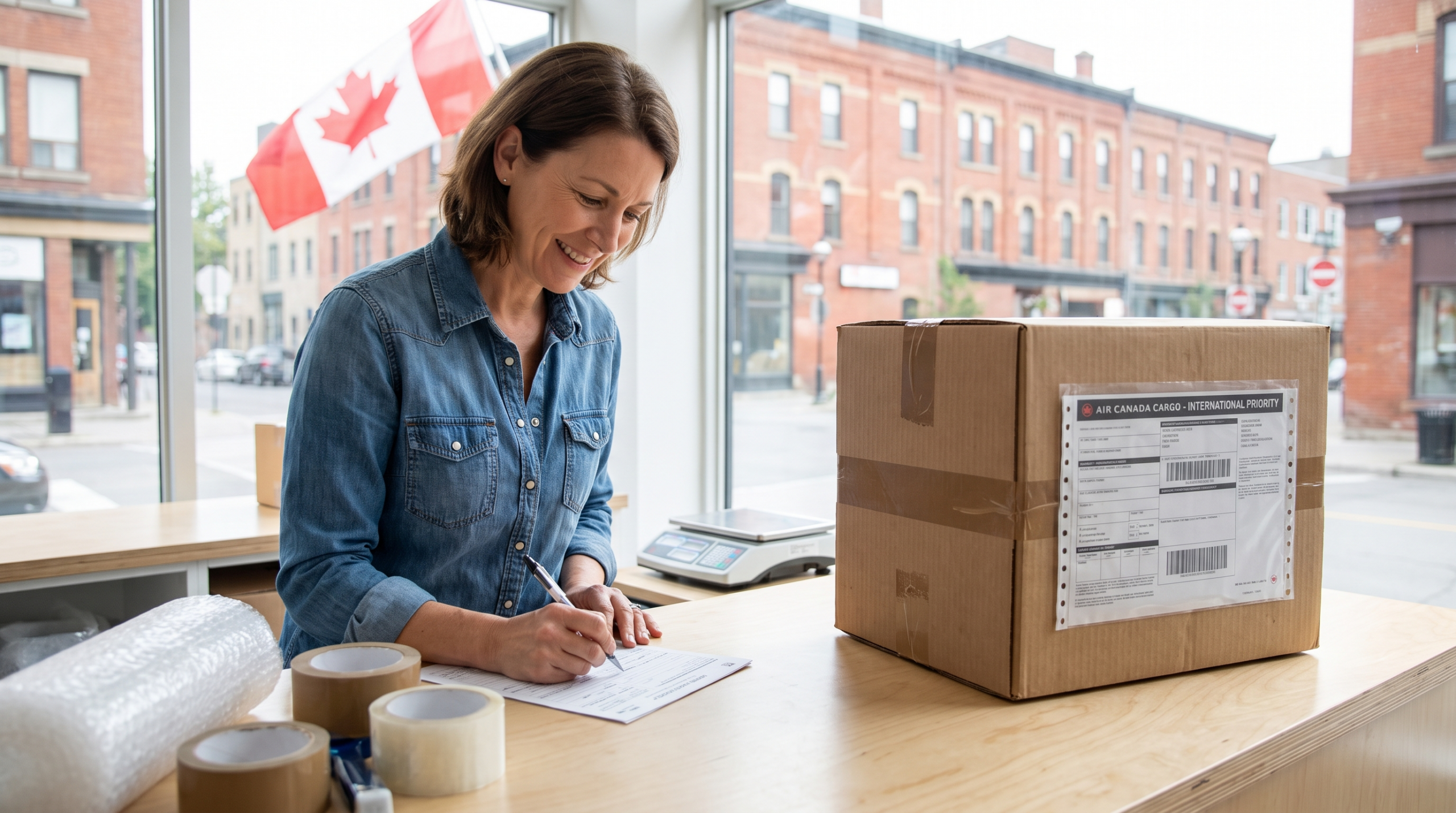
China is Canada’s second-largest trading partner, and yet shipping to China from Canada remains one of the most daunting international shipping challenges for a small business or an individual. Between shipping rates that can vary by as much as threefold, Chinese customs known for being strict, and a list of prohibited items that’s longer than anywhere else, many people either give up or end up paying too much.
Good news: With the right combination of service, packaging, and documentation, a package weighing 1 to 2 kg can be shipped from Montreal or Toronto and arrive in Shanghai or Shenzhen in 3 to 12 days—with no unpleasant surprises. This 2026 guide compares practical options, explains the pitfalls of Chinese customs, and gives you tips to keep costs down.
The prices listed are for reference only (Canadian dollars, September 2026) and vary depending on the agreement, service, region, and applicable surcharges.
Which carrier should I use to ship to China from Canada?
Four major categories of services cover mainland China from Canada: Canada Post (mail service, handed over to China Post upon arrival), integrated express carriers (FedEx, UPS, DHL Express), Purolator International (which relies on partners), and consolidators. The right choice depends primarily on three factors: weight, urgency, and declared value.
| Local Convenience | Estimated timeframe | 1-kg package (approximate) | 5-kg package (approximate) | Follow-up | Ideal for |
|---|---|---|---|---|---|
| Canada Post – International Small Package by Air | 2 to 4 weeks | 30 to 40 $ | Not included (max 2 kg) | Partial | Small, non-urgent shipments of low value |
| Canada Post – International Air Parcels | 7 to 14 days | 60 to 75 $ | 130 to 160 $ | Yes | Gifts, samples, general merchandise |
| Canada Post – XpressPost International | 6 to 10 days | 85 to 100 $ | 170 to 200 $ | Yes | Documents and small packages with guaranteed delivery times |
| UPS Worldwide Expedited / FedEx International Economy | 4 to 7 days | 110 to 160 $ | 190 to 260 $ | Full | Standard SMEs, B2B |
| DHL Express Worldwide | 3 to 5 days | 120 to 180 $ | 210 to 300 $ | Full | Urgent shipments, valuable packages, smooth customs clearance |
| Rates negotiated through Expert Shipping | 3 to 7 days | Up to 50 % less than the counter price | Up to 60 % less | Full | Any small or medium-sized business that ships more than once a month |
Keep this general rule in mind: for packages under 2 kg and non-urgent shipments, Canada Post is unbeatable; for packages over 2 kg or for business customers who require precise tracking and fast customs clearance, a negotiated-rate express carrier is often cheaper per kilogram than the postal service, especially with a business account.
Understanding Chinese Customs in 2026
China applies different rules depending on whether the recipient is an individual or a business. This is something most Canadian shippers are unaware of, and it’s the reason why the most packages are held up.
Shipments to Individuals: The «Personal Items» Rule»
Packages sent to an individual are taxed according to a flat-rate schedule (the «postal tax,», xing you shui) of 13 %, 20 %, or 50 %, depending on the product category. An exemption applies when the calculated tax is less than 50 RMB (approximately 9.50 $ CA). For packages valued at over approximately 1,000 RMB (about 190 $ CA), customs may require commercial clearance and may return or refuse the package if the recipient does not have an import license. Tip: Split up large personal shipments and declare the actual value—no more, no less.
Shipping to a Business: Commercial Invoice and HS Codes
For a business customer, prepare a commercial invoice in English (in triplicate), including a detailed description, the 6- or 8-digit HS code, country of origin («Made in Canada»), unit and total value, and the Incoterm. The Chinese recipient must provide their customs registration number (USCI). Import duties in China range from 0 to 20 % depending on the product, plus a 13 % VAT (9 % for certain agri-food products). Without an HS code, your package will be subject to «manual inspection,» which typically adds 3 to 10 days to the process.
The recipient's identification number
For several years now, Chinese customs officials have been increasingly requiring the ID number of the individual recipient in order to release a package. Be sure to ask for it in advance and include it on the customs declaration: this is the leading cause of packages being held up upon arrival for mail shipments.
Prohibited or Restricted Items: The List You Need to Know
China has stricter restrictions than most destinations. Before shipping to China from Canada, check this list, because prohibited items will be destroyed or returned at your expense (often an additional 60 to 120 $).
- Prohibited: meat, dairy products, eggs, honey, and unprocessed animal products; seeds, plants, and soil; books, DVDs, and printed materials deemed sensitive; drones and unlicensed radio communication equipment; currency and checks; weapons and replicas.
- Restrictions (documents or limitations): dietary supplements and vitamins (limited to personal quantities); cosmetics (often 1 to 3 items per package); phones, computers, and devices with lithium batteries (only with the battery installed, never loose, and shipped via an express carrier rather than the postal service); infant formula (limited quantity, strictly monitored); medications (prescription and package insert).
- Handle with care: brand-name clothing and shoes (presumed to be counterfeit if the quantity is commercial); maple syrup, maple products, and Canadian processed foods (permitted, but must include an ingredients label and expiration date).
Packaging and Labeling: The Details That Prevent 80 % Problems
A shipment to China changes hands five to eight times and undergoes an almost systematic X-ray inspection. Use a new double-wall corrugated box for anything weighing more than 2 kg, pad the contents so they are 5 cm from the sides, and seal the box with reinforced tape using the H-pattern method.
Write the address on the label in English AND in Chinese characters If your recipient can provide it: the last mile is handled by a local delivery person who may not always be able to read the Latin alphabet. Always include a Chinese phone number with the city code. Include the 6-digit Chinese ZIP code. Finally, slip a copy of the invoice or declaration inside the package, in addition to the outer envelope.
How much does shipping really cost, and how can you pay less?
The listed price is never the final price. For a 2-kg express package to Shanghai, expect additional charges: a fuel surcharge (variable, often 20 to 30 % of the base rate for express carriers), a remote area surcharge if your recipient is outside major metropolitan areas (approximately 40 to 50 $), and customs clearance fees billed to the recipient. As for weight, since China is a distant destination, the bulk density (L × W × H ÷ 5,000 in cm) applies as soon as the box is somewhat empty.
Three key factors really make a difference:
- Turn down the volume. A box measuring 30 × 25 × 20 cm has a volumetric weight of 3 kg. If your contents weigh only 1.5 kg, you’ll pay double. Switch to a box measuring 25 × 20 × 15 cm (1.5 kg volumetric weight), and your bill will drop by a third.
- Use negotiated rates. A platform like Expert Shipping provides access to business rates from FedEx, UPS, DHL, and Purolator with no minimum volume requirements, often 40 to 60 % below the international counter rate.
- Choose DDP for business customers. Paying the duties in advance prevents the package from being rejected and avoids return shipping charges, which cost more than the duties themselves.
Realistic deadlines and follow-up
An express package leaves Canada within 24 hours, transits through a hub (Anchorage, Hong Kong, or Incheon), and arrives at Chinese customs on the 2nde or 3e day. Customs clearance takes anywhere from a few hours (with all documents in order) to a week (if an inspection is required). Expect 3 to 5 business days for major coastal cities and 5 to 7 days for inland areas. For mail, double or triple these timeframes, and expect tracking to stop between the time the package leaves Canada and the first update from China Post.
Avoid shipping during the two weeks leading up to Chinese New Year (late January or February, depending on the year) and Golden Week in October: warehouses close and packages pile up.
Conclusion: A well-prepared shipment is a shipment that arrives
Shipping to China from Canada is not complicated once you follow three basic principles: declare the shipment accurately (actual value, HS code, recipient’s identity), pack it compactly and securely, and choose the shipping service based on weight and urgency rather than out of habit. The real waste comes from overpaying at the counter and packages being returned due to missing documentation.
Do you ship to China, even just occasionally? Compare the negotiated rates for Canada Post, FedEx, UPS, DHL, and Purolator in just a few seconds on Expert Shipping, print your label and customs documents, and let us guide you through the declaration process. Your package deserves to arrive, and your budget deserves to be respected.



 French
 English
 Spanish