
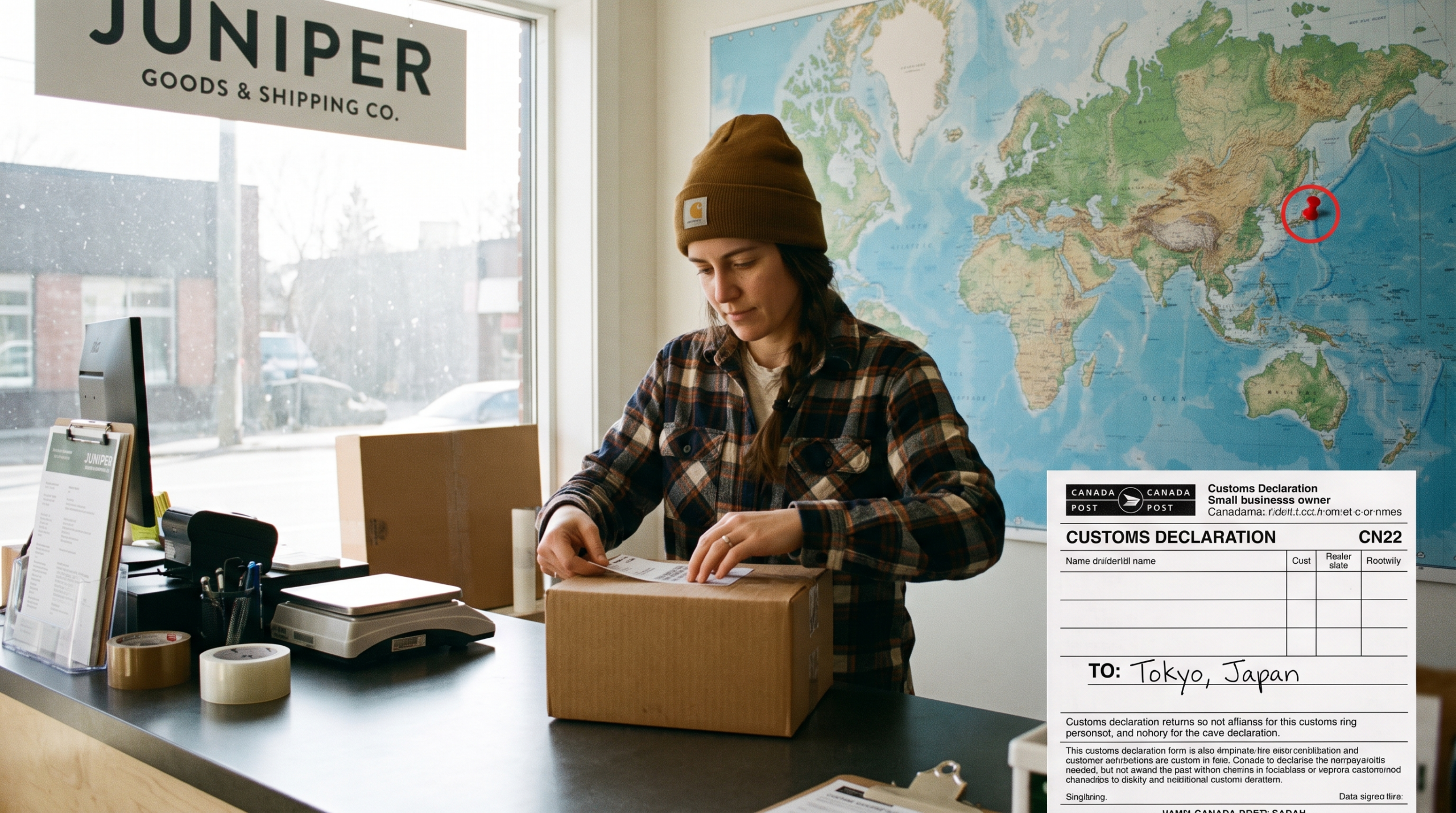
Japan is Canada's fourth-largest trading partner and one of the most mature e-commerce markets in the world. However, Ship to Japan from Canada remains a headache for many small and medium-sized businesses: customs forms, consumption tax, addresses written in kanji, prohibited items, and huge price differences among carriers.
The good news is that Japan is one of the most predictable countries when it comes to customs clearance. When a package is properly prepared, it clears customs at Narita or Kansai in a matter of hours. When it isn’t, it can be held up for a week or sent back to Canada at your expense.
This 2026 guide covers everything a Canadian company needs to know before shipping its first package to Tokyo, Osaka, or Sapporo: tax thresholds, required documents, carriers, delivery times, estimated costs, and common mistakes to avoid.
Duties and Taxes in Japan: The 10,000 JPY Threshold
Japan applies a customs duty exemption for shipments with a customs value of less than 10,000 JPY (approximately 90 to 95 CAD, depending on the daily exchange rate). Below this threshold, no duties or consumption taxes are levied, except for certain products (leather, knitwear, shoes, rice, alcohol, and tobacco), which are taxed starting from the first yen.
For amounts over 10,000 JPY, two fees apply:
- Customs Duties : Most Canadian manufactured goods are subject to reduced or zero tariffs thanks to the PTPGP (CPTPP), the free trade agreement in which both Canada and Japan participate. However, to take advantage of it, the Canadian origin must be indicated on the commercial invoice.
- The Japanese consumption tax (shōhizei) : 10 % (8 % on food and non-alcoholic beverages), calculated based on the CIF value of the shipment plus duties.
Important note: Japan does not use the declared gross value for personal shipments. For a gift or purchase intended for an individual, customs generally applies a 40 % discount to the value and then compares the result to the threshold. A package declared at 15,000 JPY is therefore often assessed at 9,000 JPY and passes through duty-free. For a commercial shipment (B2B), the total value is used.
Required Documents for Japanese Customs
Three factors determine the speed of customs clearance:
- A commercial invoice or pro forma invoice in English, with a detailed description (not just «gift» or «merchandise»), quantity, unit price, currency, country of origin, and six-digit HS code.
- The customs form CN22 or CN23 for Canada Post, or the carrier’s electronic declaration for FedEx, UPS, DHL, and Purolator. Since 2024, Japan has required advance electronic customs data: a postal package without a digital declaration may be refused upon arrival.
- The recipient's full address : seven-digit postal code (format 123-4567), prefecture, city, neighborhood, block number, and building name. Adding the address in Japanese below the romanized version speeds up last-mile delivery.
A local phone number for the recipient is also required: Japan Post and delivery companies (Yamato, Sagawa) often call before delivering, and a package without a phone number will end up at the post office.
Comparison of Canada–Japan Carriers in 2026
The rates below are approximate for a 2-kg package (30 × 20 × 15 cm) shipped from Montreal or Toronto to Tokyo. They vary depending on the negotiated agreement, fuel surcharges, and the service selected.
| Local Convenience | Estimated timeframe | Estimated cost (2 kg) | Tracking and Customs Clearance |
|---|---|---|---|
| Canada Post – International Small Package (Air) | 7 to 12 business days | 35 to 50 $ | Limited tracking; shipped by Japan Post; max. 2 kg |
| Canada Post – International Parcels (Air) | 6 to 10 business days | 60 to 80 $ | Comprehensive tracking; postal customs clearance |
| Canada Post – XpressPost International | 4 to 7 business days | 85 to 110 $ | Full tracking, signature, EMS to Japan |
| Purolator International Express | 3 to 5 business days | 110 to 150 $ | UPS Network in Japan; brokerage included |
| UPS Worldwide Expedited / Saver | 3 to 5 business days | 110 to 170 $ | Integrated customs clearance; door-to-door delivery |
| FedEx International Priority | 2 to 4 business days | 120 to 180 $ | The fastest; advance customs clearance fees available |
| DHL Express Worldwide | 2 to 4 business days | 115 to 175 $ | Very strong in Japan; advance funding fees 2 to 3 % |
For small, lightweight packages weighing less than 2 kg and of low value, Canada Post remains virtually unbeatable. For packages weighing more than 5 kg or valued at over 300 $, express services from third-party logistics providers often become a more attractive option once taxes are paid in advance and reliable tracking is included.
Please note that, unlike some European destinations, Canada Post did not suspend any services to Japan in 2026: mail is being delivered there as usual.
Actual Delivery Times and Special Considerations for Shipping to Japan
Japan has an exceptionally reliable delivery network: more than 95 % of express packages are delivered on the first attempt. Here are a few things to keep in mind:
- Time slots : Japanese recipients expect to be able to choose a delivery time slot (morning, 2:00–4:00 p.m., 6:00–8:00 p.m., etc.). Integrators that use Yamato or Sagawa offer this option; Japan Post does as well.
- Package Lockers (delivery boxes) in apartment buildings accept most packages without a signature.
- Golden Week (late April–early May), Obon (mid-August), and the New Year’s holiday period (December 28–January 4) add 2 to 5 days to delivery times. Please plan your shipments accordingly.
- Payment of Taxes : By default, the recipient pays the consumption tax and handling fees upon delivery (approximately 200 JPY for Japan Post; higher for third-party providers). For a seamless customer experience, choose the option DDP (duties and taxes paid by the sender) offered by FedEx, UPS, and DHL.
Items Prohibited or Restricted for Entry into Japan
Japanese customs are strict and consistent. The categories that cause the most problems for Canadian shippers are:
- Meat and Meat Products, including jerky, cured meats, and bouillon: prohibited without a health certificate, even in small quantities. Fines can reach 1 million JPY.
- Maple Syrup Products : permitted, but mixtures containing butter or dairy products may require a certificate.
- Cosmetics and Supplements : Limit of 24 units per personal shipment; any amount exceeding this requires a commercial import license.
- Medications : A maximum of a two-month supply for personal use; certain ingredients commonly found in Canada (pseudoephedrine) are prohibited.
- Lithium batteries : Accepted if installed in the device and labeled in accordance with IATA standards; batteries sent by mail on their own will not be accepted.
- Cannabis and cannabis-derived products (including CBD containing traces of THC): strictly prohibited, subject to criminal prosecution.
- Counterfeits and items bearing unauthorized trademarks: seized and destroyed.
How to Reduce the Cost of Shipping to Japan: 6 Practical Strategies
- Stay under 2 kg whenever possible : Canada Post's "Small Package" service often costs half as much as "International Parcel" for the same route.
- Keep an eye on the volumetric weight : Integrators charge based on the greater of the actual weight or the volumetric weight (L × W × H ÷ 5,000 in cm). Packaging that is too large for a lightweight item can easily double the bill.
- Declare Canadian origin on the invoice to qualify for the PTPGP's preferential rates.
- Combine Your Shipments to the same Japanese customer or distributor rather than shipping individual items.
- Compare Negotiated Rates : By using a shipping service reseller, an SME can obtain discounts of 30 to 60 % from FedEx, UPS, or DHL compared to the counter rate, with no minimum volume required.
- Choose DDP for B2C : DDP packages clear customs faster and avoid delivery refusals due to charges payable upon delivery.
Conclusion: A challenging but highly profitable market
Shipping to Japan from Canada isn’t rocket science as long as you follow three rules: an accurate invoice with the HS code and country of origin, a complete address with a seven-digit postal code and a phone number, and a shipping service suited to the package’s weight and value. The 10,000 JPY threshold, the 40 % discount on personal shipments, and the PTPGP agreement make Japan one of the most accessible international destinations for a Canadian small business.
Would you like to compare rates from Canada Post, Purolator, FedEx, UPS, and DHL for shipments to Japan in just a few seconds, with negotiated discounts and automatically generated customs documentation? Get a quote on Expert Shipping and ship to Asia at the best price.
The rates, thresholds, and deadlines mentioned in this article are for informational purposes only (September 2026) and may vary depending on the carrier, the negotiated agreement, the exchange rate, and any applicable surcharges.




 French
 English
 Spanish