
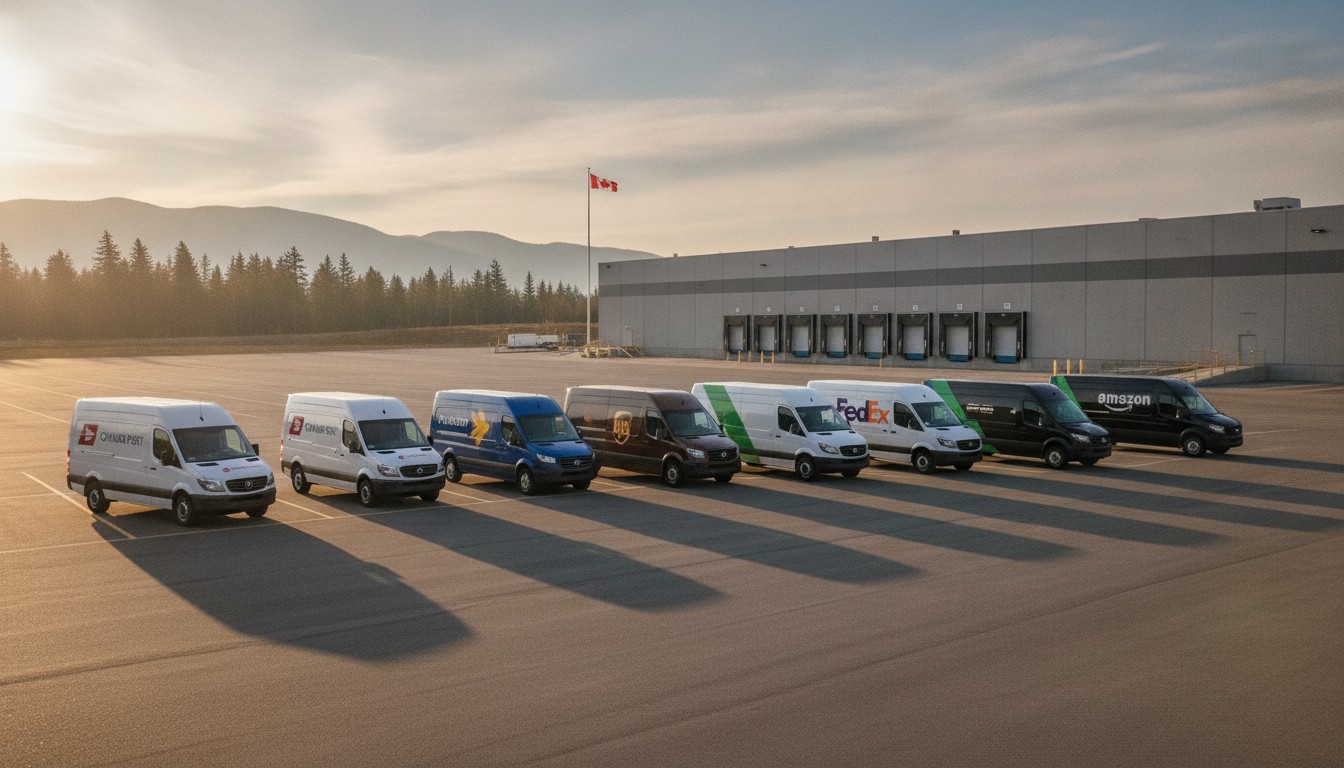
On May 30, 2026, members of the Canadian Union of Postal Workers (CUPW) will conclude their vote on two tentative agreements with Canada Post, following more than a year of rotating strikes and major disruptions. Whatever the outcome, one lesson learned by Canadian small and medium-sized businesses is clear: relying on a single carrier has become an unacceptable operational risk.
Combined with the rate increases of 5.7 to 5.9 cents per package announced by UPS, FedEx, Purolator, and DHL—which effectively translate into increases of 8 to 12 % per package once the new surcharges are applied—the climate in 2026 is forcing every small business to rethink its shipping logistics. According to industry analyses, small Canadian businesses lost nearly a billion dollars during the 2024 peak season due to the postal dispute. No one wants to relive that scenario.
This guide offers a practical approach: building a multi-carrier strategy that reduces your exposure to labor disputes, balances your costs, and improves the customer experience—without unnecessary complexity.
Why adopt a multi-carrier strategy in 2026?
The idea isn’t new, but it’s taking on a strategic dimension this year. Three factors are converging and forcing small and medium-sized businesses to diversify their shipments.
1. The vulnerability of the national postal network
Even if the tentative agreements are ratified, shippers’ confidence in Canada Post has been shaken. According to data published by industry media, more than 30% of small and medium-sized businesses affected by the 2024–2025 labor dispute have shifted some or all of their shipments to other carriers and do not intend to switch back. Operational resilience is now a key selection criterion on par with price.
2. Increases that go beyond the stated percentage
UPS and FedEx have each announced an average rate increase (GRI) of 5.9% for Q1–Q3, effective in late December 2025 and early January 2026. Purolator implemented a 5.7% rate increase for Q1–Q3 on January 1er September 2025, and DHL raised its rates by 5.9% as of 1er January 2026 (while suspending its demand surcharge effective February 17, which partially mitigates the impact).
The actual impact, however, is more severe. In 2026, FedEx will introduce a cubic volume criterion for the additional handling surcharge (Additional Handling – Dimension), which will now apply to any package exceeding 10,368 cubic inches, as well as an «Oversize» surcharge for packages exceeding 17,280 cubic inches or 110 pounds. Both carriers now round fractions of an inch up to the next whole number when calculating volumetric weight, which automatically pushes more packages into the surcharge thresholds. The result: for a non-optimized package, the bill often increases by $8 to $12, or even $10 to $18 in cross-border logistics.
3. A more mature portfolio of alternative carriers
Sendle, Canpar, ClickShip, Stallion, Chit Chats, and several regional integrators now offer small and medium-sized businesses access to commercial rates that were historically reserved for large shippers. These platforms integrate with Shopify, WooCommerce, and most order management systems, eliminating the argument of technical complexity often cited as a reason to stick with a single carrier.
The Four Pillars of an Effective Multi-Carrier Strategy
Segment your mailings by profile
A typical Canadian small business manages three or four distinct shipping profiles: small, lightweight packages (up to 2 kg), standard packages (2 to 10 kg), heavy or bulky shipments, and international shipments. Each category has its champion. A case study shared by Shopify Canada highlights a fitness equipment brand that entrusted Canada Post with its packages under 5 pounds and UPS with its packages over 10 pounds, saving $18,000 per year, or approximately $12,000.
A common mistake is to choose a «default» carrier for everything. Segmenting shipments by weight, destination, and promised delivery time allows you to get the most out of each carrier.
Set up an automatic routing system
Rather than manually assigning each order to the right carrier, multi-carrier shipping software applies automatic rules: weight, shipping destination, delivery window, and declared value. A Quebec-based kitchen gadget company, cited by Shopify, configured its tool to automatically select the cheapest carrier based on these criteria, saving an average of $2.10 per package—or about $30,000 per year.
For an SME that ships 200 packages a week, the investment in such a tool pays for itself in just a few months.
Prioritize optimizing packaging
Diversifying your carriers without adjusting your packaging is like patching a leak with duct tape. The new dimensional rounding rules from FedEx and UPS severely penalize oversized packages. An Ontario-based beauty brand that switched to smaller boxes tailored to its products reduced its volumetric weight charges by 20%, resulting in an additional $10,000 in annual savings on materials and shipping costs.
The habit to develop: round up to the next whole number (as the carrier does) before shipping, and choose a packaging size that keeps the package below the next weight threshold.
Consolidate shipments and take advantage of zone skipping
Zone skipping—which involves consolidating multiple packages destined for the same region and shipping them in bulk to a regional hub before local delivery—has become accessible to small and medium-sized businesses through consolidation platforms. A pet supply store that adopted this approach reduced its shipping cost per order by 20%, or 50,000 per year, while speeding up delivery by 30%.
Which carrier is best suited for which need in 2026?
Here is a summary of the relative strengths of the major players, based on pricing announcements and sector analyses published in the first half of 2026.
| Carrier | Main force | Things to watch for in 2026 |
|---|---|---|
| Canada Post | Rural coverage, small, lightweight packages | Residual risk of social unrest |
| Purolator | Fast nationwide delivery, extensive urban network | 5.7% increase in Q3 and new LTL surcharges |
| UPS | International, Customs, B2B Reliability | New cubic capacity of 10,368 cu. in. |
| FedEx | Express, fast cross-border | Rounded DIM and Oversize Overload 17,280 cu. in. |
| DHL | International Network, Suspension of the Demand Surcharge | Sensitive to fuel price fluctuations |
| Sendle / Canpar | Pricing for SMEs, e-commerce integrations | Varying regional coverage |
No single carrier excels in every category. That is precisely what makes a multi-carrier strategy so effective: you pay each carrier for what they do best.
How to Get Started in Four Weeks
Week 1. Analyze your shipping data from the past 90 days. Segment by weight, destination, declared value, and promised delivery time. Identify your five most common scenarios.
Week 2. Request quotes for these five scenarios from at least three carriers or consolidation platforms. Ask for an «all-inclusive» price that includes 2026 surcharges.
Week 3. Open the necessary merchant accounts (they’re free with most integrators) and configure your routing rules in your e-commerce platform or TMS.
Week 4. Run a pilot program on 20% of your shipments for two weeks, measure the differences in cost and delivery time, and then transition gradually.
Conclusion: Resilience is your new KPI
2026 won’t be a year of dramatic price hikes, but rather one of strategic adjustments. The SMEs that come out on top in the current environment are those that accept a slight increase in operational complexity in exchange for greater resilience, better cost control, and a more stable customer experience. With the CUPW vote ending this week and rate increases already in effect, now is the time to structure this diversification.
At Shipping Store, we help Canadian SMEs and shippers implement multi-carrier strategies tailored to their volume, package profiles, and customer base. A quick assessment takes just a few minutes to identify potential savings and areas of risk in your current logistics operations. Visit expertshipping.ca to compare the available options and build a more resilient expedition in 2026.



 French
  English
  Spanish