
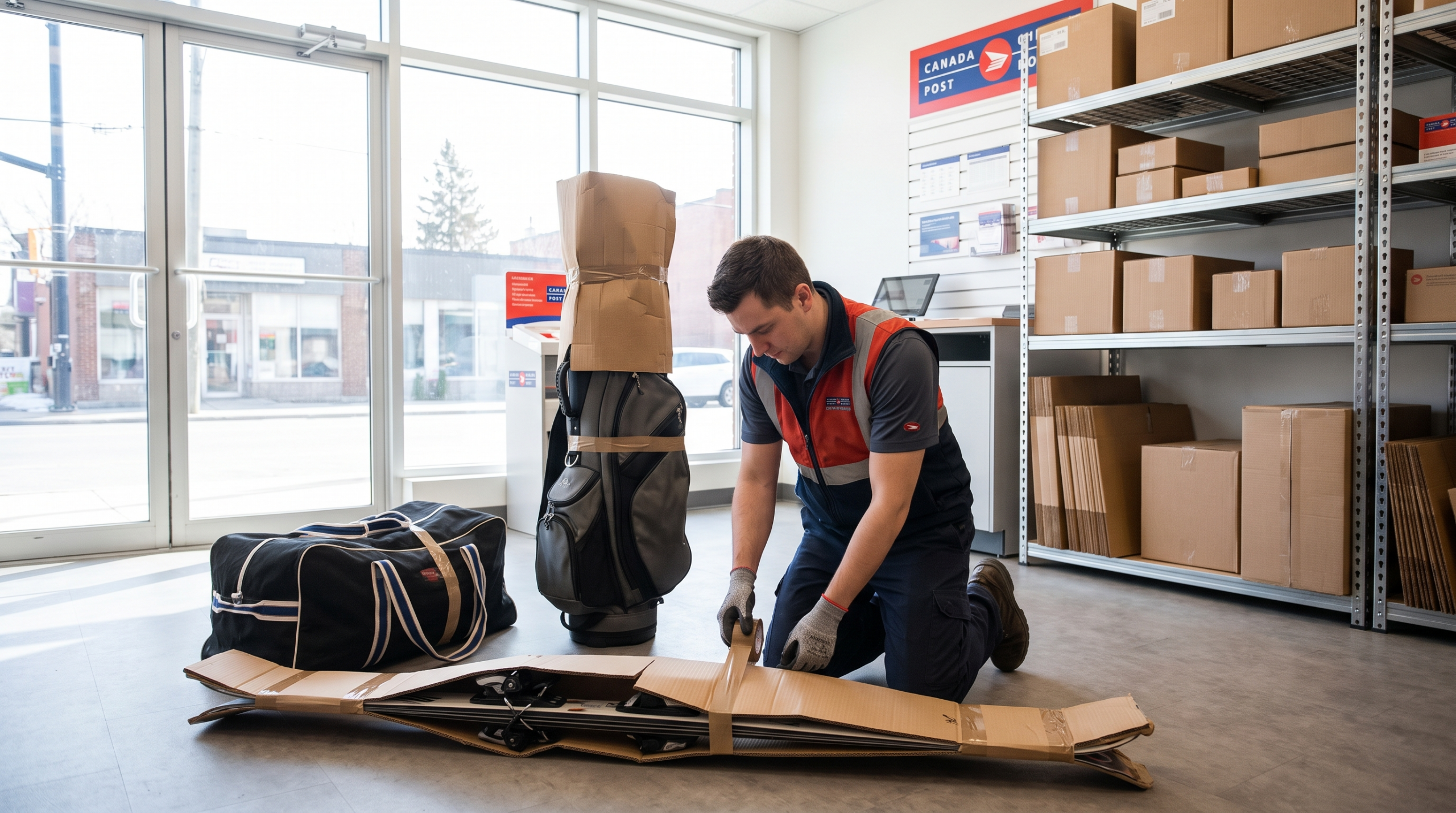
A pair of skis, a hockey bag, a set of golf clubs, or a kayak: these items are inexpensive to manufacture, but they’re expensive to ship. The reason is simple—carriers don’t charge based on what you’re shipping; they charge based on the space it takes up in the truck and how difficult it is to handle.
Every fall, sporting goods stores, clubs, and individuals who are moving face the same unpleasant surprise: a 6-kg package billed as if it weighed 30 kg, plus 60 $ in additional fees that appeared on the invoice after the fact. This isn’t a mistake on the carrier’s part. It’s simply how surcharges for oversized items work.
This guide explains how to ship sports equipment in Canada without getting hit with these fees: the thresholds you need to know, packaging that holds up, and the true cost by item type.
Why Does Sports Equipment Cost So Much?
Three factors combine, and it is their combined effect that causes the bill to skyrocket.
1. Density. Carriers calculate a billable weight based on the dimensions: length × width × height, divided by a divisor (usually 139 for inches/pounds, or 5,000 for centimeters/kilograms). A ski box measuring 175 × 25 × 20 cm has a volume of 87,500 cm³, which translates to approximately 17.5 kg in billable weight—for skis that weigh 4 kg. You’re paying for the empty space around the item.
2. Additional handling surcharges. These rules apply whenever an item exceeds a certain length, weight, or shape limit, or when it is not packed in a standard cardboard box. A hockey bag shipped as-is, without an outer box, almost always falls into this category.
3. Oversized package fees. Once a certain combined weight is exceeded, the package leaves the automated network and is processed manually. The carrier then applies a minimum billable weight—often 40 kg or more—regardless of the actual weight.
Thresholds to monitor before closing the box
The exact amounts vary depending on the carrier and your agreement, but the tiers are very similar across networks. Here are some practical guidelines for 2026:
| Criterion | Typical threshold | Consequence |
|---|---|---|
| Length of the longest side | More than 122 cm (48 in.) | Additional Handling |
| Length + circumference | More than 266 cm (105 in.) | Oversized package, minimum weight requirement |
| Absolute maximum length | About 270 cm (108 in.) | Rejection or Transfer to LTL |
| Actual weight of a single package | More than 32 kg (70 lb) | Excess Weight Overload |
| Unconventional Packaging | Bag, cover, tube, object on its own | Additional Handling |
These amounts and thresholds are for reference only: they vary depending on the carrier, the service selected, and the terms of your commercial agreement. Verify them before setting a selling price or promising free shipping to a customer.
The actual cost by type of equipment
Here's what to expect for an interprovincial ground shipment of well-packaged equipment, excluding taxes and fuel surcharges. These are rough estimates for comparison purposes, not a rate schedule.
| Article | Actual weight | Billable Weight | Risk of Overload |
|---|---|---|---|
| Golf Clubs (Hard Case) | 7–10 kg | 15–20 kg | Length: high |
| Skis or snowboard | 4–8 kg | 17–25 kg | Length: very high |
| Complete Hockey Bag | 12–18 kg | 25–35 kg | Packaging + weight: very heavy |
| Disassembled bicycle in a box | 12–16 kg | 30–45 kg | Oversized: high |
| Kayaking or stand-up paddleboarding | 15–25 kg | Recommended LTL | Off-network packages |
| Dumbbells and free weights | 20–40 kg | Actual weight | Excess weight: high |
Two useful observations. First, for almost all sports equipment, it’s the volume that determines the price, not the weight—except for cast iron, where the opposite is true. Second, once you move beyond kayaks and stand-up paddleboards, the standard parcel delivery service is no longer the right option: shipping a pallet via LTL freight is often cheaper than a package that’s been refused three times.
Pack to avoid overloading, not just to protect
Most shippers pack their items so that they arrive undamaged. While this is necessary, it is not enough: you also need to pack your items in a way that keeps you in the lowest possible rate category.
- Always double-bag the items. A hockey or golf bag in its original cover is considered non-standard packaging. When placed inside a double-wall corrugated cardboard box, it becomes a standard package. This often results in a difference of 25 to 45 $ per shipment.
- Reduce the longest dimension. Take apart whatever can be taken apart: remove the wheels and seat post from a bike, let the tires deflate, and separate the handlebar sections. Going from 130 cm to 120 cm can eliminate the entire excess weight.
- Don't make the box too big. You pay by volumetric weight for every centimeter of empty space. Cut and fold the cardboard to fit the item rather than adding filler paper.
- Protect the edges and points. Ski edges, skate blades, kayak noses: these are what pierce the cardboard and damage neighboring packages—a common reason for claims being denied.
- Remove the old labels. A gym bag that has been on the road often has three expired barcodes. This is the leading cause of lost luggage.
- Weigh and measure it yourself. The carrier reweighs the shipment at the sorting center. If your figures are incorrect, the correction will appear as a correction fee on the invoice several weeks later.
Insurance: What's Actually Covered
A carrier’s basic liability is capped at a low amount per package and often explicitly excludes fragile sports equipment, used items, and the contents of a bag that is not packed in a box. For a pair of skis worth 1,200 $ or a bicycle worth 3,000 $, this basic coverage is practically meaningless.
Three rules to ensure your claim has a chance of being successful: declare the actual value and pay for the corresponding coverage; take photos of the item and the packaging before Seal the box; keep the purchase receipt or a recent appraisal. Without these three items, a claim for used equipment is almost always denied.
When to Choose an Option Other Than Express Shipping
The fastest service is rarely the best choice for sports equipment. The price difference between express and economy shipping is typically 40 to 60 % for a large package, while the time savings amount to two or three business days. For a planned seasonal shipment—such as skis sent to the cabin in November or a golf bag sent in April—standard shipping is sufficient.
There are two situations where you should opt out of the parcel network. LTL (less-than-truckload) shipping by pallet becomes cost-effective as soon as you’re shipping several bulky items to the same destination or a single item that exceeds 270 cm. And dropping off at a service location rather than scheduling a home pickup avoids on-demand pickup fees, which are added to each pickup for occasional shippers.
Pre-shipment Checklist
- Measure the three dimensions of the closed box and calculate its volumetric weight
- Check whether the length exceeds 122 cm and whether the length plus the circumference exceeds 266 cm
- Place any bag, cover, or loose item in a box
- Break down what reduces the largest dimension
- Take a photo of the item, the inner packaging, and the sealed box
- Declare the actual value and purchase the appropriate coverage
- Remove any previous shipping labels
- Compare ground service and the LTL option before making a decision
In a nutshell
Shipping sports equipment to Canada is expensive for one specific reason: volume and shape, not weight. A shipper who measures their box before sending it, uses an outer box to contain their bags, and minimizes the longest dimension typically pays 30 to 50 % less than someone who simply brings their hockey bag to the counter as is.
At Shipping Store, we compare carriers for each oversized shipment and pack it on-site to ensure you stay within the overweight limits. Request a quote Enter your actual dimensions and check the difference before shipping.
The rates, thresholds, and surcharges listed are for reference only and vary depending on the carrier, the service, and the terms of your commercial agreement.

 French
 English
 Spanish